(888) 737-7690
17 Questions to Ask Before Hiring a Private Investigator
The best questions to ask a private investigator are the ones that expose how the work will actually be performed. A professional should be able to explain licensing, authority, scope, methods, cost controls, evidence handling, reporting and limitations before accepting sensitive information or a substantial retainer.
This matters because “private investigation” can describe very different assignments: surveillance, background research, a missing-person locate, fraud fact development, asset research, litigation support, interviewing, digital forensics or a technical surveillance countermeasures inspection. No investigator is automatically the right fit for every service or jurisdiction.
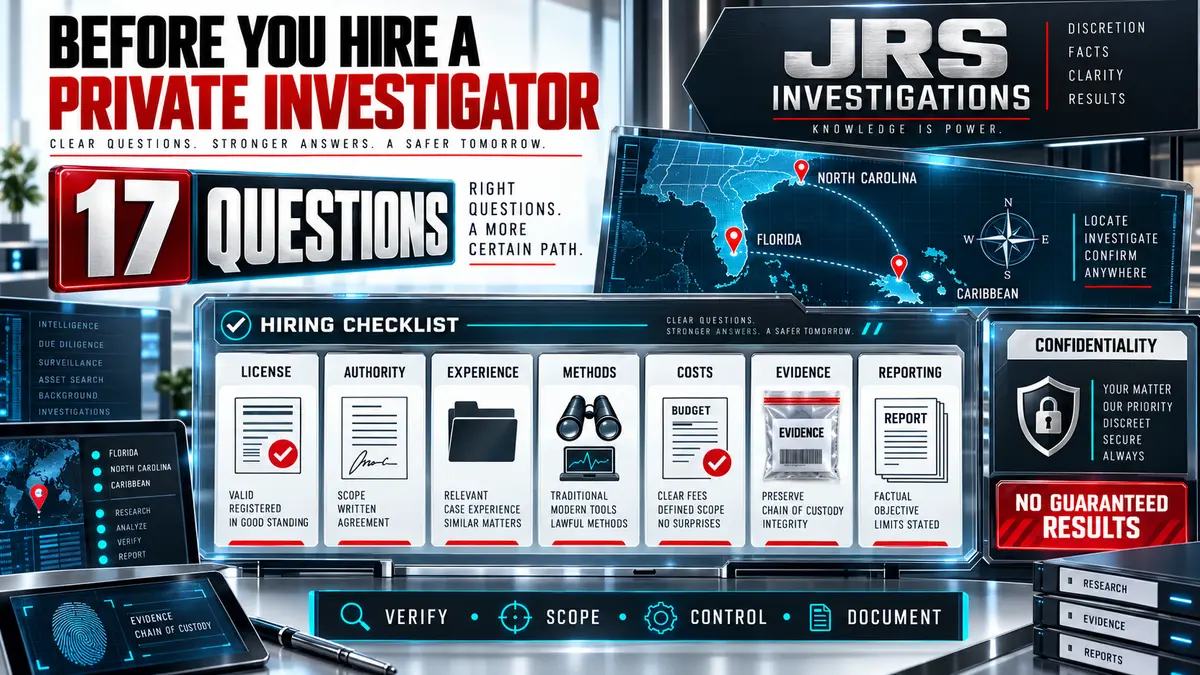
Use the 17 questions below as a structured hiring interview. The goal is not to demand a guaranteed result. It is to determine whether the provider offers a lawful, proportionate and well-documented process.
1. Are the agency and assigned investigator properly licensed?
Ask for the exact legal names, license numbers and issuing authority that apply to the service and location. Verify them independently with the regulator. In Florida, private investigative work is regulated under Chapter 493, Florida Statutes, and the Florida Department of Agriculture and Consumer Services administers the licensing program. North Carolina requirements are addressed in Chapter 74C of the North Carolina General Statutes.
Licensing rules vary by jurisdiction and type of work. An association membership, former occupation, online badge or business registration does not substitute for a required license.
2. Who will manage and who will perform my case?
The person conducting the intake may not be the person doing research, surveillance, field inquiries or technical work. Ask for each participant’s role, qualifications and supervision. If subcontractors or local resources may be used, ask how they are vetted, authorized, briefed and required to protect the file.
3. What experience is directly relevant to this assignment?
Request examples of similar methods and deliverables without asking the investigator to reveal another client’s identity or confidential facts. Years in business do not prove competence in every specialty. Surveillance experience does not automatically qualify someone for digital forensics, financial analysis or TSCM.
A good answer identifies the comparable scope, the investigator’s role, the reporting standard and what limitations commonly arise.
4. Do you have any conflicts of interest?
Provide enough identifying information for a meaningful conflict check before disclosing the full matter. Attorneys and companies should identify related parties, counsel, witnesses and entities. Ask what happens if a conflict appears after work begins and how the file will be isolated or closed.
5. Is my objective lawful and appropriate?
Explain why you need the information and how it will be used. The investigator should test your authority, not simply accept an instruction. A client cannot authorize trespass, unauthorized account access, unlawful impersonation, prohibited interception, harassment or tracking that the law does not allow.
In Florida, section 934.03 addresses interception and disclosure of wire, oral and electronic communications, while section 934.425 addresses installation of tracking devices or tracking applications. Facts such as consent, ownership and location matter. Ask counsel when the legal boundary is uncertain.
6. What exact question will the investigation answer?
“Find everything” is an invitation to wasted time and irrelevant data. Convert the concern into a decision-focused question with named people or entities, dates, locations and a defined purpose. The investigator should separate confirmed facts, client-reported information and hypotheses that require testing.
7. What is the proposed first phase?
A staged plan usually gives the client better control. Phase one might resolve identities, preserve evidence and build a chronology before fieldwork. A locate may begin with records and open-source research. A fraud matter may begin with a transaction map. A TSCM assignment begins with authority, access history and a threat-informed scope.
Ask what result would justify expanding, changing or stopping the assignment.
8. Which methods will you use, and what are their limits?
The investigator should explain method categories without disclosing tactics that would compromise safety or lawful operations. Ask why each method is proportionate to the question, which sources are primary, how database leads are corroborated and which areas will not be examined.
For service context, review JRS private investigation services, background investigations, and TSCM and counter-surveillance services.
9. What information and access do you need from me?
Ask for a written intake list. It may include a chronology, identifiers, original messages or files, photographs, addresses, vehicles, companies, relevant orders or contracts, access records and decision deadlines. Confirm who owns or controls premises, devices, networks and records.
Do not send passwords or unnecessary sensitive information through ordinary email. Preserve original files rather than repeatedly forwarding, editing or converting them.
10. What will the investigation cost?
Ask about the retainer, hourly or fixed charges, minimum blocks, mileage, travel, parking, database fees, equipment, specialist work, reporting time, cancellation and unused funds. A quote should connect cost to scope and assumptions; otherwise two prices may not describe comparable work.
There is no honest universal price. Complexity, jurisdiction, urgency, subject movement, record access, staffing and reporting can materially change the budget.
11. How will additional work be approved?
Set a dollar or time threshold that requires written authorization. Identify who can approve scope changes and how quickly the investigator will report that an assumption has failed. A useful engagement letter also states what happens when the subject moves outside the original area or a new entity or device enters the case.
12. How and when will you communicate?
Agree on update frequency, urgent-notification rules and approved communication channels. Daily narration may waste billable time, while silence can leave the client unable to make decisions. Define which developments require immediate notice and which belong in a scheduled update or final report.
13. How will evidence be preserved?
Ask how original files, working copies, notes, photographs, video, device images and physical items are identified and stored. The process should preserve source information, dates and transfers. If litigation is pending or likely, counsel should help define preservation, privilege, disclosure and witness requirements before collection begins.
An investigator should not promise that evidence will automatically be admissible. Courts and agencies apply legal and procedural rules to the specific facts.
14. What will the final report contain?
Request a sample structure or redacted example. A useful report identifies the assignment, authority, scope, dates, methods, sources, factual findings, supporting exhibits, conflicts, limitations and recommended next actions. It distinguishes observation from inference and avoids unsupported legal conclusions.
Negative findings require precision. “Not identified within the agreed sources and period” is more accurate than saying a person, event or asset does not exist.
15. How will you protect confidentiality and data?
Ask who can access the file, how information is transmitted and stored, how conflicts are controlled, how long records are retained and how they are destroyed. If the case crosses borders, includes sensitive personal data or uses third-party systems, ask which legal and contractual safeguards apply.
Organizations may also want to align investigative-file handling with recognized security practices such as the NIST Cybersecurity Framework, while obtaining legal advice about the specific data and jurisdiction.
16. What insurance or other business protections apply?
Do not assume that one policy is mandatory or sufficient everywhere. Ask what coverage is relevant to the proposed work, request evidence when appropriate, and have counsel or a risk professional assess any contract requirement. Insurance is one factor; it does not replace licensing, competence or lawful methods.
17. What can you guarantee?
The correct answer is limited. An investigator can commit to the agreed scope, lawful methods, budget controls, communication and reporting standards. The provider cannot guarantee that a suspected fact is true, a subject will appear, a device will be found, an asset exists, evidence will be admitted or litigation will succeed.
Guaranteed results, pressure to act immediately or claims of secret access to protected records are serious warning signs.
Match the questions to the type of investigation
Surveillance and domestic matters
Ask about lawful vantage points, staffing, scheduling, subject movement, safety, image quality and neutral reporting. Do not ask for trespass, account access or prohibited tracking. JRS’s infidelity investigation guide explains why documentation should focus on observable conduct and a defined decision rather than sensational assumptions.
Missing persons and witnesses
Ask how identity will be resolved, which sources are permitted, how field verification will be handled and whether releasing a location could create risk. Emergencies belong with law enforcement first. Review the JRS missing-person investigation process.
Background checks and due diligence
Ask which records are relevant, how name matches will be verified, how disputes or adverse information will be handled and whether the intended use triggers consumer-report law. The Fair Credit Reporting Act may apply to employment and other regulated purposes; legal advice may be necessary before using a report.
Fraud, litigation and asset research
Ask about document preservation, timelines, corporate relationships, source records, interviews and counsel coordination. Asset research identifies lawful indicators and relationships; it does not guarantee ownership, control, value or recoverability. JRS’s international asset investigations page explains the difference between research and legal recovery.
TSCM and digital concerns
Ask whether the concern involves a physical space, radio-frequency environment, network, phone, computer or online account. TSCM and digital forensics are different scopes. A provider should explain the authority, baseline, instruments, anomaly-validation process, evidence response and limitations.
Red flags during the hiring process
- refusal to provide verifiable licensing information;
- guaranteed outcomes or court admissibility;
- claims of unrestricted access to bank, phone, medical or government records;
- a willingness to trespass, impersonate, hack, intercept or track unlawfully;
- pressure to pay without a written scope and fee structure;
- vague answers about subcontractors or evidence handling;
- no explanation of reporting or limitations;
- requests for unnecessary passwords or highly sensitive data; and
- statements that every anomaly proves wrongdoing.
What to prepare before calling
- one paragraph explaining the decision you must make;
- a chronology with dates and locations;
- names, aliases, companies, addresses, vehicles and known contact details;
- original files and the source of each item;
- relevant legal or contractual deadlines;
- the jurisdictions involved;
- who owns or controls relevant property and devices; and
- a realistic budget range.
Organizing the intake helps the investigator propose a smaller, more useful first phase. It also makes competing proposals easier to compare.
Frequently asked questions
Should I hire the least expensive investigator?
Compare scope, staffing, travel, data, reporting and cost controls—not the headline rate alone. A lower price may omit work that another proposal includes.
Is a referral enough?
No. A referral can identify a candidate, but licensing, conflicts, relevant experience, methods, engagement terms and reporting should still be verified.
Must a private investigator have a physical office?
Not necessarily. Remote administration does not by itself establish quality or risk. Focus on licensing, identity, secure communications, availability, records handling and a clear contract.
Should I tell the subject about the investigation?
Discuss safety, preservation and legal strategy first. Premature confrontation can change behavior, destroy evidence or create risk.
Can I reuse a report for another purpose?
Not automatically. A report prepared for one decision, client or legal basis may not be suitable for employment, tenant, credit, litigation or public disclosure. Ask counsel before repurposing it.
Start with a defined consultation
The best investigator is not the one who makes the biggest promise. It is the one who can explain the lawful path from question to documented finding. Review JRS’s areas served and contact JRS Investigations with the purpose, locations, deadline and intended use of the work.