(888) 737-7690

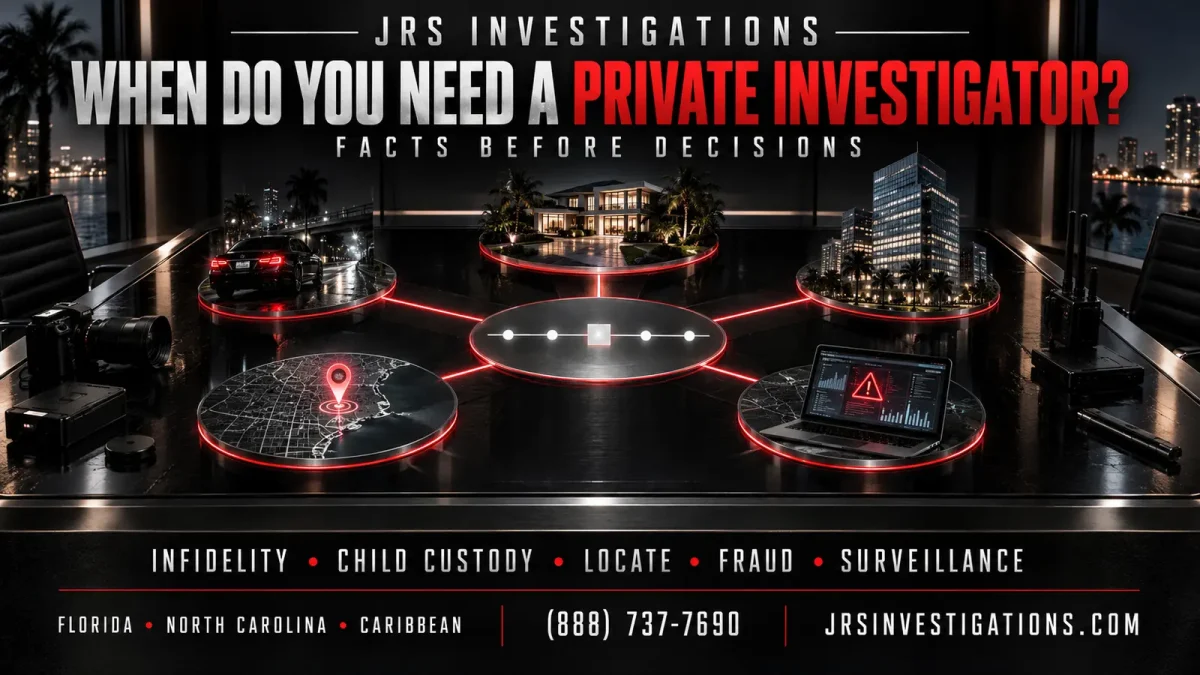
When Do You Need a Private Investigator? 12 Clear Signs
You may need a private investigator when an important decision depends on facts you cannot safely, lawfully, or objectively obtain on your own. A licensed investigator can define the question, develop a legal fact-finding plan, document observations, locate records and people, interview sources, and preserve useful evidence.
The right time to call is usually before the situation becomes a confrontation, a public accusation, or a trail of lost evidence. JRS Investigations provides professional private investigation services for individuals, attorneys, businesses, insurers, and other authorized clients across Florida, North Carolina, and the Caribbean.
12 situations when a private investigator may help
1. You need objective facts about a relationship concern
Suspected infidelity, undisclosed living arrangements, or conflicting explanations can create a cycle of anxiety and confrontation. A private investigator can assess whether lawful surveillance or another fact-finding method is appropriate. The goal is not to manufacture a dramatic moment; it is to document relevant activity accurately and discreetly.
2. A child-custody or welfare concern requires documentation
In a custody dispute, specific conduct matters more than general suspicions. An investigator may document observable issues such as unsafe supervision, prohibited contact, repeated schedule violations, or activity that conflicts with court orders. No investigator can promise a custody outcome, and the scope should be coordinated with legal counsel when litigation is active.
3. You need to locate a person
A former tenant, witness, heir, debtor, family member, or defendant may be difficult to find because the available address is old or the person has limited public activity. Professional locate work can combine lawful databases, public records, address history, business connections, field verification, and source development. A name and date of birth can help, but every case begins with the identifiers already available.
4. A background or identity claim needs verification
People and businesses do not always present complete histories. Depending on the legal purpose and required consent, an investigator can help verify identity, residences, business affiliations, litigation, criminal-history information available through lawful sources, professional claims, and other relevant facts. Employment and tenant screening are regulated activities, so the intended use must be discussed before research begins.
5. Fraud or a suspicious claim needs investigation
Insurers, companies, law firms, and individuals may need help with suspected insurance fraud, staged loss, disability or workers’ compensation concerns, vendor fraud, embezzlement indicators, false invoices, or misrepresented activity. The assignment might involve records analysis, interviews, surveillance, site visits, or coordination with counsel and internal compliance teams.
6. An attorney needs facts, witnesses, or field support
Civil and criminal matters often turn on information outside the case file. Investigators can locate and interview witnesses, verify scenes, photograph conditions, develop timelines, identify additional records, conduct background research, and assist with service-related fieldwork. The attorney remains responsible for legal strategy; the investigator develops and documents facts.
7. A business faces theft, misconduct, or information loss
Inventory loss, unauthorized side work, conflicts of interest, time theft, policy violations, vendor relationships, and the departure of a key employee may justify a carefully scoped investigation. Acting too quickly can alert the subject or create employment-law complications. Management should preserve access logs, communications, video, transaction records, and device evidence before taking action.
8. A major transaction requires due diligence
Before a partnership, investment, acquisition, high-value purchase, or important hire, decision-makers may need more than a basic online search. Due diligence can examine corporate history, litigation, business relationships, public filings, reputation indicators, and inconsistencies in the information provided. The depth of the work should match the value and risk of the decision.
9. Harassment, stalking, or a personal-safety concern is escalating
Repeated unwanted contact, unexplained appearances, threatening messages, or suspected tracking should be taken seriously. Immediate threats belong with law enforcement. An investigator may help organize the timeline, preserve evidence, identify patterns, verify a subject where legally permitted, or coordinate other protective steps. Avoid confronting a suspected stalker or creating a predictable counter-surveillance routine.
10. You suspect hidden cameras, listening devices, or tracking
A physical privacy concern may require Technical Surveillance Countermeasures rather than conventional surveillance. JRS provides professional TSCM bug sweeps for authorized homes, offices, vehicles, and vessels. A physical sweep is different from a cybersecurity or digital-forensics examination of a phone, computer, or online account.
11. Online information does not answer the real question
Search engines and public websites can produce names and fragments, but they rarely establish context, identity, timing, or reliability. When you need to know whether two records concern the same person, whether an address is current, whether a business is operating, or whether conduct can be independently documented, professional verification becomes valuable.
12. You need a neutral record before making a serious decision
Sometimes the issue is not criminal or dramatic. You may simply need an objective timeline before filing a lawsuit, ending a partnership, changing a custody arrangement, confronting an employee, or making a financial commitment. A disciplined investigation can replace assumptions with a factual basis—even when the facts do not confirm the original suspicion.
What can a private investigator legally do?
Authority varies by jurisdiction and assignment, but a licensed private investigator may generally conduct lawful surveillance from permitted locations, research public and properly authorized records, locate people, interview willing sources, photograph or video observable activity, inspect authorized property, and document findings in a professional report.
A private investigator is not a police officer and does not receive unlimited access to private data. An investigator cannot lawfully trespass, hack accounts, wiretap protected conversations, impersonate law enforcement, obtain records through false pretenses, or ignore privacy and consumer-reporting rules. JRS defines the purpose, authority, location, and intended use of the information before accepting an assignment.
When should you call law enforcement, an attorney, or another specialist?
Call emergency services when anyone is in immediate danger. Report crimes and credible threats to the appropriate law-enforcement agency. Speak with an attorney when you need legal advice, a court filing, subpoena authority, or guidance about how evidence may be used. Contact a qualified cybersecurity or digital-forensics specialist for malware, compromised accounts, deleted-device data, or network intrusion.
A private investigator can work alongside these professionals, but does not replace them. The best cases have a clear division of responsibility and a scope built around the actual decision the client must make.
Why hiring early can protect the investigation
Delays allow memories to fade, records to be overwritten, online material to disappear, and routines to change. At the same time, rushing into surveillance without a plan can waste money or create legal problems. Early consultation gives the investigator time to identify the most useful evidence, select the right method, and explain realistic limits before fieldwork begins.
Do not announce that you plan to hire an investigator. Avoid accessing another person’s accounts, installing tracking technology, recording protected conversations, or entering property without permission. Preserve what you already have and let the investigator determine what additional steps are lawful.
How to prepare for the first consultation
- Write one or two sentences describing the decision you need to make.
- Create a concise timeline with dates, locations, names, and unusual events.
- Gather photographs, identifiers, vehicle details, known addresses, messages, court orders, and relevant records.
- Explain what has already been done and who knows about the concern.
- Identify deadlines, safety issues, litigation, and the intended use of the findings.
- Set a practical budget and ask how priorities will be handled if new facts emerge.
A good investigator will ask focused questions rather than promise a particular result. JRS serves clients in multiple jurisdictions; review our areas served directory and agency background when evaluating the right fit.
Once you decide to seek help, use our local private investigator hiring guide to evaluate providers and prepare for a consultation.
Questions to ask before hiring a private investigator
- Are you licensed for the location and type of assignment?
- What investigative methods are appropriate for this objective?
- What information do you need from me before work begins?
- How will time, expenses, updates, and scope changes be handled?
- What will the final report or deliverable include?
- What limitations or legal concerns should I understand?
Beware of guaranteed outcomes, promises of access to “any record,” requests to break the law, or vague billing with no defined objective. Professional investigations are evidence-based, documented, and bounded by legal and ethical limits.
Frequently asked questions
How much does a private investigator cost?
Cost depends on the objective, location, urgency, travel, number of investigators, record fees, surveillance hours, and reporting requirements. JRS defines an initial scope and budget before work begins and discusses material changes as the case develops.
Will the subject know I hired an investigator?
Discretion is central to most assignments, but no ethical investigator can promise that a subject will never notice surveillance or contact. The plan should minimize unnecessary exposure while maintaining safety and legal compliance.
Can a private investigator guarantee proof?
No. An investigator can guarantee a professional process, not a predetermined fact. A finding that does not confirm the suspicion may still be valuable because it narrows uncertainty and prevents decisions based on assumptions.
Can a private investigator testify in court?
An investigator may testify about personal observations, methods, records, photographs, video, and reports when properly admitted. Your attorney should decide how investigative evidence fits the case and whether testimony is needed.
What information should I provide?
Provide accurate identifiers, the reason for the assignment, known facts, safety concerns, relevant legal documents, deadlines, and the intended use of the information. Do not alter evidence or obtain private data unlawfully in an attempt to help.
Schedule a confidential consultation
If a personal, legal, or business decision depends on facts you cannot confirm, a confidential consultation can clarify whether an investigation is appropriate and what a lawful scope would look like.
Call (888) 737-7690 or contact JRS Investigations to discuss the situation discreetly.