(888) 737-7690

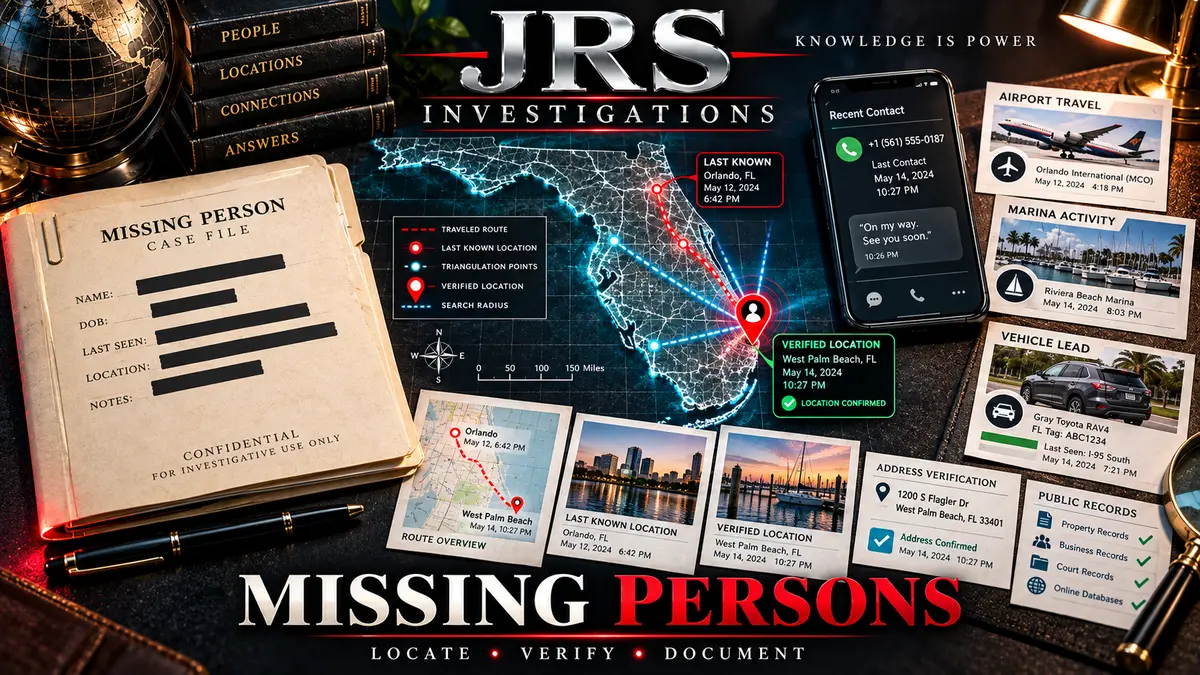
Missing Persons Investigations: 8 Essential Steps
If someone may be in immediate danger, call 911 and contact the law-enforcement agency where the person was last seen. A private missing-person investigation should support—not delay, replace, or interfere with—the official response. For a missing child, report the case to local law enforcement immediately and then contact the National Center for Missing & Exploited Children at 1-800-THE-LOST (1-800-843-5678).
Missing-person cases move quickly, but speed without structure can destroy useful leads. A reliable investigation begins by separating confirmed facts from assumptions, preserving source material, and establishing who has legal authority to receive information. JRS Investigations assists families, attorneys, fiduciaries, businesses, and other authorized clients with lawful records research, interviews, location development, field verification, and clear reporting.
What Florida law says about a missing-person report
Florida law requires agencies to accept missing-child and missing-adult reports in the jurisdiction where the person was last seen, while allowing another agency to accept a report when jurisdiction is unclear. The law also sets prompt database-entry and case-review requirements. See Florida Statutes section 937.021 for the current statutory language.
Florida’s Missing Endangered Persons Information Clearinghouse coordinates state alert programs and supports law-enforcement agencies. Not every disappearance qualifies for a public alert. For example, the Florida AMBER Alert criteria require specific findings by law enforcement, including a well-founded belief that a child was kidnapped and faces imminent danger. Families should not wait for an alert decision before filing a report or preserving evidence.
Eight essential steps in a missing-person investigation
1. Confirm the emergency and establish authority
The first questions are practical: Is there evidence of immediate danger? Is the person a child, a vulnerable adult, or an adult who may have chosen to leave? Has law enforcement been notified? Who is requesting the investigation, and what is that person’s relationship to the subject?
These distinctions affect urgency, lawful access to information, and what can be disclosed. A competent investigator documents the client’s identity and purpose before taking action. When a restraining order, custody dispute, guardianship issue, or threat is involved, the investigator may require attorney or law-enforcement coordination.
2. Build a verified timeline
A timeline should begin with the last independently confirmed sighting or communication—not with rumor. Useful entries may include dates, times, places, witnesses, transportation, phone calls, messages, financial activity lawfully supplied by an authorized account holder, appointments, medication needs, and deviations from routine.
Original screenshots, voicemail files, emails, photographs, receipts, and social-media links should be preserved with their dates and sources. Avoid editing images, forwarding files repeatedly, logging into another person’s accounts, or publicly posting sensitive details that law enforcement has asked the family to hold back.
3. Organize identifiers and case records
Accurate identifiers prevent wasted searches and mistaken identity. A case file may include the person’s full legal name, aliases, date of birth, recent photograph, physical description, known addresses, phone numbers, email addresses, vehicles, employers, schools, relatives, close associates, medical or behavioral risk factors, and the official report or case number.
Only provide records you possess or are authorized to share. Investigators do not need—and should not request—someone else’s passwords or unauthorized access to private accounts. For child cases, families can also consult NCMEC’s official guidance on what to do when a child is missing.
4. Conduct lawful records and open-source research
Records research can connect names, addresses, companies, property, court matters, professional licenses, vehicles, vessels, relatives, and known associates. Open-source research may identify public posts, marketplace activity, news reports, event listings, or other time-stamped clues. Every apparent match must be corroborated because reused photographs, shared names, stale profiles, and automated data errors are common.
For long-term cases, the National Missing and Unidentified Persons System provides a national resource for missing, unidentified, and unclaimed-person cases, including investigative, analytical, and forensic support. Public entries are vetted with the investigating agency before publication.
5. Interview witnesses without contaminating accounts
Friends, relatives, neighbors, coworkers, landlords, and service providers may hold different pieces of the timeline. Interviews work best when questions are neutral and the witness’s own words are documented. Investigators compare accounts for dates, independent corroboration, and material inconsistencies rather than assuming that every inconsistency is deception.
Witness safety and privacy matter. Public accusations, impersonation, harassment, and deceptive attempts to obtain protected records can harm the person, compromise an official case, and create legal exposure.
6. Develop location and travel leads
A location lead is not the same as a confirmed location. Investigators may compare lawful records, known destinations, transportation options, prior habits, associates, public-facing activity, and geographic patterns. Vehicle descriptions, license information lawfully supplied by the client, marina or aviation leads, and cross-jurisdiction contacts may be relevant depending on the facts.
Florida cases can move rapidly across counties, states, ports, airports, and international borders. JRS can coordinate appropriately scoped research through its international investigations experience when a credible lead crosses jurisdictions, but government border, immigration, and criminal databases remain restricted to authorized agencies.
7. Verify leads in the field
Lawful fieldwork may include checking public locations, verifying an address, documenting a vehicle visible from a lawful vantage point, or conducting proportionate surveillance. Fieldwork must be planned around safety, privacy, property boundaries, and the risk of alerting a dangerous person.
If an investigator finds evidence of danger, a crime scene, a wanted person, or a missing child, law enforcement takes priority. The investigator should preserve observations and communicate through the proper channel rather than attempt a confrontation or recovery.
8. Report, reassess, and protect the person located
A professional report distinguishes verified facts, source statements, analytical leads, and unresolved questions. It should identify what was checked, what could not be verified, and what next step is proportionate. This gives the client, counsel, or law enforcement a useful record instead of a pile of disconnected search results.
When a competent adult is found safe and does not consent to location disclosure, privacy and safety may limit what an investigator can tell the requester. In some cases the appropriate result is welfare confirmation or delivery of a message—not disclosure of an address. JRS does not force contact, seize a person, detain anyone, or guarantee a reunion.
How a private investigator can support an official case
Law enforcement controls criminal investigation, emergency response, restricted databases, subpoenas, warrants, and public alerts. A licensed private investigator can provide focused work within a defined civil scope: organizing a timeline, tracing lawful public and commercial records, interviewing willing witnesses, verifying addresses, documenting public-location observations, and packaging credible leads for counsel or the assigned agency.
Clients may also need related background research to distinguish two people with similar names, verify an associate, or understand a business connection. JRS’s broader investigation services allow the assignment to be scoped around the facts rather than around a single search database.
Common case types and special cautions
- Missing children: Report immediately. Do not accept claims that a waiting period is required. Preserve recent photographs, custody information, device details, and the official case number.
- Endangered or vulnerable adults: Share medication, cognitive, mobility, behavioral, and transportation information with law enforcement. Florida’s alert categories have specific criteria and are activated by authorized agencies.
- Adults who may have left voluntarily: Concern may be genuine even when no crime occurred. The investigation must respect consent, privacy, and a competent adult’s right not to disclose a location.
- Family or custody disputes: A missing-person investigation is not a substitute for a custody order or legal process. Counsel should address contested authority and disclosure.
- Long-term or cold cases: Rechecking identifiers, relationships, records, photographs, DNA pathways, and geographic assumptions may reveal leads unavailable during the original inquiry.
- Interstate or international cases: Jurisdiction, language, local licensing, data-protection rules, and agency coordination must be mapped before field activity begins.
Why missing-person cases are difficult
The greatest challenge is uncertainty. A person may be endangered, avoiding contact, using a different name, traveling, hospitalized, incarcerated, homeless, deceased, or simply absent from the digital trails researchers expect. Online databases can lag or combine records from different people. Social-media content can be scheduled, reposted, manipulated, or published by someone else.
Families are also vulnerable to false tips and payment scams. Treat anyone demanding money, gift cards, cryptocurrency, account credentials, or secrecy as unverified. Preserve the communication and report threats or extortion to law enforcement. A credible investigator explains fees, scope, reporting, limitations, and licensing before work begins.
What to bring to an initial consultation
- The law-enforcement agency, report number, assigned contact, and date reported.
- A recent unfiltered photograph and verified physical description.
- The last confirmed contact, sighting, location, time, and source.
- Known phones, emails, usernames, vehicles, addresses, employers, schools, and associates.
- Relevant medical, cognitive, domestic-violence, custody, or threat information.
- Original messages, screenshots, receipts, travel details, and a list of steps already taken.
- Your relationship to the person and the lawful purpose for requesting help.
Do not delay an emergency report while collecting every item. Begin with the most reliable information available and update the official agency as facts are confirmed. The FBI’s annual NCIC missing-person statistics illustrate the scale and categories of records handled nationally, while local facts determine the correct response in an individual case.
Frequently asked questions
Do I have to wait 24 or 48 hours to report someone missing?
No waiting period should be assumed. Report a missing child or an immediate safety concern at once. In Florida, section 937.021 directs agencies to accept and promptly handle missing-child and credible missing-adult reports.
Can JRS access a missing person’s phone, bank account, or private messages?
No. JRS does not hack accounts, obtain passwords, impersonate the subject, or access protected records without lawful authority. Clients may provide records they own or are authorized to share, and investigators use lawful sources and methods.
Can a private investigator activate an AMBER, Silver, Purple, or other alert?
No. Alert activation is controlled by law enforcement and the responsible state authorities under defined criteria. An investigator can organize and document information for the assigned agency.
Will you reveal the address of an adult you locate?
Not automatically. Safety, consent, the client’s legal authority, court orders, and the circumstances control disclosure. A competent adult may choose not to disclose a location. Welfare confirmation or message delivery may be the appropriate outcome.
Can you guarantee that the person will be found?
No ethical investigator can guarantee a location or reunion. JRS provides a documented, lawful effort and reports confirmed findings, credible leads, limitations, and recommended next steps.
Speak with JRS Investigations
After the emergency report has been made, JRS can evaluate whether a private investigation would add useful, lawful support. Start with the dedicated Missing Persons & Skip Tracing service, review our Florida missing-person investigations page, or contact JRS Investigations for a confidential consultation. Call 1-888-737-7690.