(888) 737-7690

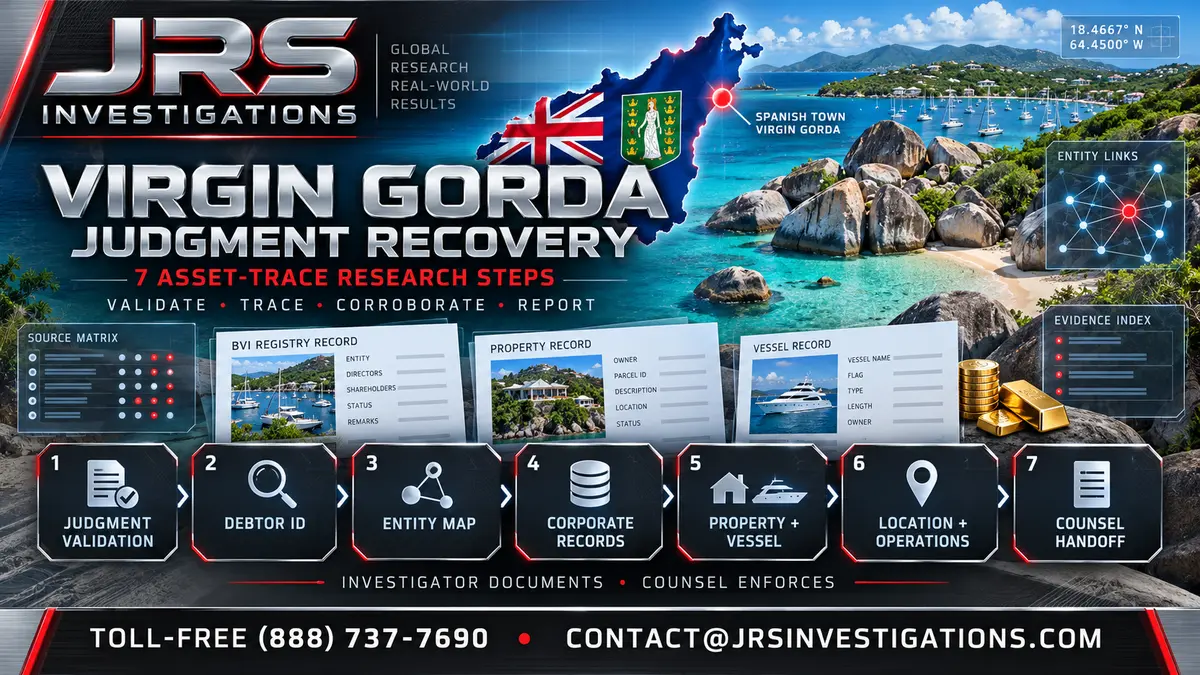
Virgin Gorda Judgment Recovery Investigator: 7 Research Steps
A Virgin Gorda judgment recovery investigator can help a creditor, attorney, fiduciary or authorized business client locate and document lawful asset leads. The investigator’s role is fact development: confirm identities, map companies and jurisdictions, research accessible records, locate operations and property connections, and organize findings for counsel. The investigator does not freeze an account, seize property, garnish income, register a foreign judgment or promise that an asset can be recovered.
Those distinctions matter in the British Virgin Islands. A judgment may involve a debtor who lives or conducts business on Virgin Gorda, an entity registered elsewhere in the Territory, property connected to multiple parties, or assets and proceedings in more than one country. BVI counsel should decide the legal route, while JRS Investigations develops a source-based research record that counsel can evaluate.
For local investigative support, see our Virgin Gorda private investigator services and our dedicated British Virgin Islands judgment-recovery guide.
What judgment-recovery research can and cannot do
Useful investigation begins with a specific, lawful objective. The assignment may be to verify whether a named debtor controls a company, identify a registered office or business location, develop property or vessel leads, locate the debtor for attorney review, document continuing commercial activity, or reconcile conflicts among filings and public statements. Each lead must be tied to reliable identifiers and tested against independent information.
An investigator cannot treat a shared surname, an address, a photograph of a yacht or a company connection as proof of ownership. Nor can an investigator lawfully obtain protected bank balances, tax returns, private communications or restricted beneficial-ownership information without proper authority. Public and authorized sources can reveal valuable connections, but availability differs by record, requester, jurisdiction and date.
JRS separates three questions that are often blurred together: whether a lead exists, whether the debtor legally owns or controls the asset, and whether a court permits enforcement against it. Investigative research addresses the first question and may help counsel evaluate the second. Counsel and the court control the third.
Seven asset-trace research steps
1. Validate the judgment and enforcement objective
The intake should identify the issuing court, parties, judgment date, amount, current balance, interest, appeals, stays, settlements and prior enforcement attempts. Counsel should confirm that the judgment remains enforceable and determine whether recognition or registration is required in the BVI. JRS uses that direction to focus research on relevant people, entities, locations and time periods rather than conducting a broad search for wealth.
2. Confirm the debtor’s identity
Accurate identity resolution prevents false matches. Useful identifiers include full legal name, aliases, date of birth when lawfully supplied, prior addresses, nationality, occupation, known companies, directorships, telephone numbers and email domains. For a company debtor, the registration number, legal name, former names, jurisdiction, registered agent and office are more reliable than a trading name alone. Every report should distinguish a confirmed match from a possible match.
3. Map entities, people and jurisdictions
Asset ownership may be divided among operating companies, holding companies, partnerships, trusts, nominees or family interests. A relationship map can show the debtor, directors, officers, registered agents, shareholders when accessible, related addresses, counterparties and transaction jurisdictions. The map is a research aid, not a declaration that every connected entity holds recoverable property. JRS can coordinate a broader international asset investigation when the facts extend beyond the BVI.
4. Research corporate filings and ownership indicators
BVI company research should use lawful Registry and regulatory channels. Searchable information may establish registration status, formation date, registered agent, registered office, name history and available transaction records. Some ownership information may be obtainable only through a qualified request or other authorized process. An investigator should document the search date, company number, source and exact record obtained, because company status and filings can change.
5. Develop property, vessel and business-activity leads
Depending on lawful access, research may examine real-property references, vessel registrations, corporate charges, secured interests, court records, professional registrations, commercial websites, tenders, licensing information, advertising and observable operations. A villa, parcel, vehicle, charter vessel or business name may be a lead without being an asset owned by the debtor. The report should show the connection, contrary evidence and the additional record needed to test ownership.
6. Locate the debtor and document operations
Locating work can confirm a current address, business presence, service location or operational pattern for attorney review. On Virgin Gorda, that may require realistic planning around Spanish Town, North Sound, Leverick Bay, marinas, villa communities, ferry schedules and inter-island travel. Observation must use lawful vantage points and respect private property. JRS does not trespass, enter a residence, impersonate an official or obtain information through hacking or stolen credentials.
7. Build the report and counsel handoff
A useful final product includes an executive summary, subject identifiers, entity and jurisdiction map, source log, chronology, confirmed findings, unresolved leads, conflicting information and recommended next research steps. Original records should be preserved with access dates and file names. Counsel then decides whether a lead justifies a formal search, disclosure request, charging remedy, examination, registration, injunction or other court process.
For a deeper look at lawful corporate and ownership research, review our Tortola BVI asset-search guide and hidden-asset investigation service.
Virgin Gorda and BVI field considerations
Virgin Gorda combines residential communities, resorts, marinas, charter activity, construction, hospitality businesses and high-value vacation property. The island’s geography affects what can be verified efficiently. A location near Spanish Town differs operationally from a North Sound assignment; ferry and boat schedules, weather, road conditions, gated access and seasonal occupancy can all affect timing.
Many Registry, regulatory, legal and court functions are coordinated through Road Town on Tortola even when the subject or property lead is on Virgin Gorda. Research plans should therefore distinguish island-based field verification from records work, counsel activity and formal applications elsewhere in the Territory. Combining both without a plan can waste time and create false assumptions about where a person or company actually operates.
Tourism and charter activity also require careful interpretation. A person may appear at a marina without owning a vessel; a company may market a villa without holding title; an address may belong to a management company or registered agent. Observation and advertising are starting points. Reliable ownership conclusions require corroborating records.
BVI records, court procedure and privacy boundaries
The Eastern Caribbean Supreme Court Civil Procedure Rules (Revised Edition) 2023 include procedures for enforcing judgments and orders, writs of execution and reciprocal enforcement. The correct process depends on the judgment, issuing jurisdiction, debtor and proposed remedy. JRS does not interpret the rules for a client or file an enforcement application; qualified BVI counsel should direct those steps.
The BVI Financial Services Commission Registry of Corporate Affairs maintains the Register of Companies and administers core company legislation. Its registered-entity search guidance describes information that may appear in a search report, including entity status, formation date, registered agent, registered office and transaction history. The availability of a document or ownership detail should be confirmed through the current Registry process rather than assumed.
The Territory also operates under the Data Protection Act, 2021. The Government of the Virgin Islands has described the Act as part of its electronic-government framework. Investigation should collect only information relevant to a legitimate purpose, protect sensitive data, limit disclosure and use authorized methods. JRS does not purchase stolen data, bypass access controls or claim access to confidential banking systems.
If a matter raises insolvency, beneficial ownership, disclosure, freezing, service, privilege or cross-border recognition issues, the client should obtain legal direction before expanding the investigation. A careful pause for counsel is different from abandoning the search; it keeps the work useful and reduces the risk of compromising a remedy.
What a strong report should show
- the client’s lawful purpose and counsel’s instructions;
- the judgment, parties, issuing court and relevant dates;
- verified subject and company identifiers;
- the jurisdictions and sources searched;
- confirmed findings separated from possible leads;
- entity, address and relationship maps with source references;
- property, vessel or business indicators and their limitations;
- conflicts, gaps and negative search results;
- preserved source records and a chronological evidence index; and
- specific follow-up options for counsel to approve.
Neutral reporting matters. “Associated with,” “appears in the record” and “requires confirmation” are different from “owns” or “controls.” A report should use the strongest wording the evidence supports—and no stronger.
Information to provide at intake
Before work begins, provide the judgment or order, case number, issuing court, party names, current balance if known, appeal or stay information, counsel contacts, debtor identifiers, known BVI companies, former addresses, related parties, suspected jurisdictions, prior searches and the deadline. Identify what counsel needs to decide after the first phase.
A staged budget is often more efficient than an unrestricted assignment. Phase one can validate identities, entity connections and accessible records. Phase two can address selected property, vessel, location or cross-border leads. Phase three can preserve evidence and support counsel’s chosen process. Clients comparing providers can use our 17 questions to ask before hiring a private investigator and review our Tortola investigation guide.
Frequently asked questions
Can an investigator freeze or seize a debtor’s assets?
No. An investigator develops and documents leads. Counsel seeks any authorized court remedy, and the appropriate officer or institution carries it out.
Can JRS obtain a debtor’s bank balance?
JRS does not access protected bank records without lawful authority. Public filings, litigation records, business activity and other lawful sources may identify financial relationships for counsel to evaluate.
Does a BVI company search reveal every beneficial owner?
No. Record availability depends on current law, the requester and the applicable Registry process. Public information, obtainable records and restricted information should never be treated as the same category.
Can a foreign judgment automatically be enforced in Virgin Gorda?
Not necessarily. Recognition, registration and enforcement depend on the judgment and applicable BVI procedure. Local counsel should evaluate the legal route before investigative activity is represented as an enforcement step.
Can JRS guarantee recovery?
No. A well-designed investigation can improve the factual picture, but asset ownership, priority, exemptions, insolvency, jurisdiction, legal costs and court decisions affect whether recovery is possible.
Request a confidential Virgin Gorda case review
Call JRS Investigations toll-free at (888) 737-7690 or email contact@jrsinvestigations.com. Provide the judgment, debtor identifiers, known BVI connections, counsel contact, priority leads and deadline. JRS will define a lawful, staged research scope and document the results for professional review.
For broader regional capabilities, see our British Virgin Islands private investigator page. Validate. Trace. Corroborate. Report. The investigator documents facts; counsel directs enforcement.