(888) 737-7690
Tortola BVI Asset Search: Lawful Records and Strategy
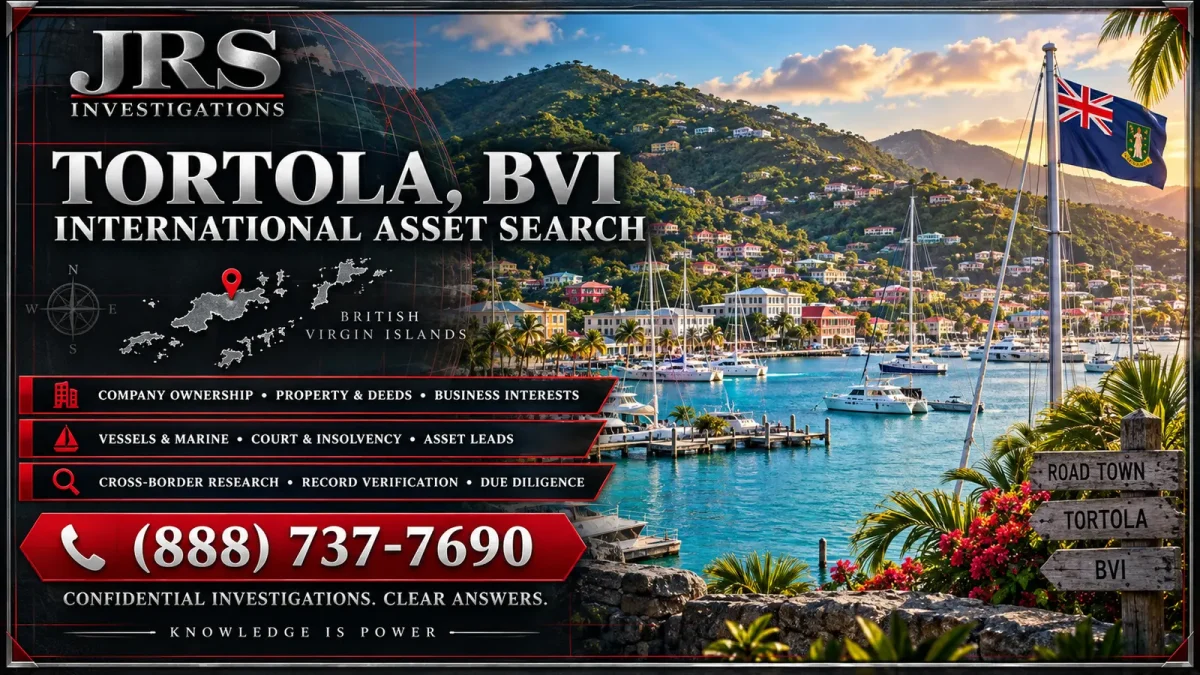
Tortola BVI international asset search work can help attorneys, creditors, business owners, investors, fiduciaries, and private clients develop lawful leads about companies, property, vessels, litigation, and connected interests in the British Virgin Islands. JRS Investigations approaches these matters as evidence-led research—not as a promise to expose a secret account, seize property, or guarantee recovery.
Road Town is the commercial and government center of Tortola, but an asset inquiry rarely ends with one local search. A BVI company may connect to a registered agent, overseas parent, director, shareholder, vessel, court proceeding, or property interest in another jurisdiction. The useful question is not simply “Does this person have assets?” It is which identifiers, entities, locations, and records can be lawfully verified, and what additional legal process may be needed.
What is a Tortola BVI international asset search?
An international asset search is a structured investigation into ownership indicators, corporate relationships, property, business interests, litigation, insolvency events, and other lawful asset leads. It can support due diligence, judgment-enforcement planning, fraud inquiries, probate and estate matters, shareholder disputes, divorce litigation, or a decision about whether further legal action is commercially sensible.
It is important to distinguish an investigative lead from proof of title or control. A company filing may identify a registered agent or historic shareholder information without establishing who controls an entity today. A property record may identify a registered owner without showing current equity. A court judgment may establish a debt without showing that an asset is reachable. JRS documents sources and limitations so counsel can decide what should be confirmed through formal disclosure, a court order, or a qualified BVI professional.
Eight asset categories JRS can examine
1. BVI companies and limited partnerships
The BVI Registry of Corporate Affairs maintains the register of companies and administers the BVI Business Companies Act. The Commission’s current registered-entity search guidance explains that a search report may include a company name and number, entity type, incorporation date, status, registered agent and office, previous names, transaction history, and certificate history. JRS can compare these details with client documents and overseas records to identify inconsistencies or connected entities.
A registry result is a starting point. It does not automatically reveal every private agreement, beneficial interest, nominee relationship, source of funds, bank account, or asset held through another entity. Access to particular corporate or beneficial-ownership information depends on the governing law, the requester, the record, and the available procedure.
2. Beneficial-ownership and control indicators
The BVI Financial Services Commission now provides a central Public Search and Beneficial Ownership Search portal, with separate procedures for entity searches, ownership-information requests, and certificates. JRS can help organize the subject identifiers, entity numbers, ownership allegations, counterparties, and chronology needed for a focused request or for counsel’s formal process.
We do not represent that all beneficial-ownership details are open to the public or that a search will reveal a natural person behind every structure. Where access is restricted, JRS reports that limitation and can identify lawful next steps with the client’s attorney or an appropriate BVI service provider.
3. Land and property records
The Government of the Virgin Islands identifies the Department of Land Registry in Road Town as the public department responsible for land-registration services. Depending on the matter and lawful access, property research may help identify a registered proprietor, parcel, transfer, charge, or other land-related record.
Property research should not be confused with a title opinion, appraisal, or calculation of available equity. Trust interests, financing, co-ownership, pending transfers, restrictions, and unrecorded agreements may require further work. JRS can develop and organize the record trail; a BVI attorney or qualified land professional should advise on title, priority, enforceability, and legal remedies.
4. Vessels and marine interests
Tortola’s marinas and charter industry make vessels a relevant category in some investigations. Research can examine vessel names, official numbers, registration indicators, ownership entities, operators, managers, charter businesses, mortgages when available, marina connections, and public movements. Similar names and flag changes create false matches, so hull identifiers and registration records matter more than a photograph or social-media post.
A vessel sighting does not prove ownership. It may be chartered, leased, managed for a third party, or owned by a company with no established connection to the subject. JRS treats visual and online information as leads to be corroborated, not as a shortcut to a legal conclusion.
5. Court, insolvency, and enforcement records
The British Virgin Islands is within the jurisdiction of the Eastern Caribbean Supreme Court, including a Commercial Division that handles significant company, insolvency, and cross-border disputes. Court records may identify parties, claims, judgments, liquidators, receivers, charging orders, freezing applications, or competing ownership assertions. The meaning of a filing depends on the pleadings, orders, status, and outcome—not simply the existence of a case.
JRS can build a litigation chronology and retrieve available source documents. Counsel should determine whether an order remains effective, whether recognition or enforcement is required, and what remedies are available in the BVI or another jurisdiction.
6. Regulated financial-services relationships
The BVI Financial Services Commission’s regulated-entities resources can help verify whether a business appears in an official regulatory category. This may be relevant when a subject claims to operate a fund, fiduciary, investment, insurance, corporate-services, or virtual-asset business.
Regulatory status does not prove that a subject owns client assets or that a particular investment is sound. JRS compares the claimed legal name, trading name, license category, address, status, and responsible parties, and can review enforcement notices where relevant.
7. Overseas companies, property, and litigation
A BVI entity may own or finance assets elsewhere, and a Tortola-based subject may have business interests in the United States, United Kingdom, wider Caribbean, or another financial center. JRS can expand research using verified names, company numbers, addresses, directors, counterparties, litigation parties, and transaction dates. Our international asset investigation services explain how cross-border scopes are built around jurisdiction and evidence.
Cross-border matching requires care. Repeated company names, transliteration, nominee services, and stale databases can create misleading results. We show why an entity or asset is believed to be connected and separate confirmed facts from reasonable leads.
8. Online, media, and open-source indicators
Company websites, archived pages, professional profiles, advertisements, news reports, photographs, aircraft or vessel references, and social posts can reveal names, locations, relationships, and timelines. These sources can also be inaccurate, staged, outdated, or attributed to the wrong person. JRS preserves the source and date, then looks for independent corroboration before treating an online clue as meaningful.
When a BVI asset investigation may be useful
Judgment-enforcement planning
A creditor and counsel may want to understand whether identifiable assets or business interests justify domestication, recognition, disclosure, or enforcement efforts. An investigation can prioritize possible property, shares, vessels, receivables, or connected entities. It cannot determine legal reachability on its own. Exemptions, secured creditors, trusts, priority, beneficial ownership, and court jurisdiction are legal questions.
Business and investment due diligence
Before a transaction, JRS can compare corporate status, ownership representations, management history, litigation, regulatory claims, property assertions, and connected parties. The objective is to identify facts that could change the decision before funds, access, or reputation are committed. See our due diligence investigation services for related scope considerations.
Fraud, shareholder, and fiduciary disputes
When records suggest an undisclosed affiliate, diverted opportunity, conflicting ownership claim, or unexplained transfer, JRS can map the people, entities, addresses, transactions, and public filings around the allegation. Investigation does not replace discovery, forensic accounting, or legal process. It helps counsel identify where documents may exist and which questions require proof. Related matters may also fall within our fraud investigation services.
Divorce, probate, and estate matters
Asset research can help test sworn disclosures or identify corporate and property leads relevant to a marital or estate proceeding. The client must have a lawful purpose, and private financial records require authorization or valid legal process. JRS does not impersonate account holders, hack systems, purchase stolen data, or claim access to private banking information.
How JRS structures a Tortola asset-search assignment
Phase 1: Define the legal objective
We identify the subject, claim, decision, deadline, available judgment or pleadings, known entities, addresses, dates of birth, company numbers, suspected asset categories, and relevant jurisdictions. A clear objective prevents an expensive worldwide search from replacing a focused investigation.
Phase 2: Verify identifiers and priority records
JRS resolves name variations and starts with the records most likely to change the client’s decision. These may include BVI entity searches, regulatory records, court and insolvency materials, property inquiries, vessel indicators, and overseas corporate or litigation records.
Phase 3: Connect and corroborate
We compare names, dates, addresses, registered agents, directors, counterparties, family or business relationships, and transaction history. A connection is not reported as ownership unless the evidence supports that conclusion. Conflicts, gaps, and alternative explanations are documented.
Phase 4: Report and next-step recommendations
The report separates confirmed records, investigative leads, negative searches, limitations, and questions for counsel. If the initial phase identifies a viable direction, the client can authorize targeted document retrieval, interviews, overseas research, or lawful fieldwork. This phased approach controls cost and allows decisions to be made as evidence develops.
What an investigator cannot lawfully promise
- Access to private bank balances, tax returns, passwords, or protected account records without authorization or legal process.
- A complete list of every asset held directly, indirectly, through a trust, or through an undisclosed nominee.
- That an identified asset belongs to the subject, has available equity, or can be seized.
- That a registry, database, or online source is current, complete, or free of filing errors.
- Recovery of money, recognition of a judgment, or a particular court outcome.
Clients should be cautious of anyone who guarantees offshore bank access or asset recovery. A responsible investigator explains the lawful sources, likely limitations, costs, and decision points before work begins.
Frequently asked questions
Are all BVI company ownership records public?
No. Publicly available and requestable information depends on current BVI law, the record, and the requester’s basis for access. Company search reports can provide useful entity information, while beneficial-ownership information follows separate procedures. JRS will not claim access beyond what the law and authorized process permit.
Can JRS find a private BVI bank account?
JRS may develop lawful indicators of financial relationships, transactions, companies, or assets, but it does not obtain private account records without consent or valid legal authority. Bank records generally require disclosure by the owner, lawful discovery, a subpoena or court process recognized in the appropriate jurisdiction.
Does finding a BVI company prove it owns assets?
No. Registration proves that an entity appears in the official record with specified filing information. It does not prove operational activity, solvency, current beneficial control, or ownership of a particular asset. Those questions require corroboration.
How long does a Tortola asset search take?
Timing depends on the number of subjects and entities, identifiers available, jurisdictions, registry response times, court-document access, language issues, and whether local retrieval or fieldwork is needed. JRS can prioritize urgent searches and propose a defined first phase.
Request a confidential Tortola BVI asset-search review
For case intake, local coordination and the wider range of available services, visit the JRS Investigations Tortola private investigator page. Discuss your objective, available identifiers and reporting needs before agreeing to an asset-search scope.
Prepare the subject’s full legal name, aliases, date of birth if lawfully available, company names and numbers, addresses, known associates, relevant court documents, suspected asset types, jurisdictions, time period, and the decision the investigation must support. JRS will identify a proportionate scope and explain what can be verified through records, investigation, and authorized local resources.
Clients seeking broader regional coverage can also review our Caribbean private investigation services and Caribbean international asset-search guide.
Knowledge is power. Contact JRS Investigations or call (888) 737-7690 for a confidential consultation.