(888) 737-7690

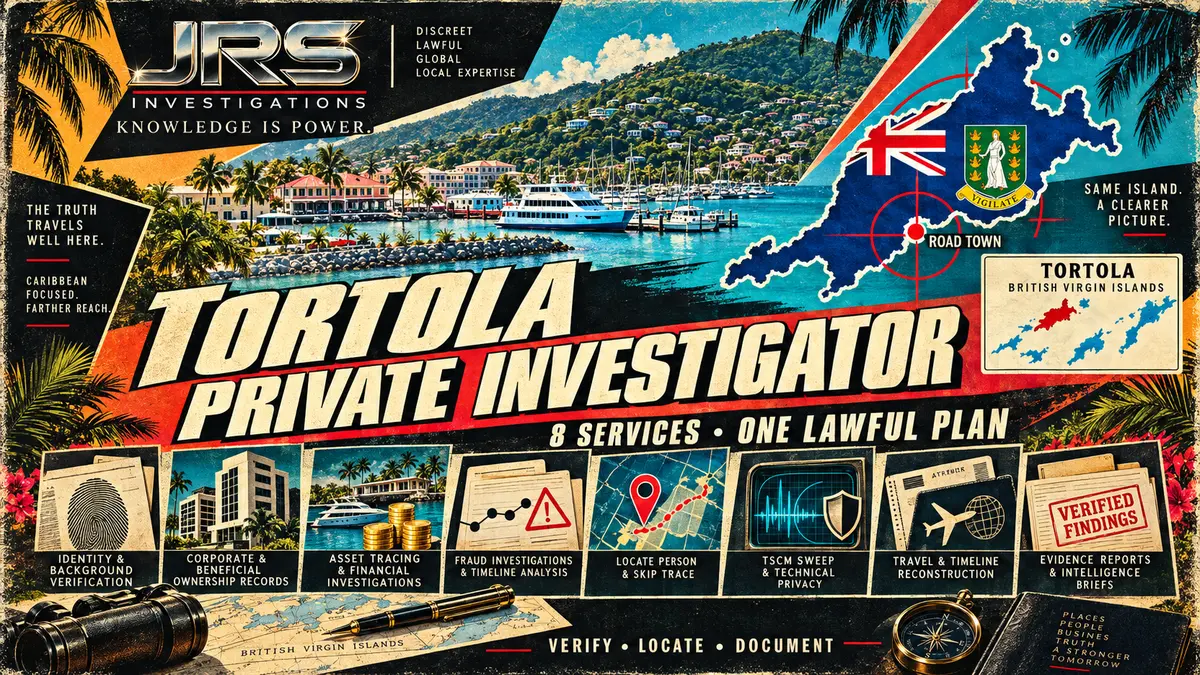
Tortola Private Investigator: 8 Services and Hiring Steps
A Tortola private investigator can help turn a personal, corporate or legal concern into a defined fact-finding plan. The useful starting point is not a promise of a particular result. It is a clear question, lawful authority, a realistic scope and a reporting standard that matches the decision you need to make.
JRS Investigations supports matters connected to Road Town and the wider British Virgin Islands through coordinated research, fieldwork and specialist resources appropriate to the assignment. Tortola’s compact geography, steep roads, ferry and marina traffic, visitor economy and role in international business can all affect timing, access and evidence collection. Work should therefore be planned case by case, with local law and professional advice controlling.
Immediate danger, a missing person at risk or an active crime should be reported to the Royal Virgin Islands Police Force or the appropriate emergency authority first. A private investigation does not replace police action, legal advice, a court order or a regulated financial-services process.
Eight investigative services commonly requested in Tortola
1. Background research and due diligence
Before a transaction, appointment, investment or sensitive personal decision, an investigator may verify identity information, addresses, business affiliations, litigation indicators and other lawfully available records. The objective is to distinguish confirmed facts from unverified claims and identify gaps that need direct clarification. JRS can coordinate this work with its broader background investigation services.
2. Corporate and beneficial-ownership research
Tortola is closely associated with BVI corporate administration, but that does not mean every ownership record is open to the public. A properly scoped assignment may examine company identifiers, filing history, directors or officers where accessible, connected entities, addresses, litigation records and records in other jurisdictions. Requests for protected beneficial-ownership information must follow the applicable BVI access process. The BVI Financial Services Commission is the authoritative starting point for current registry, regulatory and beneficial-ownership information.
3. Hidden-asset and judgment-support research
Asset research can organize lawful indicators of real property, vessels, vehicles, companies, secured interests, litigation and financial relationships. It cannot guarantee that an asset exists, that it belongs beneficially to the subject or that it can be recovered. Counsel decides which disclosure, freezing, charging or enforcement procedure is available. For a focused overview, see JRS’s Tortola asset-search guide and BVI judgment-recovery investigation guide.
4. Fraud and corporate fact development
When a company sees unexplained payments, conflicting invoices, unauthorized vendor changes or suspected diversion, the investigation should begin with a dated chronology and preservation plan. Records may include contracts, emails supplied with authority, access logs, invoices, shipping documents and witness accounts. The investigator tests competing explanations and documents sources; legal counsel determines privilege, disclosure duties and litigation strategy.
5. Marital and relationship investigations
Clients sometimes need lawful documentation relating to a spouse or partner. A professional scope focuses on conduct visible from lawful vantage points, time-and-location corroboration, travel or accommodation facts supplied with authority, and neutral reporting. It does not authorize trespass, account intrusion, impersonation, unlawful interception or harassment. Findings should be documented without sensational language and discussed with local counsel when they may affect a family-law proceeding.
6. Locating people and verifying contact information
A locate assignment may combine identifiers, address history, public records, permitted databases, open-source research and carefully planned field inquiries. The purpose and safety context matter. Adoption, debt, family, witness, service-of-process and missing-person matters do not carry the same authority or disclosure rules. JRS assesses the reason for the request before releasing sensitive location information and may restrict or decline disclosure where safety concerns arise.
7. TSCM and privacy-risk assessment
A technical surveillance countermeasures inspection evaluates a defined residence, office, meeting space, vessel or vehicle for technical anomalies and security weaknesses. It should start with the owner’s or authorized occupant’s written permission and a threat-informed scope. A defensible process can include an environmental baseline, physical examination, radio-frequency analysis, network review where authorized, validation of anomalies and a written report. Learn more about JRS counter-surveillance and TSCM services.
8. Incident, travel and timeline reconstruction
Tortola assignments may involve villas, hotels, ferries, charter vessels, marinas, airports or business meetings spread across several islands. An investigator can organize receipts, reservations, communications supplied by the client, photographs, witness accounts and lawful records into a single chronology. Early preservation matters because commercial video, access and booking records may be overwritten or subject to retention limits.
How a Tortola investigation should proceed
- Define the decision. State what the client, attorney, company or insurer must decide and which facts would materially affect that decision.
- Confirm authority and jurisdiction. Identify who owns the premises, account, device or records; where relevant conduct occurred; and whether BVI counsel or another local professional is needed.
- Preserve what already exists. Keep original messages, documents, photographs and devices intact. Record when and how each item was obtained. Avoid editing files or confronting a subject before a preservation strategy is set.
- Build a subject and event matrix. Resolve names, aliases, companies, dates, addresses, vessels, phone numbers and known associates. Separate verified facts from client reports and investigative hypotheses.
- Use proportionate methods. Start with the least intrusive lawful method likely to answer the question. Expand only when new facts justify the time, cost and privacy impact.
- Validate important findings. A name match or database entry is a lead, not proof. Material conclusions should be corroborated with primary records, direct observation or independent sources whenever possible.
- Report facts, limits and next actions. A useful report identifies the source of each finding, explains unresolved conflicts, separates observation from inference and lists practical follow-up steps.
Why Tortola changes the investigation plan
Road Town concentrates government, legal, financial and commercial activity, while residences, resorts and marinas extend across hilly terrain and coastal areas. Ferry schedules, charter movements, short-term visitors, weather and inter-island travel can make a narrow surveillance window unrealistic. A field plan should allow for access constraints and should not mistake ordinary tourism or marina activity for evidence.
Corporate matters also require precision. A BVI company connection may be only one part of a wider structure involving registered agents, professional intermediaries and assets elsewhere. The investigator’s role is to map verifiable relationships and preserve source records, not to imply wrongdoing from incorporation in the jurisdiction. The Eastern Caribbean Supreme Court publishes court information and judgments, while the FSC governs regulated financial-services and registry functions. Access, use and interpretation depend on the matter.
Privacy, evidence and legal boundaries in the BVI
The Virgin Islands Data Protection Act, 2021 establishes rules for processing personal data, including lawful purpose, proportionality, security, accuracy, retention and disclosure. Those principles affect how investigative information is collected, stored, shared and eventually destroyed. Consent is not the only possible legal basis, but a client should not assume that a private purpose automatically authorizes every form of collection.
Protected accounts should never be accessed without authority. Investigators should not install tracking software, intercept communications, misrepresent themselves to obtain confidential records or enter private property without permission. Recording, surveillance and device examination can raise separate criminal, civil, privacy and evidentiary questions. BVI counsel should review any method whose legality or admissibility is uncertain.
Potential money-laundering, sanctions or suspicious-activity issues may also trigger obligations beyond the private assignment. The BVI Financial Investigation Agency publishes official information about its competent-authority, sanctions and financial-intelligence functions. An investigator does not decide a regulated entity’s reporting duty or promise access to protected intelligence.
How to vet an investigator for Tortola
- Ask who will perform each part. Determine whether research, fieldwork, technical examination or specialist analysis will be handled directly or through a vetted local resource.
- Verify relevant authority. Licensing, registration, data access and professional requirements depend on the service and location. Request the applicable credentials rather than accepting a broad “internationally licensed” claim.
- Require a written scope. It should identify the question, approved methods, exclusions, reporting format, budget controls and circumstances that require new authorization.
- Discuss conflicts and confidentiality. Sensitive island and corporate matters require careful conflict screening, limited access and secure communications.
- Ask how evidence is handled. The answer should address original files, working copies, timestamps, notes, exhibits, transfers, retention and who can receive the report.
- Reject guarantees. A professional can promise a disciplined process, not a particular factual finding or court outcome.
What to prepare before the first call
Prepare a concise chronology, the names and identifiers already known, the exact question to be answered, the decision deadline, locations involved and any court or regulatory dates. Preserve original messages and files. Identify who owns relevant devices or premises and whether counsel is already involved. Do not send passwords or unnecessary sensitive records through ordinary email.
For regional context, review the main Tortola private-investigator service page, the broader British Virgin Islands investigations page, or JRS’s investigation services. A focused intake lets the investigator propose a proportionate first phase instead of an open-ended assignment.
What a useful final report includes
- the assignment, authority and scope;
- a dated chronology and subject identifiers;
- methods used and sources consulted;
- factual findings with supporting exhibits;
- conflicts, gaps and alternative explanations;
- the limits of the work; and
- recommended next steps for the client or counsel.
Reports should avoid conclusory legal labels unless supplied by qualified counsel. They should also make clear when a result is negative: “not identified within the agreed sources and period” is more accurate than “does not exist.”
Frequently asked questions
Is hiring a private investigator in Tortola legal?
Private fact-finding may be lawful, but each method must comply with applicable BVI law and any law governing another location, record or device. Confirm the provider’s authority for the specific service and obtain legal advice when the method or intended use is uncertain.
Can an investigator obtain a BVI company’s beneficial owner?
Not automatically. Availability and access conditions are set by current BVI law and FSC procedures. Publicly or lawfully available corporate information can be researched, and counsel can advise on formal disclosure routes.
Can JRS guarantee that hidden assets or infidelity will be proven?
No. Investigators can define a lawful method, follow leads, corroborate findings and report limitations. They cannot guarantee that a suspected fact is true or that recoverable assets exist.
How quickly can a Tortola investigation begin?
Timing depends on scope, conflicts, authority, local resources, travel, weather, records and urgency. A staged plan often begins with document preservation and research while field logistics are arranged.
Will the report be usable in court?
A careful report can support counsel, but admissibility and disclosure are legal questions. Involve counsel early when litigation is pending or likely so collection, privilege, preservation and witness issues can be managed correctly.
For a travel or personal-protection need, review JRS’s BVI private security and executive protection planning. Protection staffing and investigation services each require a defined lawful scope and confirmed local resources.
Start with a confidential, defined scope
The strongest Tortola investigation begins with one answerable question and a lawful plan. Contact JRS Investigations to outline the issue, relevant locations, deadline and intended use of the findings. JRS can then identify a practical first phase, appropriate resources and clear reporting expectations.