(888) 737-7690

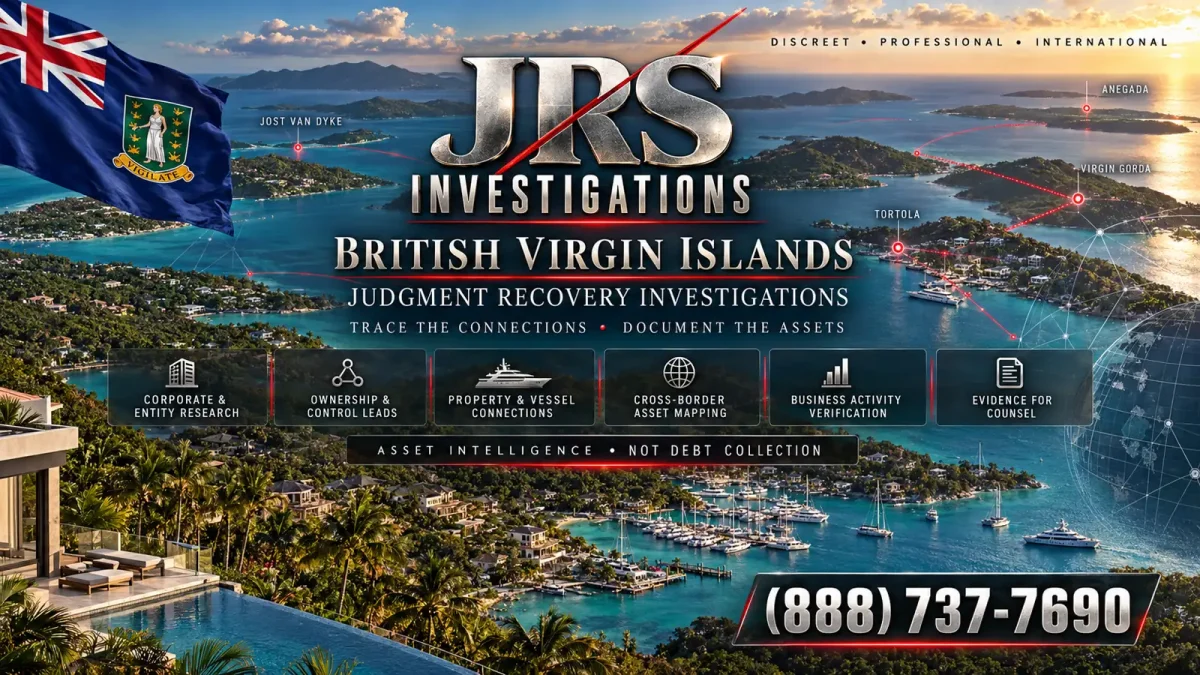
British Virgin Islands Judgment Recovery Investigator
A court judgment confirms that money is owed, but it does not automatically identify where a debtor holds value or which assets may be available to satisfy the award. A British Virgin Islands judgment recovery investigator can help close that information gap by identifying people, companies, property interests, business activity, and cross-border connections that may matter to an enforcement strategy.
JRS Investigations provides discreet, lawful asset intelligence for judgment creditors, attorneys, businesses, and fiduciaries with matters connected to Tortola, Virgin Gorda, Jost Van Dyke, Anegada, and BVI-registered entities. We investigate and document facts. We do not practice law, seize assets, collect debts, or guarantee recovery. BVI counsel determines which court procedures and remedies are available.
British Virgin Islands Judgment Recovery Starts With Asset Intelligence
Enforcement is strongest when counsel receives organized, current information instead of an unverified list of possible assets. The investigative stage should answer practical questions: Is the debtor correctly identified? Which companies are connected? Are assets held personally, through a business, or through another entity? Does the debtor maintain a residence, office, vessel, investment, or commercial relationship in the BVI? Are there indicators that ownership or control changed after the dispute began?
Investigation and legal enforcement serve different roles
JRS develops leads and documents relationships through lawful records research, open-source intelligence, professional databases, field inquiries when appropriate, and evidence organization. An attorney evaluates admissibility, recognition of a foreign judgment, disclosure applications, freezing relief, charging orders, receivership, insolvency options, and other legal remedies. Keeping those roles separate protects the integrity of the matter.
Early research helps avoid wasted enforcement costs
A debtor may use a similar name, operate through several companies, or have no meaningful connection to an address found in an old report. Confirming identifiers and ownership clues before filing additional proceedings can help counsel direct resources toward viable targets and avoid pursuing unrelated people or inactive entities.
Eight Ways JRS Supports a BVI Judgment-Recovery Strategy
1. Confirm the debtor’s identity
We reconcile names, aliases, dates of birth, addresses, telephone numbers, email identifiers, professional roles, and known associates. This identity work is especially important when the debtor has a common name, multiple citizenships, international residences, or businesses with similar names.
2. Map BVI companies and registered relationships
We identify BVI business companies, limited partnerships, foreign companies, previous names, status changes, registered agents, registered offices, and transaction-history clues available through lawful sources. The official BVI FSC company-search guidance explains that search reports may include the entity name and number, incorporation date, current status, registered agent, registered office, previous names, and filing history.
3. Develop ownership and control leads
A company name alone does not establish who controls its assets. JRS compares corporate records with litigation documents, professional profiles, company websites, archived pages, addresses, related entities, directors or officers identified in lawful sources, and other corroborating evidence. We clearly distinguish confirmed records from investigative leads that require additional proof.
4. Identify real-property and occupancy connections
Where legally available, research may identify property interests, development activity, mailing addresses, occupancy indicators, management relationships, or links to residential and commercial locations. A location is not treated as an asset merely because the debtor has visited it or used it for correspondence; ownership and control require corroboration.
5. Research vessels, aircraft, vehicles, and high-value assets
Marinas, charter operations, vessels, aircraft, and luxury assets can create useful leads in the BVI, but photographs and social-media posts are not proof of ownership. We compare registration information, company affiliations, operational history, sales listings, port or marina references, financing clues, and other records to determine what can be documented.
6. Trace business activity and revenue indicators
Active contracts, executive roles, commercial premises, regulated licenses, investment interests, operating websites, and current business relationships may help counsel understand where value is generated. JRS does not access private bank accounts or obtain protected financial data without lawful authority. We document legitimate indicators and preserve the source of each finding.
7. Connect BVI findings to other jurisdictions
A BVI company may hold interests elsewhere, while a debtor living outside the Territory may use BVI entities in a broader structure. We map cross-border names, addresses, companies, litigation, property connections, and professional relationships so the client and counsel can see the network rather than isolated records.
8. Build an attorney-ready evidence package
Useful research must be understandable. Our reporting can include an executive summary, subject identifiers, entity charts, source citations, dated screenshots, record copies, chronological findings, unresolved conflicts, and recommended next investigative steps. Counsel can then decide what requires formal discovery, a court order, testimony, certification, or additional jurisdiction-specific work.
What Official BVI Corporate Records Can Establish
The BVI Registry of Corporate Affairs administers the BVI Business Companies Act and maintains the Register of Companies. Its public-search system can provide company and limited-partnership information for a fee. Depending on the entity and available filings, a search report may identify the registered agent, registered office, entity status, previous names, capital information, and transaction or certificate history.
A registered office is not automatically an operating location
Many BVI entities use a professional registered agent and office. That address should not be described as the debtor’s home, business premises, or asset location without supporting evidence. JRS separates statutory registration details from verified operational facts.
Beneficial-ownership information has legal access limits
The BVI FSC maintains a dedicated beneficial-ownership information page and related guidance. Access, disclosure, and permitted use depend on current law and the requester’s authority. We never claim that a public company search automatically reveals every beneficial owner, shareholder, bank relationship, trust interest, or underlying asset.
BVI Location Matters, but Corporate Registration Is Not Physical Presence
Road Town on Tortola is the Territory’s main commercial and administrative center, while significant residential, resort, marina, and investment activity extends through Virgin Gorda, Jost Van Dyke, Anegada, and the surrounding islands. A judgment-recovery investigation may therefore require both corporate research and location-specific verification.
However, incorporation in the BVI does not prove that the debtor lives there or that company assets are physically located there. A strong investigation tests the connection. Our British Virgin Islands private investigator guide explains how to scope local assignments, while our Virgin Gorda investigator guide covers island-specific planning and evidence handling.
Foreign Judgments Require BVI Legal Advice
A judgment issued outside the BVI may not be enforced in the same way as a local judgment. The correct route can depend on the issuing court, applicable legislation, the judgment’s finality, service, limitation periods, public-policy considerations, and the relief requested. JRS does not determine whether a judgment is registrable or enforceable.
Before significant investigative expense, the creditor should ask qualified BVI counsel to review the judgment and proposed strategy. JRS can then tailor research to counsel’s priorities—for example, confirming an entity, documenting a property lead, mapping related companies, locating a person for lawful service support, or preserving evidence of business activity.
Warning Signs That Additional Asset Research May Be Needed
- The debtor claims to have no assets despite visible business activity or a high-value lifestyle.
- Companies, property, or contracts appear to have moved to relatives, associates, or newly formed entities.
- A business changed its name, registered agent, office, officers, website, or operating address after the dispute arose.
- The debtor uses several jurisdictions, citizenships, addresses, or variations of the same name.
- Known assets are titled through companies or partnerships rather than the individual debtor.
- Social-media content conflicts with sworn disclosures or representations made to the creditor.
- Old reports contain unsupported bank-account claims, incomplete identifiers, or records that can no longer be verified.
These facts do not prove concealment. They identify questions that should be investigated and documented carefully.
What JRS Will Not Do
Credible judgment-recovery work must stay within clear legal and ethical boundaries. JRS will not impersonate the debtor, access private accounts, obtain bank balances without lawful authorization, hack devices, purchase stolen data, trespass, place illegal trackers, threaten a subject, or misrepresent an investigative lead as a confirmed asset. We do not promise that an asset will be found or recovered.
For a related island-specific example, review our Virgin Gorda judgment-recovery research guide. For ownership research involving another BVI island, see our Jost Van Dyke hidden-assets guide.
What to Provide Before the Investigation Begins
- A complete copy of the judgment and any amendments or related orders.
- The debtor’s full legal name, known aliases, date of birth, citizenship, and last known addresses.
- Company names, registration numbers, websites, email addresses, telephone numbers, and known associates.
- Prior asset reports, discovery responses, sworn statements, contracts, invoices, and correspondence.
- Known BVI connections, including registered agents, properties, marinas, employers, counterparties, or professional advisers.
- The name and contact information for counsel coordinating the legal strategy.
JRS uses this information to prevent duplicate work, resolve identity conflicts, establish a research baseline, and define which questions the investigation must answer.
Frequently Asked Questions
Can JRS recover money from a BVI bank account?
No. JRS does not seize funds or access private bank accounts. We may research lawful indicators of financial and business relationships, while BVI counsel uses appropriate legal procedures to seek disclosure or enforcement relief.
Can you guarantee that assets will be found?
No ethical investigator can guarantee a result. Records may be restricted, outdated, held under another legal structure, or located outside the BVI. We report what can be verified, identify limitations, and explain which leads remain unresolved.
Do you investigate individuals and companies?
Yes. An assignment may involve an individual debtor, a company debtor, related entities, officers, counterparties, or a network spanning several jurisdictions. Scope and lawful purpose are confirmed before work begins.
Is “judgment” or “judgement” the correct spelling?
Both spellings appear in international searches. “Judgment” is common in legal usage and is used on this page, while many clients search for “judgement recovery.” The investigative service is the same.
How quickly can an investigation begin?
Timing depends on the quality of the identifiers, the number of entities and jurisdictions, record availability, and whether local fieldwork is required. An initial review can identify priority questions and a phased scope before extensive research begins.
Speak With JRS About a BVI Judgment-Recovery Investigation
For wider case planning and local assignment information, review our British Virgin Islands private investigator services.
If you have a judgment, suspected BVI assets, or a debtor connected to a BVI company, begin with a confidential case review. JRS Investigations can help verify identities, map companies, develop ownership and location leads, document asset indicators, and organize findings for your attorney.
Call (888) 737-7690 to discuss British Virgin Islands judgment-recovery research. Have the judgment, debtor identifiers, known company names, and counsel’s priority questions available so we can evaluate the most efficient starting point.
This article provides general investigative information and is not legal advice. Recognition and enforcement of judgments in the British Virgin Islands should be handled by qualified BVI counsel.