(888) 737-7690

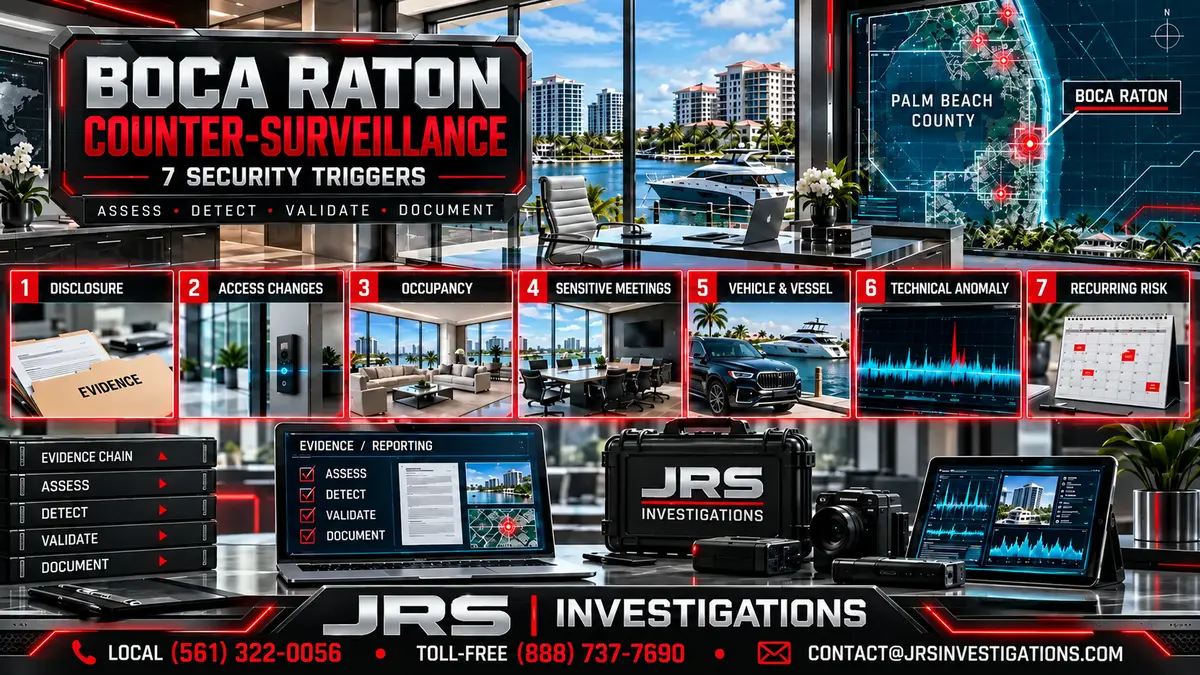
Boca Raton Counter-Surveillance: 7 Security Triggers
Boca Raton counter-surveillance should begin with facts, authority and a defined security question—not a promise that every unexplained event proves someone is listening. JRS Investigations provides lawful Technical Surveillance Countermeasures (TSCM) inspections for authorized homes, executive offices, vehicles, vessels and meeting spaces in Boca Raton and Palm Beach County. The objective is to assess risk, examine the agreed environment, validate anomalies and document practical next steps.
In a city shaped by financial services, law, real estate, healthcare, technology, seasonal residences and private waterfront activity, confidential conversations can move between offices, homes, automobiles, hotels and marinas in a single day. A professional assessment helps clients separate ordinary electronic behavior from conditions that warrant closer review. For local investigative support beyond technical inspections, see our Boca Raton private investigator services and our private investigation services.
Seven security triggers for a Boca Raton counter-surveillance review
1. Sensitive information appears outside the expected circle
A business strategy, legal position, transaction detail or private family matter may surface where it should not. That does not automatically establish electronic surveillance. Information can leak through normal access, forwarded messages, cloud sharing, overheard conversations, compromised credentials or an authorized participant. A TSCM assessment is useful when the client can identify what was exposed, when it was discussed and who had legitimate access. Those details help build a defensible scope instead of turning suspicion into a conclusion.
2. Contractors, renovations or storm-restoration work changed access
Renovations, audiovisual upgrades, networking work, cleaning, maintenance and post-storm repairs can bring multiple vendors through sensitive areas. The risk is not that every contractor is suspicious; it is that access patterns and equipment inventories may no longer be clear. A review can establish a new baseline after work is completed, verify the agreed spaces and help management document which devices and systems belong there.
3. A change in occupancy, staffing or tenancy created uncertainty
Executive turnover, domestic staff changes, a departing tenant, a new property manager or a shared-office transition can alter who had keys, codes, network access or unsupervised time. Seasonal properties add another layer because a residence may be vacant, serviced or occupied by guests for long periods. A scoped inspection may be appropriate after access is formally recovered and the owner or authorized representative can approve the work.
4. A confidential meeting or home office carries unusual exposure
Board discussions, litigation strategy, acquisitions, wealth management, healthcare matters and high-value real estate negotiations require disciplined privacy. A risk-based inspection can be scheduled before a critical meeting, after an unexplained disclosure or as part of a recurring protective program. The assessment should cover the authorized environment and the client’s actual communication workflow, not just one room in isolation.
5. A vehicle or vessel moves between sensitive locations
Boca Raton clients often work across residences, offices, airports, marinas and neighboring Palm Beach County communities. Vehicles and vessels can become part of the information-security boundary. Florida law places important restrictions on tracking devices and tracking applications, so ownership, consent and legal authority must be confirmed before examination or any investigative action. The current text of Florida Statute 934.425 explains the rule and its exceptions.
6. Unfamiliar equipment or a technical anomaly needs validation
An unknown network name, unexplained battery drain, interference, a changed cable, a device that appears out of place or an unusual account alert may have an innocent explanation. Consumer electronics, neighboring transmitters, software updates and configuration errors routinely create confusing symptoms. A professional review documents the condition, compares it with the known environment and determines whether additional technical or digital analysis is justified. An anomaly is a lead to evaluate—not proof of surveillance.
7. The organization needs a recurring risk-management program
Some environments merit periodic review because confidential meetings, leadership travel, vendor access or competitive information recur. The cadence should follow risk and operational change rather than fear. A baseline assessment, access controls, equipment inventory, incident procedures and scheduled rechecks can work together. The NIST Cybersecurity Framework 2.0 offers a useful high-level model for governing, identifying and managing cyber risk alongside physical and technical security.
What a professional TSCM process should include
A careful inspection is layered. No single instrument, app or quick scan can answer every question. JRS defines the assignment around the client’s authority, risk profile, locations and decision needs. Our dedicated Boca Raton TSCM service page explains local coverage, while the Florida TSCM overview provides statewide context.
- Confirm authority and scope. Identify the owner, tenant, employer or other person authorized to approve access. Define spaces, vehicles, vessels, systems, timing and exclusions in writing.
- Preserve useful context. Record dates, access changes, equipment changes and specific disclosures. Avoid dismantling, discarding or publicly confronting anyone before professional guidance.
- Establish a baseline. Inventory known systems and expected signals so normal infrastructure can be separated from items that require validation.
- Conduct a layered examination. Combine visual, physical and appropriate electronic methods based on the environment and assignment. Dense coastal and urban radio-frequency activity makes interpretation especially important.
- Validate anomalies. Recheck findings, compare them with known equipment and avoid treating a single indicator as a conclusion.
- Respond with evidence in mind. If a suspicious item is identified, coordinate the next step with the client, counsel or law enforcement as appropriate. Preservation may be more important than immediate removal.
- Report and reduce future risk. Deliver a clear summary of scope, observations, limitations and recommendations for access, meetings, devices and follow-up.
For a broader explanation of professional selection criteria, read our guide to the seven reasons to hire a professional TSCM bug-sweep investigator.
TSCM is not the same as digital forensics
TSCM focuses on the authorized physical and technical environment: spaces, installed electronics, signal activity, infrastructure and items within the agreed scope. Digital forensics examines data on computers, phones, accounts or storage media using a separate legal and technical process. A suspicious login, forwarded email, spyware concern or cloud-access issue may call for account security, incident response or digital forensic support rather than—or in addition to—a physical sweep.
This distinction prevents wasted effort. A room inspection cannot prove that an online account is secure, and a phone scan cannot establish that an office environment has been fully evaluated. JRS helps define which discipline fits the facts and, when necessary, coordinates the investigation so physical observations and digital evidence remain properly separated.
Boca Raton environments that may require special planning
Executive and professional offices: Financial, legal, healthcare and real-estate teams may need reviews around boardrooms, private offices and temporary deal spaces. Access logs, visitor procedures and audiovisual systems should be considered with the physical environment.
Residences and condominiums: Gated communities and managed buildings can involve owners, associations, staff and vendors with different access rights. Authorization must be clear, especially for shared areas or property the client does not control.
Hotels and private meetings: A temporary meeting space changes quickly and may contain equipment the client does not own. The scope, timing and permission should be established with the appropriate property representative.
Vehicles, marinas and vessels: Salt air, onboard electronics, maintenance work and changing locations can complicate technical assessment. Ownership, consent and safe access must be verified before work begins.
Seasonal or recently renovated property: Long vacancy periods and multiple service visits make an accurate equipment inventory valuable. A baseline after turnover, restoration or system upgrades can reduce future uncertainty.
Legal and licensing boundaries matter
Florida regulates private investigative agencies and investigators under Chapter 493. The Florida Department of Agriculture and Consumer Services licensing page explains the state classifications and regulatory framework. Clients should verify the provider, the assignment and the written scope before work begins.
Florida also restricts interception and disclosure of wire, oral and electronic communications. Florida Statute 934.03 contains the current rule and exceptions. A counter-surveillance inspection does not authorize unlawful interception, access to another person’s accounts, trespass or examination of property outside the client’s control. When a matter may involve criminal conduct, litigation or employee monitoring, the client should obtain advice from qualified counsel.
How to prepare without compromising the inquiry
- Limit discussion of the planned inspection to people who need to know.
- Write down the specific event, disclosure or change that raised concern.
- List authorized equipment, recent installations and known vendors.
- Confirm ownership or written authority for each space, vehicle or vessel.
- Preserve unusual items and messages; do not alter them unnecessarily.
- Keep normal routines unless safety, counsel or law enforcement requires otherwise.
- Identify the decisions the final report must support.
Do not rely on consumer “detector” apps, social-media checklists or a single radio-frequency reading as proof. In a connected Boca Raton property, legitimate Wi-Fi, cellular, Bluetooth, security, building-management and marine electronics can create extensive normal activity.
Questions to ask a Boca Raton counter-surveillance provider
- Are the agency and assigned investigator properly licensed for the work?
- How will you confirm my authority over every location or asset?
- What methods fit this environment, and what are their limitations?
- How will you distinguish physical TSCM concerns from digital-security issues?
- What happens if you identify a suspicious item or unresolved anomaly?
- Will the report explain scope, observations, limitations and recommendations?
- How will confidentiality, evidence handling and communications be managed?
Frequently asked questions
Can a TSCM sweep guarantee that no surveillance exists?
No responsible provider should promise absolute certainty. Results depend on scope, access, timing, equipment, the environment and the behavior of any device. A professional inspection reduces uncertainty by applying documented methods and clearly stating limitations.
Should I remove an unfamiliar object myself?
Usually, preserve the scene and get guidance first unless there is an immediate safety issue. Handling or powering down an item can alter evidence or alert another party. Contact law enforcement for emergencies or suspected criminal activity.
Can JRS inspect a condominium, office, vehicle or vessel?
Potentially, when the client can establish lawful authority and safe access. Shared spaces, leased property and managed buildings may require additional permission. Scope is confirmed before scheduling.
How often should a business schedule counter-surveillance?
There is no universal calendar. Review frequency should reflect access changes, confidential events, travel, renovations, leadership transitions and prior findings. Some organizations use event-driven inspections; others combine a baseline with periodic reassessment.
What if the concern is a hacked phone or online account?
That may require digital forensics or cybersecurity support. JRS can help clarify the investigative question, but physical TSCM and device-level digital analysis should not be treated as interchangeable services.
Request a confidential Boca Raton consultation
If you have a specific concern or need a preventive review, contact JRS Investigations to define the location, authority, timeline and decision you need to make. Explore our areas served, review our Boca Raton TSCM guide, or contact JRS Investigations for a confidential discussion.
Assess. Detect. Validate. Document. Knowledge is power when the process is lawful, scoped and evidence-conscious.