(888) 737-7690

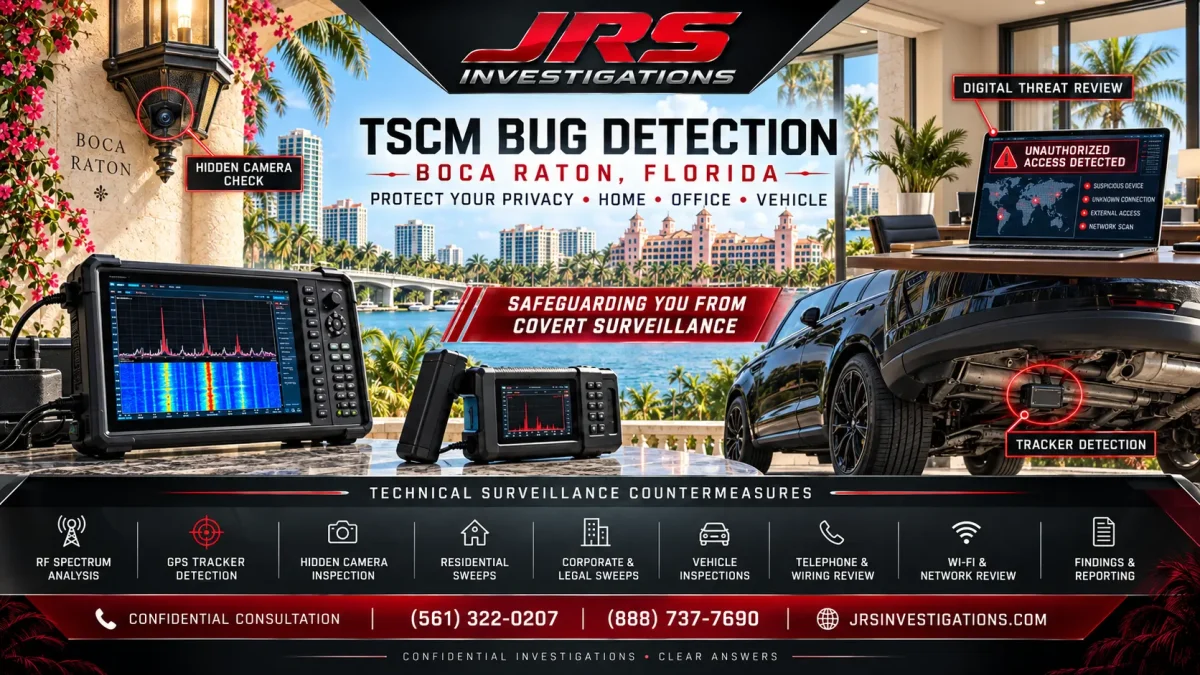
Boca Raton TSCM Bug Detection: Methods, Scope, and Results
When privacy concerns surface in a Boca Raton home, office, conference room, or vehicle, guessing is not a useful response. Professional technical surveillance countermeasures (TSCM) combine several inspection methods to identify, evaluate, and document technical anomalies. JRS Investigations provides discreet Boca Raton TSCM bug detection services for individuals, attorneys, executives, businesses, and property decision-makers who need clear information and a defensible next step.
A legitimate inspection is more than a quick radio-frequency scan. Some surveillance devices transmit continuously, some transmit intermittently, and others may store information locally without broadcasting at all. That is why a responsible TSCM examination uses layered technical and physical methods instead of relying on a single detector.
What a Boca Raton TSCM Inspection Evaluates
The scope is built around the location, the concern, and the systems present. In Boca Raton, that may mean a waterfront residence, condominium, gated property, professional office, executive suite, boardroom, hospitality setting, or vehicle. Before work begins, the investigator should understand who has lawful authority to approve the inspection, which rooms or assets are in scope, and whether recent access, construction, maintenance, or personnel changes may be relevant.
The objective is to evaluate potential pathways for unauthorized audio, video, location, or data collection. Depending on the agreed scope, the inspection may include radio-frequency activity, electronic components, hidden cameras, telephone and low-voltage wiring, accessible network equipment, physical concealment areas, and vehicles.
Why One “Bug Detector” Is Not Enough
Consumer detectors often react to ordinary wireless activity without explaining what created it. A modern residence or workplace can contain Wi-Fi access points, Bluetooth accessories, cellular devices, smart televisions, security systems, wireless cameras, and building controls. A useful TSCM process separates expected signals from unexplained activity and follows anomalies until they are reasonably identified or documented for further action.
Just as important, not every device emits a signal during the inspection. Recorders may store data locally. A cellular or Wi-Fi device may remain dormant until triggered. A concealed camera can be wired. Layered testing helps address these differences and reduces the risk of treating one quiet RF scan as a complete answer.
RF Spectrum Analysis
Radio-frequency spectrum analysis examines the active signal environment. The investigator surveys relevant frequency ranges, observes signal behavior, and compares activity across rooms or zones. Direction-finding and near-field techniques may then help narrow the source of an unexplained transmission.
The goal is not simply to produce a screen full of peaks. It is to determine which signals match known equipment, which appear external to the property, and which deserve closer inspection. Intermittent signals may require repeated observations or controlled changes to the environment. Findings should be interpreted in context rather than labeled suspicious based only on signal strength.
Non-Linear Junction Detection
A non-linear junction detector, commonly called an NLJD, can help locate semiconductor components even when a device is powered off or not transmitting. The instrument may be used around furnishings, fixtures, walls, containers, and other areas where electronics could be concealed.
NLJD responses require careful evaluation because legitimate electronics and certain materials can also create a response. The operator compares harmonic behavior, inspects the area, and correlates the result with other observations. The instrument is a powerful part of a sweep, but it is not a substitute for judgment or a physical examination.
Hidden-Camera and Optical Inspection
Camera checks focus on both wired and wireless devices. Optical tools can help reveal lenses, while inspection of power sources, network connections, fixtures, decorations, smoke detectors, chargers, and other plausible concealment points may identify anomalies. Thermal observations may be useful in certain circumstances, but heat alone does not establish that an object is a surveillance device.
Lighting, viewing angles, reflective surfaces, and the layout of the room all affect the search. A professional inspection combines optical observations with RF, NLJD, network, and physical findings rather than relying on a single flashing-lens tool.
Telephone, Wiring, and Network Review
When included in the scope, JRS Investigations can review accessible telephone equipment, wiring paths, low-voltage connections, network hardware, and visible devices for unexplained additions or changes. This is not a substitute for a full cybersecurity assessment, but it can help identify physical devices, unfamiliar connections, unauthorized access points, or other conditions that warrant technical follow-up.
Clients should avoid unplugging or reorganizing suspected equipment before the inspection unless immediate safety requires it. Changes can erase useful context, alter signal behavior, or complicate documentation.
Residential TSCM Sweeps in Boca Raton
Residential concerns can arise after a relationship dispute, household staffing change, contractor visit, security-system installation, property access issue, or unexplained disclosure of private information. A residential sweep may cover bedrooms, home offices, living areas, common rooms, garages, exterior-access points, and other agreed areas.
Condominiums and managed communities can add shared infrastructure, neighboring wireless signals, and access restrictions. These conditions make planning especially important. The client should identify the spaces they control and arrange any permissions needed for common or managed areas before the appointment.
Corporate, Legal, and Executive Environments
Boca Raton’s professional offices, executive suites, medical and financial practices, boardrooms, and hospitality spaces can involve confidential conversations and sensitive records. TSCM work may be appropriate after an access-control incident, a contentious departure, unusual competitive knowledge, a major negotiation, or a specific privacy concern.
For attorneys and business leaders, advance coordination helps protect privilege, confidentiality, and operational continuity. The inspection can be scheduled around occupancy and business needs, with the findings communicated only to authorized contacts.
Vehicle TSCM Inspections
Vehicle inspections may address concerns about location tracking, concealed audio capture, hidden cameras, or unexplained electronic components. The review can include an RF survey, accessible interior and exterior areas, power connections, diagnostic-port vicinity, trim, cargo areas, and other likely installation points.
Factory electronics, aftermarket accessories, fleet-management systems, toll transponders, and insurance devices can all create legitimate signals or hardware. The purpose is to identify and document what is present—not to assume that every unfamiliar component is malicious.
Preparing for the Inspection
Good preparation improves efficiency and preserves useful information. Before the appointment:
- Confirm that you have authority to authorize the inspection of the property, room, system, or vehicle.
- Limit discussion of the planned sweep to people who need to know.
- Do not confront a suspected person or remove a suspected device.
- Keep ordinary electronics in their usual locations unless instructed otherwise.
- Prepare a concise timeline of the concern, relevant access, and unusual disclosures or events.
- Identify high-priority rooms, conversations, systems, and vehicles.
- Arrange keys, access credentials, parking access, and building permissions as needed.
During the intake, JRS Investigations can help define the practical scope without requiring the client to diagnose the technology first.
How Anomalies Are Resolved
An anomaly is a reason to investigate further, not automatically proof of surveillance. The investigator may repeat measurements, compare adjacent spaces, trace a signal, isolate known devices, inspect a physical location, or document an item for specialist review. Correlating several observations is more reliable than relying on one instrument alert.
If a suspicious item is discovered, handling decisions depend on safety, legal considerations, and the client’s objectives. Photographing and documenting the item in place may be more appropriate than immediately removing it. When litigation, law enforcement, or disciplinary action may follow, counsel should be involved promptly so evidence-preservation decisions are made carefully.
Findings and Reporting
A professional TSCM engagement should conclude with a clear explanation of the work performed, significant observations, identified equipment, unresolved anomalies, and practical next steps. The formality of the report can be matched to the client’s needs, from a confidential verbal briefing to written documentation suitable for consultation with counsel or security professionals.
No responsible provider can promise that every possible device will be found under every condition. Results are limited by access, scope, construction, device behavior, timing, and the systems available for inspection. A well-planned sweep reduces uncertainty by using multiple methods and documenting what was actually evaluated.
Florida Law and Signal Jammers
Florida’s interception law is found in Florida Statute 934.03. Because surveillance, recording, access, and evidence questions can be fact-specific, clients should seek legal advice when a matter may lead to litigation or criminal reporting.
JRS Investigations does not use or recommend illegal signal jammers. The Federal Communications Commission warns that operating, marketing, or selling devices designed to block authorized radio communications is prohibited in the United States. Professional TSCM focuses on lawful detection, analysis, documentation, and protective recommendations.
Why Boca Raton Clients Choose JRS Investigations
JRS Investigations approaches TSCM as a confidential fact-finding process. The work is planned around the client’s environment, conducted with professional equipment and layered methods, and explained in plain language. The emphasis is on lawful access, discretion, careful documentation, and useful answers—not dramatic claims.
For local scheduling and inspection scope, review our Boca Raton TSCM bug-sweep service page.
Clients who are still deciding whether a sweep is appropriate may also review our guide to Boca Raton counter-surveillance warning signs or learn about types of listening devices a TSCM sweep may encounter.
Request a Confidential Boca Raton TSCM Consultation
If you have a specific privacy concern involving a Boca Raton residence, office, conference room, or vehicle, contact JRS Investigations to discuss the location, circumstances, and appropriate inspection scope. Call the Palm Beach County line at (561) 322-0207 or toll-free at (888) 737-7690. You can also use the secure contact options at JRSInvestigations.com.
Confidential Investigations • Clear Answers.