(888) 737-7690

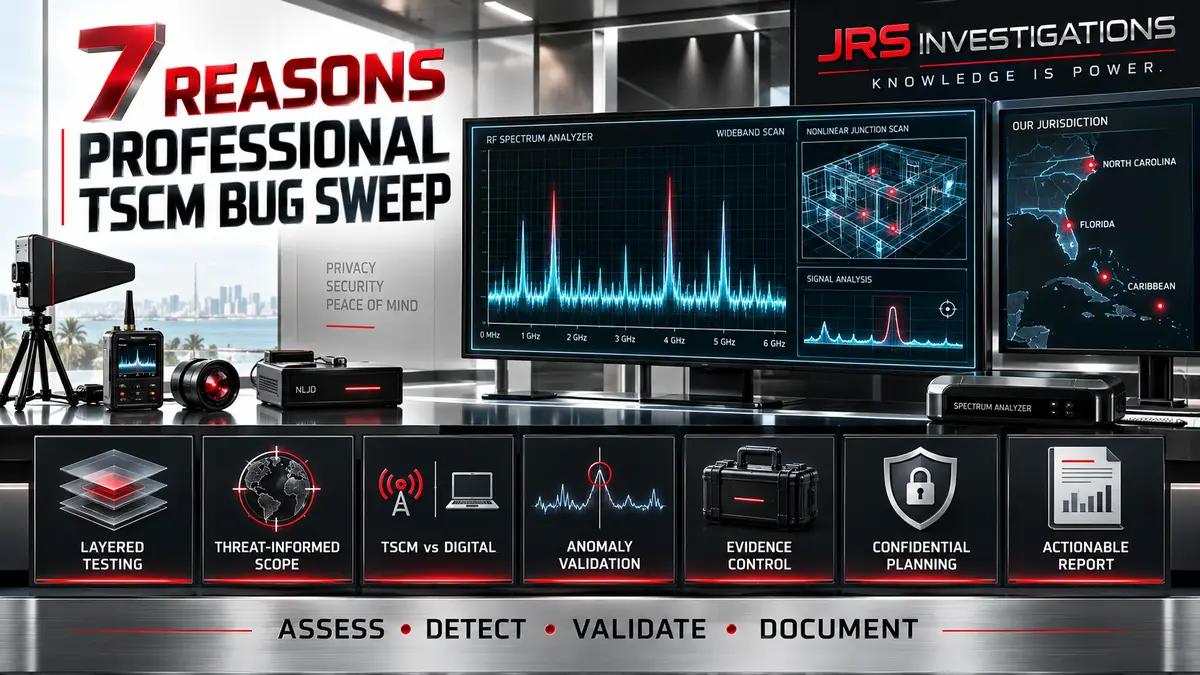
Professional TSCM Bug Sweep: 7 Reasons to Hire an Investigator
A professional technical surveillance countermeasures inspection is not a quick pass with a handheld detector. It is a planned examination of a defined environment, performed with the property owner or another authorized person, using several complementary methods. The goal is to identify and assess credible surveillance risks, document significant findings and help the client decide what to do next.
JRS Investigations provides counter-surveillance and debugging sweeps for authorized homes, offices, vehicles, vessels and temporary meeting spaces in Florida and selected Caribbean locations. The seven reasons below explain when a professional TSCM bug sweep offers more value than consumer gadgets or an improvised inspection.
What is a professional TSCM bug sweep?
TSCM is a structured search for technical surveillance risks. Depending on the agreed scope and conditions, an inspection may combine a visual and physical review, radio-frequency observations, electronic testing, inspection of relevant infrastructure and validation of anomalies. No single instrument can address every threat. Some devices transmit continuously, some transmit intermittently, some store information locally and some apparent “signals” are ordinary building or consumer electronics.
A responsible provider therefore defines the question before selecting tools. The inspection should be proportionate to the client’s lawful objective, the space, recent access, the information at risk and any operational constraints. A professional should also explain what the work does not cover. For example, a physical TSCM inspection is different from a forensic examination of a phone, computer, cloud account or enterprise network.
7 reasons to hire a professional for a TSCM sweep
1. A layered examination is stronger than a single detector
Consumer “bug detectors” often react to many ordinary radio sources. A professional approach uses different observations to test an anomaly from more than one direction. Equipment may assist with spectrum review, nonlinear-junction examination, lens or optical inspection, thermal observations, cable and infrastructure checks, and documentation. The exact toolset should follow the scope rather than serve as a marketing checklist.
Instrumentation still requires judgment. The operator must understand the environment, recognize expected devices, account for neighboring signals and distinguish a repeatable concern from harmless activity. Equipment does not guarantee detection, and a credible provider should never say that one sweep can prove a space is permanently secure.
2. The sweep begins with a threat-informed scope
A useful inspection starts with authority and context. Who owns or controls the location? Which rooms, vehicles or vessels may be examined? What confidential information is at risk? Who recently had legitimate access? Have contractors, guests, tenants, maintenance teams or vendors entered the space? Were there moves, renovations, storms or equipment changes?
These facts help prioritize time and testing. A boardroom used for a transaction has a different risk profile from an occupied residence, a vehicle, a marina berth or a hotel suite used for one meeting. A defined first phase also helps the client control cost and avoid a vague, open-ended engagement.
3. A professional separates TSCM from digital forensics
Many privacy concerns involve phones, computers, accounts, wireless networks or cloud services rather than a hidden physical device. A TSCM provider should recognize that distinction and avoid promising to solve every technical problem with the same sweep.
If the concern involves possible spyware, account access, message forwarding or device compromise, a qualified digital-forensics or cybersecurity specialist may be needed. If the concern involves a hidden camera, listening device, unfamiliar wiring, an unknown radio source or an unexplained physical change, TSCM may be appropriate. Some matters require coordinated but separate workstreams, with clear authorization and evidence controls for each.
4. Validation reduces false alarms and missed context
Modern homes and offices contain Wi-Fi access points, Bluetooth devices, building controls, smart televisions, security systems, chargers, sensors and neighboring transmitters. An unexplained signal is not automatically surveillance. Likewise, the absence of an obvious signal does not rule out every risk.
Professional value comes from establishing a baseline, correlating observations, testing repeatability and recording why an item was cleared, monitored or escalated. That process reduces unnecessary disruption and gives the client a reasoned basis for the next decision.
5. Evidence-conscious handling protects options
If an unusual device or component is found, impulsively removing, powering or publicizing it can change the facts. The safer response depends on the client’s authority, immediate safety, legal advice and whether law enforcement or counsel should be contacted.
A professional investigator can photograph the condition, record location and time, limit unnecessary handling and document the transfer or preservation steps used. That does not make evidence automatically admissible or determine who installed an item. Those are legal and investigative questions. It does, however, create a clearer factual record than an undocumented discovery.
6. Confidential planning limits unnecessary exposure
The inspection itself can reveal sensitive information: executive schedules, family concerns, litigation strategy, financial records, travel patterns or the existence of an internal inquiry. The provider should explain who will know about the engagement, who will attend, how findings will be communicated and how notes, images and reports will be stored.
Scheduling also matters. A discreet plan may require authorized after-hours access, coordination with a facilities representative, confirmation of ordinary equipment and control over who enters the area during testing. Confidentiality should be an operating practice, not a slogan.
7. The client receives findings and next actions
A useful TSCM report should identify the agreed scope, locations examined, relevant limitations, significant observations, items cleared or escalated and practical recommendations. Recommendations may include physical-security changes, access controls, inventory improvements, network or device review, follow-up monitoring or referral to counsel, law enforcement or a digital specialist.
The report should distinguish facts from interpretation. It should not identify a responsible person without sufficient evidence, promise a legal outcome or use dramatic language to compensate for uncertainty.
How JRS structures a TSCM inspection
- Confirm authority and objective. Identify the authorized client, the property or asset to be examined and the decision the inspection should support.
- Build the scope. List rooms, systems, vehicles or vessels, priorities, recent access and any known changes.
- Preserve the environment. Avoid unnecessary alterations before arrival and document time-sensitive conditions.
- Establish a baseline. Identify expected electronics, networks, building systems and surrounding radio activity.
- Conduct layered testing. Apply appropriate visual, physical and electronic methods to the defined scope.
- Validate anomalies. Correlate observations, test repeatability and classify items for clearance, monitoring or escalation.
- Document and remediate. Deliver factual findings, limitations and prioritized next steps.
Clients can review JRS private investigation services, coverage through our areas served page, and related local guidance for Orlando corporate TSCM, Satellite Beach TSCM and Fort Myers bug sweeps. For broader Brevard County casework, review our Satellite Beach private-investigator services and Palm Bay private-investigator services.
Situations that may justify a professional sweep
A sweep may be reasonable after unauthorized or poorly documented access to a sensitive area, a move or renovation, a change in occupancy, a high-confidentiality meeting, a dispute involving proprietary information, unexplained equipment changes or a credible disclosure of private conversations. It may also be part of a risk-based security program for executive offices, legal strategy rooms, deal teams or other environments where confidential discussions occur.
Ordinary electronic behavior is not proof of surveillance. Static, dropped calls, battery drain, warm devices, unfamiliar vehicles and isolated noises have many innocent explanations. The decision to inspect should be based on context, access and the consequences of exposure, not a viral checklist.
TSCM, tracking and privacy-law boundaries
A lawful engagement requires permission to inspect the relevant property and systems. Investigators do not obtain passwords, enter protected accounts, intercept communications or install tracking technology without appropriate legal authority. Florida’s communications-interception statute, tracking-device statute and video-voyeurism statute illustrate why authority and method must be addressed before work begins.
Private-investigation licensing is also jurisdiction-specific. Florida clients can review Chapter 493 and the Florida Department of Agriculture and Consumer Services licensing portal. For broader security planning, the NIST Cybersecurity Framework provides a useful risk-management structure. These sources are informational; clients should consult qualified counsel about their circumstances.
Questions to ask a TSCM provider
- Who will manage the matter, and who will perform the on-site inspection?
- What licensing or other credentials apply to this engagement?
- How will you define the scope and exclusions in writing?
- Which methods are relevant to this environment, and what are their limitations?
- How will you distinguish expected electronics from anomalies?
- What happens if a concerning item is found?
- How will photographs, notes, evidence and reports be protected?
- What is included in the fee, and who approves changes?
- Will the report separate observations, conclusions and recommendations?
- What follow-up or remediation support is available?
Be cautious of guaranteed detection, universal “military-grade” claims, fear-based sales tactics, a refusal to define scope, instructions to destroy or secretly move a device, or promises that findings will automatically be admissible in court.
How to prepare before the inspection
- Do not conduct a disruptive search or announce the planned sweep broadly.
- Preserve photographs, access logs, maintenance records and relevant timelines.
- List authorized occupants, recent visitors, contractors and equipment changes.
- Identify ordinary electronics and network equipment in the target area.
- Arrange lawful access to every agreed room, vehicle, vessel or system.
- Designate one decision-maker for scope, scheduling and change approvals.
- Tell the provider about immediate safety concerns before the appointment.
Frequently asked questions
Can a TSCM sweep find every surveillance device?
No responsible provider should guarantee that result. Detection depends on the device, operating state, environment, access, scope and methods. A layered inspection reduces uncertainty but does not eliminate it.
Does TSCM include checking a phone for spyware?
Not automatically. Phone, computer, account and cloud compromise usually require digital-forensics or cybersecurity work under a separate lawful scope.
Should I remove a suspicious device myself?
Pause before touching it unless immediate safety requires action. Photograph the condition if safe, restrict access and obtain guidance from the investigator, counsel or law enforcement as appropriate.
How often should a business schedule sweeps?
There is no universal interval. Frequency should reflect the sensitivity of information, access changes, travel, renovations, incidents and the consequences of exposure.
What should the final report contain?
At minimum, it should state the authorized scope, locations examined, material limitations, significant observations, items requiring follow-up and prioritized recommendations.
Request a confidential TSCM consultation
If you need a professional TSCM bug sweep for an authorized residence, office, vehicle, vessel or meeting location, contact JRS Investigations. Bring the location, access history, time window, information at risk and the specific decision you need the inspection to support.