(888) 737-7690

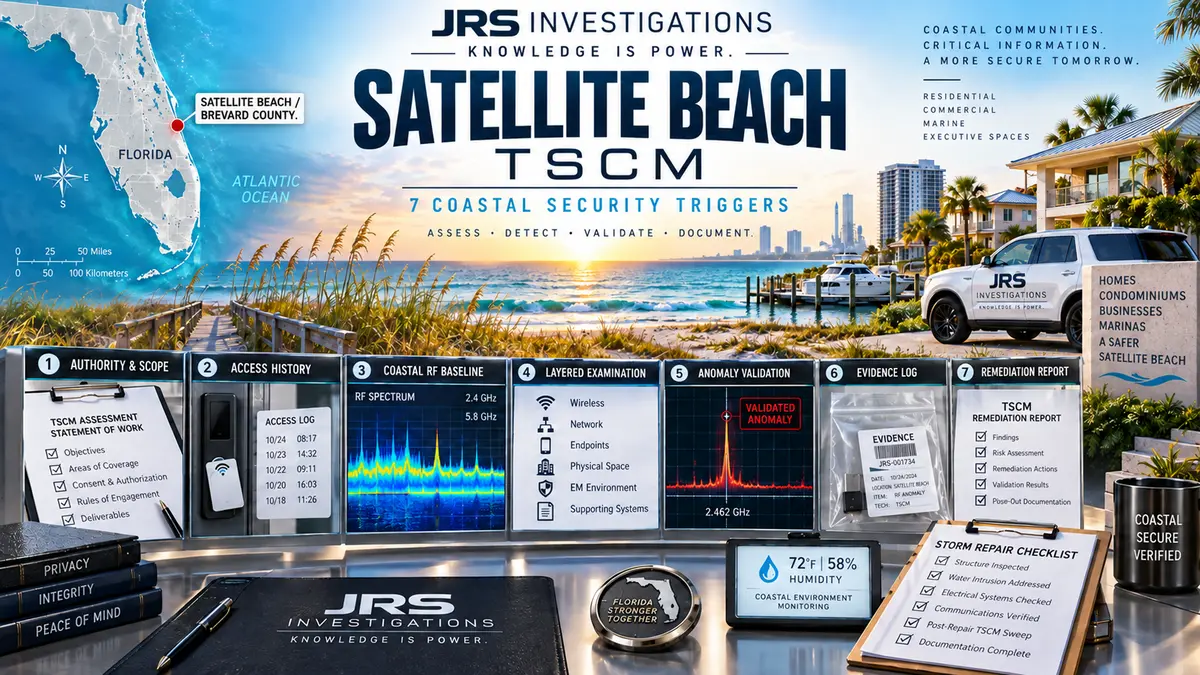
Satellite Beach TSCM Sweep: 7 Coastal Security Triggers
A Satellite Beach TSCM sweep should answer a defined security question—not simply produce a list of ordinary electronics. Technical surveillance countermeasures combine authority, threat assessment, environmental baselining, physical examination, spectrum analysis, network review where authorized, anomaly validation and documented remediation. The goal is to distinguish a credible technical concern from common interference, configuration problems and unsupported assumptions.
Satellite Beach presents a distinctive operating environment. Coastal residences, condominiums, home offices, short-term rentals, vehicles, vessels and nearby aerospace or technology workplaces can all have different access histories and risk profiles. Salt air, humidity, storm repairs, building density and a crowded radio-frequency environment may also affect equipment, signals and inspection planning. JRS Investigations scopes each assignment to the location, client authority and intended use of the findings.
If there is immediate danger, stalking, domestic violence or an active crime, contact law enforcement or an appropriate safety resource first. Do not remove, disable or confront anyone about a suspected device until safety, legal authority and evidence preservation have been considered.
Seven reasons to consider a professional Satellite Beach TSCM sweep
1. Sensitive information is appearing outside the expected group
A specific, repeated disclosure can justify a structured review, especially when it relates to legal strategy, executive decisions, pricing, intellectual property or private family matters. Begin by documenting exactly what information was exposed, who legitimately knew it, when it became known and what normal channels could explain the leak. A TSCM inspection is one part of that inquiry; access control, email, cloud sharing, visitors and ordinary conversation should also be reviewed.
2. A residence or office had substantial contractor access
Renovations, repairs, smart-home installations, cleaning, property management and post-storm restoration can create many legitimate changes to wiring, furniture, network equipment and device placement. That does not prove surveillance. It does mean the access timeline and environmental baseline may need to be rebuilt. Satellite Beach’s official post-disaster permitting information illustrates why repair and rebuilding activity can expand the number of people and systems entering a property after a major event.
3. Occupancy or access rights recently changed
A tenant turnover, separation, employee departure, management change or revoked vendor relationship may warrant a security review. The first steps are administrative: recover keys and credentials, update access lists, change authorized passwords, document returned assets and preserve relevant logs. A technical inspection can then address defined spaces or equipment with the property owner’s or authorized occupant’s written permission.
4. Confidential work is being performed from a coastal residence
Home offices may hold legal, financial, healthcare, aerospace, engineering or executive information alongside consumer smart devices and family networks. A defensible assessment separates physical-space questions from cybersecurity questions. TSCM can examine the authorized environment for technical anomalies; account security, endpoint compromise and cloud access may require a qualified digital-forensics or cybersecurity resource.
5. A vehicle or vessel is part of the concern
Vehicles and boats introduce changing locations, multiple operators, maintenance access, factory telematics, rental or fleet systems and strong background radio activity. Ownership and authority must be confirmed before inspection. Findings should distinguish built-in equipment and authorized accessories from unexplained modifications. Florida tracking law must be considered before any device or application is installed, used, removed or attributed.
6. A hotel, vacation rental or temporary meeting site will host sensitive activity
Short-term environments have access and configuration histories that the client may not control. The practical response is risk-based: minimize sensitive discussions, control documents, limit unnecessary devices, confirm meeting-room access and arrange an authorized pre-use assessment where appropriate. A sweep cannot certify a room as permanently “safe”; conditions can change after the inspection.
7. A recurring security program is justified
Organizations with repeated confidential meetings, executive travel, sensitive projects or high-consequence negotiations may need periodic inspections tied to events and access changes. The program should be integrated with physical security, visitor management, IT, offboarding and incident response. The CISA Insider Threat Mitigation Guide supports a broader, prevention-oriented approach rather than treating a technical sweep as a standalone control.
What a professional TSCM process includes
1. Authority, intake and threat-informed scope
The investigator confirms who controls the premises, vehicle, vessel, network segment or device and who may authorize inspection. The intake identifies the triggering facts, sensitive information, access history, relevant dates, known equipment, safety issues and intended use of the report. Scope should identify rooms, systems, vehicles and exclusions rather than promise to “check everything.”
2. Preservation and client instructions
The client should preserve suspicious messages, photographs, access logs, maintenance records and original files. Avoid mass-resetting devices or dismantling objects before the inspection unless safety requires it. If a suspected item is encountered, document its condition and location without unnecessary handling. Counsel or law enforcement may need to direct the next step.
3. Environmental and network baseline
Technicians document legitimate electronics, wireless networks, building systems and expected signal sources. In coastal Brevard County, neighboring residences, vehicles, marine communications, consumer devices and nearby infrastructure can contribute to a busy RF environment. A signal is not evidence by itself; context, behavior, direction, persistence and correlation matter.
4. Layered technical and physical examination
A professional inspection applies methods appropriate to the defined environment. These may include careful visual and physical examination, radio-frequency analysis, inspection of accessible infrastructure, nonlinear-junction detection or other specialist techniques, and an authorized review of relevant network information. No single instrument detects every possible technology.
5. Anomaly validation
Potential findings must be tested. A signal may come from ordinary Wi-Fi, Bluetooth, cellular, smart-home, security, vehicle or neighboring equipment. An unfamiliar object may be legitimate building hardware. The technician should seek corroboration before labeling an anomaly as a surveillance device or unauthorized system.
6. Evidence-conscious response
If a credible item is identified, the client should not automatically destroy or publicize it. The response may require scene documentation, photographs, identifiers, controlled packaging, chain-of-custody records and coordination with counsel or law enforcement. Safety and legal process determine whether the item is isolated, left in place or transferred.
7. Reporting and remediation
The report should state the authority, scope, date, methods, equipment categories, observations, validated findings, limitations and recommended actions. Remediation may include access changes, account security, device inventory, vendor review, physical repairs or a follow-up inspection. A negative result means no reportable device was identified within the agreed scope and conditions—not that surveillance is impossible.
Satellite Beach conditions that change the inspection
Salt, humidity and storm restoration
Corrosion, water intrusion, replaced materials, temporary wiring and repair work can create equipment faults and unfamiliar conditions. Inspection planning should include recent construction, storm damage, utility work, roofing, electrical, HVAC, communications and smart-home changes. These factors create false positives and legitimate access events that must be documented.
Condominiums and closely spaced properties
Shared walls, neighboring wireless networks, common building systems and association-controlled spaces complicate attribution. The client may authorize inspection of a unit but not a common area or another unit. Scope and reporting must respect those boundaries.
Home offices and sensitive regional work
People living in Satellite Beach may handle confidential work connected to many industries, including technology and aerospace. The inspection should be based on the client’s actual information, access and threat indicators—not a general assumption about the community. Technical findings should be integrated with document, visitor, identity and cybersecurity controls.
Vehicles, boats and marina access
Maintenance providers, detailing, valet, shared use, charter operations and manufacturer systems can all explain changes or signals. Accurate ownership records, access history and a list of authorized devices help the technician separate normal equipment from anomalies.
What TSCM does—and does not—cover
TSCM addresses technical surveillance risk in a defined, authorized environment. It does not automatically determine who installed a device, when it was placed, what data it collected or whether a crime occurred. It also does not replace digital forensics. Suspicious account logins, malware, cloud sharing, forwarded email or compromised credentials may require preservation and examination by a qualified digital specialist.
Consumer “bug detectors” can alert on ordinary radio traffic and create false confidence or unnecessary fear. Likewise, static on a call, battery drain, misplaced furniture or an unfamiliar vehicle is not reliable proof of surveillance. A professional assessment weighs specific facts and competing explanations.
For service context, review the JRS Satellite Beach TSCM service page, its broader counter-surveillance and bug-sweep service, the Satellite Beach private-investigator page, or the complete JRS investigation services overview.
Florida legal boundaries
Florida law affects how audio, video and location information may be collected. Section 934.03, Florida Statutes addresses interception and disclosure of wire, oral and electronic communications. Section 934.425 addresses installation of tracking devices or tracking applications, subject to its terms and exceptions. Section 810.145 addresses video voyeurism.
Private investigative work is regulated under Chapter 493. These laws are starting points, not case-specific advice. Ownership, consent, location, reasonable expectations of privacy, court orders and the type of technology can change the analysis. Confirm uncertain methods with Florida counsel.
How to prepare for the sweep
- Identify the exact property, rooms, vehicle, vessel or systems to be assessed.
- Confirm ownership or written authority for each part of the scope.
- Create a chronology of disclosures, access changes, repairs and suspicious events.
- List known wireless networks, smart-home devices, security systems and legitimate transmitters.
- Preserve original messages, photographs, logs and device information.
- Provide contractor, property-management and maintenance history.
- Avoid confronting a suspected person or broadly discussing the scheduled inspection.
- Ask what access, power, network information, parking and inspection time will be required.
Questions to ask a TSCM provider
- Who will perform the inspection, and what relevant training and Florida authority apply?
- How is scope tied to the stated threat and access history?
- Which method categories are appropriate, and what are their limitations?
- How will ordinary signals and legitimate devices be ruled out?
- What happens if a credible item is identified?
- What report, photographs and evidence records will the client receive?
- How are confidentiality, data retention, travel and follow-up handled?
Nearby operations can also be coordinated through JRS’s Cape Canaveral TSCM page and Cocoa Beach TSCM page.
Frequently asked questions
Can a TSCM sweep guarantee that a room is secure?
No. It assesses a defined place at a particular time using agreed methods. Conditions, devices and access can change afterward.
Should I remove a suspected device before the technician arrives?
Usually not without safety, legal and preservation guidance. Photograph and document what you observed, minimize handling and contact counsel or law enforcement when appropriate.
Does TSCM include phone or computer forensics?
Not automatically. Technical-space inspection and digital forensics are different scopes. Account, malware or device concerns may require a qualified digital examiner and a separate preservation plan.
How long does a Satellite Beach sweep take?
Timing depends on the size and complexity of the environment, access, known equipment, vehicles, network scope and anomalies requiring validation. A provider should estimate time only after intake.
When should a sweep be repeated?
Consider a risk-based follow-up after significant access changes, renovations, sensitive events, validated incidents or changes in the threat assessment. Routine frequency should be tied to actual risk.
Request a defined, evidence-conscious inspection
A professional Satellite Beach TSCM sweep begins with authority, specific facts and a scope that can be explained and verified. Contact JRS Investigations with the location type, triggering concern, access history and deadline so the appropriate first phase can be planned.