(888) 737-7690

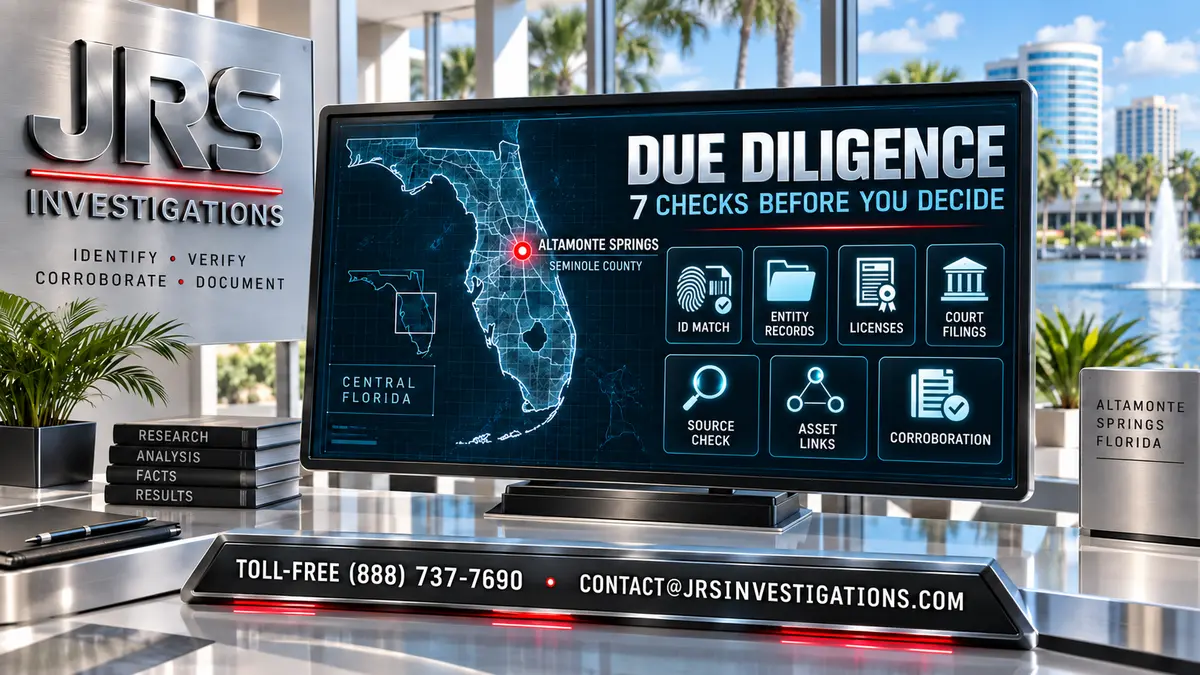
Altamonte Springs Due Diligence Investigator: 7 Checks
Altamonte Springs due diligence investigator services should help a client answer a defined business or legal question before money, authority, reputation or strategy is committed. JRS Investigations conducts lawful, scoped due diligence for companies, attorneys, investors, property interests and private clients in Altamonte Springs and throughout Seminole County. The goal is not to produce a dramatic dossier. It is to identify the correct subject, test important claims, document reliable sources and explain what remains unresolved.
Altamonte Springs sits inside the greater Orlando business corridor, where decisions frequently involve vendors, healthcare and professional-service firms, contractors, commercial property, key hires and regional partnerships. A subject may operate under several business names or across several jurisdictions. A disciplined review connects those records without pretending that one database contains the whole answer. For broader local support, review our Altamonte Springs private investigator services and our investigative services.
For a South Florida comparison, review our Weston due diligence investigation guide.
Seven due diligence checks to complete before a decision
1. Confirm the person, company and identifiers
The first question is whether the records actually belong to the intended subject. Similar names, former names, abbreviations, related companies and outdated addresses can produce false matches. JRS begins with identifiers the client can lawfully provide, then compares them with reliable records and source documents. For a business, that may include the exact legal name, document number, registered agent, managers, officers, filing history and known trade names. For an individual, the available identifiers depend on the assignment, consent, permissible purpose and applicable law. Correct identification prevents a fast search from becoming a confident mistake.
2. Map ownership, control and connected entities
A company’s public-facing name may not reveal who controls it, which entity signed a contract or how related organizations connect. The Florida Division of Corporations record search can show entity filings, officers, managers, registered agents and filed documents. Those records are a starting point, not proof that every listed relationship is current or complete. An investigation may compare filing dates, addresses, authorized representatives, related businesses and the documents supplied by the subject. The resulting entity map helps a client ask better questions about contracting authority, conflicts and responsibility.
3. Verify credentials, licenses and claimed experience
Resumes, proposals and biographies can compress dates, overstate responsibility or refer to credentials that cannot be confirmed. Depending on the engagement, JRS may verify employment or professional history through appropriate sources, examine licensing records, compare education claims with available confirmation methods and review whether a stated qualification applies to the work being offered. A missing online result does not automatically mean a claim is false, and a displayed certificate does not automatically prove it is current. Each material claim should be labeled verified, contradicted, unconfirmed or outside scope.
4. Review relevant court, lien and public-record history
Litigation and public records can reveal disputes, judgments, liens or patterns that deserve closer examination, but a name-only hit is not enough. The Seminole County Clerk court-record search and official-record systems may be relevant for local matters. Other counties, states or federal jurisdictions may also need review when the subject has operated elsewhere. JRS evaluates parties, case numbers, dates, dispositions and source documents so an allegation is not reported as a judgment and an unrelated person is not assigned to the subject.
5. Test reputation and adverse information
Search results, reviews and social posts can surface useful leads, but they also repeat rumors, duplicate syndicated stories and rank old information without context. A due diligence review should trace a material claim back to its original source, identify who published it, determine whether the subject match is sound and look for a response, correction or later disposition. When interviews are authorized and appropriate, the investigator should document who was contacted and separate firsthand knowledge from opinion. The report should make clear which reputational issues are supported and which remain unverified.
6. Examine financial and asset claims within lawful limits
A client may need to understand whether visible ownership, property interests or business filings support a subject’s representations. Public records and client-provided documents may help identify real property, corporate interests, liens, judgments or transaction relationships. This is not a promise to reveal secret bank balances or gain access to protected financial accounts. Asset-related work must stay within lawful sources, authorization and a defined purpose. If ownership questions are central to the decision, see JRS Investigations’ hidden asset investigation services.
7. Identify conflicts, gaps and facts requiring corroboration
The most valuable result is often not a single negative record but a conflict between documents, dates, addresses or explanations. A company may list different principals across filings; a proposed vendor may describe experience that predates its formation; or a subject may omit a related entity that appears in litigation. JRS builds a timeline and source matrix so those discrepancies can be tested. Some gaps will have reasonable explanations. Others may justify additional documents, an interview, counsel review or a decision not to proceed. The report should support judgment, not replace it.
When Altamonte Springs clients use due diligence
Vendor and contractor onboarding: Confirm the contracting entity, decision-makers, licensing, relevant disputes and the experience represented in a proposal before access, payment or sensitive information is provided.
Executive and key-position review: Verify material credentials and employment claims while following the rules that apply to the contemplated use. Employment screening carries requirements that do not apply to every commercial investigation.
Partnerships and transactions: Map ownership and control, examine significant public-record issues, test representations and identify unanswered questions before a joint venture, acquisition or investment moves forward.
Litigation support: Help counsel identify entities, addresses, relationships, assets or source records relevant to pleadings, discovery, settlement or enforcement strategy. The investigative scope should be coordinated with counsel.
Commercial property and private wealth matters: Clarify entity relationships, contractors, counterparties and recorded interests connected to a proposed deal or dispute. An investigation does not substitute for a title search, appraisal, audit or legal opinion.
How a professional due diligence investigation works
- Define the decision. Identify what the client is deciding, the deadline, the material claims and the level of risk.
- Confirm authority and permissible purpose. Determine what information may lawfully be obtained and how the final report will be used.
- Identify the subject precisely. Resolve names, aliases, entities, addresses and jurisdictions before searching broadly.
- Build a source plan. Select official records, primary documents, appropriate databases and authorized interviews that match the question.
- Collect and preserve. Record source locations, dates, identifiers and relevant documents so important findings can be retraced.
- Corroborate. Compare material facts across independent sources and investigate conflicts instead of reporting the first match.
- Report findings and limitations. Separate verified facts, indicators, unresolved items and recommendations in a decision-ready format.
Clients preparing to retain an investigator can also use our 17 questions to ask before hiring a private investigator to compare scope, licensing, methods, communication and reporting.
Records do not interpret themselves
Public databases are essential, but every record has limits. A corporate filing reflects information submitted at a point in time. A court docket may show that a case exists without explaining the underlying evidence. A property record may identify a titled owner without establishing beneficial control. A news article may accurately describe an allegation but predate the final disposition. The work is to connect the right record to the right subject, understand what the source proves and avoid stretching it beyond its meaning.
That is why JRS uses a source-conscious process. A useful report shows the route from claim to record to conclusion. It also flags inconsistencies and missing information so the client can decide whether additional investigation is proportionate. For an overview of related capabilities across the state, see 10 private investigation services JRS provides in Florida.
Legal and privacy boundaries
Florida regulates private investigative agencies and investigators. The Florida Department of Agriculture and Consumer Services licensing page explains the state’s private-investigation license categories. A client should verify the agency, identify who will perform the work and obtain a written scope.
Employment, housing, credit and insurance decisions can trigger specialized rules. When a third party provides a consumer report for employment purposes, the Fair Credit Reporting Act and federal anti-discrimination laws may govern notice, authorization, use and adverse-action procedures. The EEOC and FTC employer guidance on background checks summarizes important federal requirements. Clients should consult qualified counsel about their specific use.
Due diligence does not authorize pretexting, trespass, unlawful account access, acquisition of protected records without authority or misrepresentation of findings. JRS defines lawful collection methods at the start and reports source limitations. No legitimate investigation can guarantee that every relevant fact exists in an accessible record.
What to provide at the start
- The decision, transaction or dispute the report must support.
- Correct names, known aliases, company names and available identifiers.
- Documents, resumes, proposals or representations that need verification.
- Known locations and jurisdictions connected to the subject.
- The deadline and any scheduled closing, hearing or onboarding date.
- Counsel contact information when the assignment is litigation-related.
- The intended use of the findings and any consent already obtained.
A focused intake reduces irrelevant searching and directs effort toward the facts that could change the client’s decision. It also helps establish whether a background check, asset investigation, records review, interview program or another service is the appropriate tool.
Frequently asked questions
Is due diligence the same as a background check?
No. A background check may be one part of due diligence. Due diligence is built around a transaction, relationship or decision and may include entity mapping, claim verification, litigation review, licensing, reputation, assets, interviews and other sources appropriate to the scope.
Can an investigation confirm that a company has no risk?
No. The work can identify and evaluate information available within the authorized scope, but it cannot eliminate all uncertainty. A professional report states what was searched, what was found and the limits of the available evidence.
How quickly can JRS complete a review?
Timing depends on the number of subjects and jurisdictions, record availability, the depth of verification and whether interviews or source documents are required. A narrow preliminary review may move faster than a multi-state corporate inquiry. JRS defines priorities and reporting stages during intake.
Can JRS investigate a potential vendor or business partner?
Yes, when the client has a lawful purpose and the requested methods fit the assignment. The review can focus on the contracting entity, control, credentials, public-record history, material representations and related parties.
Will the subject know about the investigation?
That depends on the scope and applicable law. Some verifications or interviews require direct contact, consent or notice; other public-record research may not. JRS discusses confidentiality, contact strategy and legal requirements before work begins.
Request an Altamonte Springs due diligence consultation
Before approving a vendor, partnership, key appointment, transaction or litigation strategy, contact JRS Investigations to define the decision and the facts that require verification. Call (888) 737-7690 or email contact@jrsinvestigations.com. You can also review our Altamonte Springs investigator hiring guide.
Identify. Verify. Corroborate. Document. Knowledge is power when the decision is built on traceable facts.
JRS Investigations in Altamonte Springs: Altamonte Springs TSCM bug sweeps