(888) 737-7690
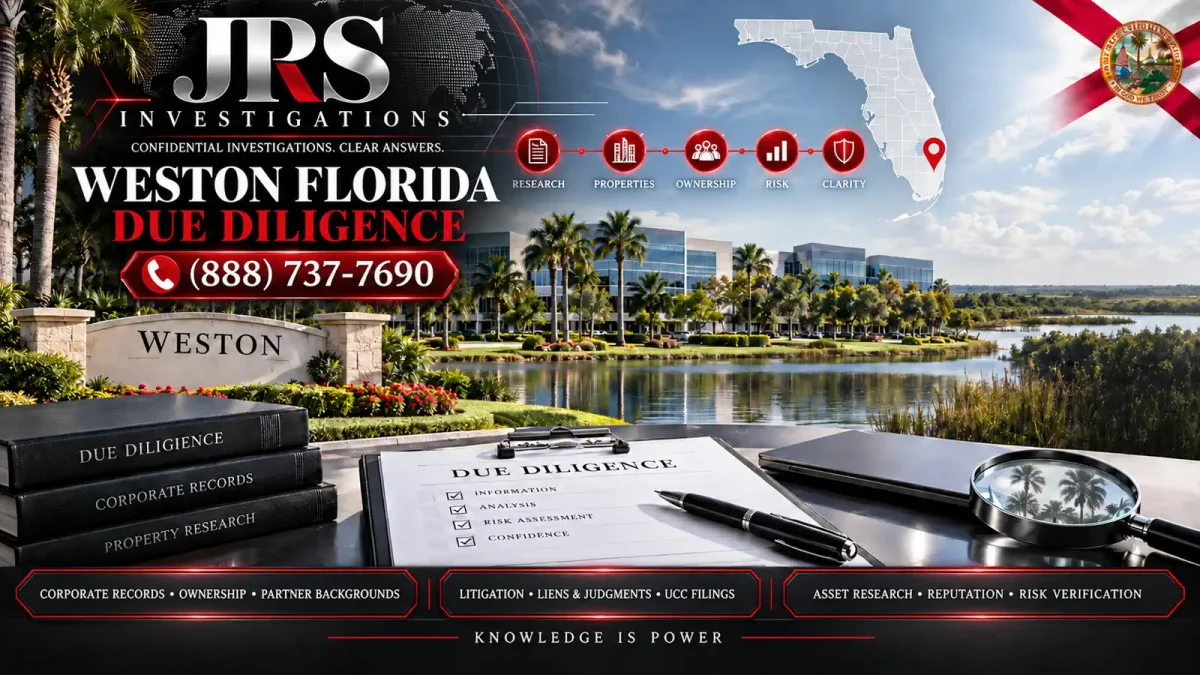
Weston Due Diligence Investigations: Verify Before You Commit
Weston due diligence investigations help decision-makers verify the people, companies, assets, disputes, and representations behind a proposed transaction. JRS Investigations supports business owners, investors, attorneys, lenders, insurers, and private clients with lawful fact development in Weston, Broward County, and connected jurisdictions. The goal is not to create the largest possible file. It is to identify the facts that could change the decision before money, access, reputation, or legal exposure is committed.
A useful due diligence investigation goes beyond a quick database search. It resolves identities, compares statements with source records, follows ownership and management history, reviews relevant litigation and liens, and documents what could not be independently confirmed. JRS separates verified facts, reported information, and investigative analysis so the client and counsel can evaluate risk without mistaking an allegation or name match for proof.
When is a Weston due diligence investigation useful?
Due diligence can be appropriate before acquiring a company, investing in a private venture, selecting a business partner, extending substantial credit, hiring a key executive, retaining a sensitive vendor, purchasing valuable property, or entering a relationship in which another person will control funds or confidential information. It may also be used after inconsistencies emerge, provided the investigation has a lawful purpose.
Weston transactions often connect to Fort Lauderdale, Miami, Palm Beach County, other states, or offshore entities. A local address is only a starting point. JRS develops the subject’s identifiers and relevant connections first, then selects records and fieldwork based on the client’s actual decision. Clients who need broader local coverage can review our Weston private-investigator services.
Eight areas JRS can examine
1. Identity and name resolution
Common names, aliases, prior addresses, spelling variations, and similarly named companies can create false matches. JRS compares available identifiers before attributing a record to a person or entity. A responsible report explains why a match is believed to be the same subject and flags unresolved identity issues. Our background-check services provide additional detail about verification and permissible-use limits.
2. Corporate records and ownership history
We can review formation documents, annual filings, registered agents, managers, officers, authorized persons, status changes, mergers, and connected entities. The Florida Department of State provides the official Sunbiz search records. A filing is evidence of what was submitted to the state on a particular date; it does not by itself prove current beneficial ownership, financial strength, operational activity, or the truth of every representation. JRS compares filings across time and jurisdictions and looks for unexplained changes or relationships.
3. Litigation, bankruptcy, and regulatory history
Civil lawsuits, criminal matters, bankruptcies, administrative actions, and professional discipline may reveal disputes or patterns relevant to the proposed transaction. JRS can review the Broward County Clerk public case search and, when relevant, the federal courts’ PACER case resources. We read the docket and material documents rather than treating the existence of a case as proof of wrongdoing. Dismissals, outcomes, dates, parties, and the subject’s role matter.
4. Liens, judgments, and secured interests
Judgment liens, tax liens, UCC financing statements, and related filings may affect a company’s assets or indicate creditor claims. Florida’s Division of Corporations directs users to the state’s UCC filing and search resources. A UCC filing can provide a lead, but the underlying obligation, collateral, amendments, continuation, termination, and current legal effect require context. JRS documents the filing and refers legal conclusions about priority or enforceability to counsel.
5. Property and asset leads
Property records, deeds, mortgages, corporate interests, vehicles, vessels, and other lawful asset indicators can help test representations about ownership or financial position. The Broward County Property Appraiser offers official property-search tools. JRS can organize ownership history and connected names, but an assessor record is not a complete title opinion, valuation, or guarantee that an asset is available to satisfy a claim. Our record-search and asset-research services explain this evidence-led approach.
6. Professional and investment backgrounds
When a subject claims licenses, credentials, investment experience, or authority to handle funds, we can identify the appropriate issuing body and compare the representation with available records. For securities professionals, FINRA BrokerCheck provides employment, registration, qualification, and disclosure information. A clean search is not a guarantee of future conduct, and the correct regulator depends on the activity and jurisdiction.
7. Reputation and reference development
Online reviews and social posts can be useful leads, but they can be incomplete, manipulated, or unrelated to the correct person. When appropriate, JRS can seek voluntary interviews with former associates, vendors, clients, neighbors, or industry contacts. We attribute each statement, distinguish firsthand knowledge from rumor, and report meaningful conflicts rather than presenting reputation as a popularity score.
8. Lawful field verification
Public records do not always show whether a business operates at a claimed location, whether stated activity occurs, or whether people and assets are connected as represented. A lawful field visit or limited surveillance assignment may help confirm observable facts. JRS does not trespass, enter private systems, or use prohibited interception methods. See our surveillance investigation services for the documentation standards used in field assignments.
Due diligence for a business, partner, or investment
Company acquisition or private investment
The investigative scope can compare the seller’s or promoter’s narrative with corporate filings, litigation, property, secured interests, professional history, operating locations, and connected entities. Financial statements, tax returns, bank statements, customer lists, and contracts are private records and should be reviewed only when the client lawfully possesses them, the owner authorizes disclosure, or counsel obtains them through proper legal process. JRS does not promise access to private accounts.
Prospective business partner
A partner review may focus on identity, prior ventures, ownership disputes, bankruptcies, material lawsuits, credentials, conflicts of interest, and references. The question is not whether the person has ever faced a dispute; it is whether the verified history is consistent with the proposed role, representations, and risk tolerance.
Vendor, contractor, or key employee
High-trust roles may justify verification of experience, licenses, company status, litigation, sanctions, and references. Employment background checks using a consumer-reporting company can trigger Fair Credit Reporting Act requirements. The Federal Trade Commission’s employment background-check guidance explains written-permission and notice requirements. Clients should have counsel confirm the permissible purpose, authorization, notices, and any state or local requirements before ordering or using a consumer report.
For related examples, see our guide to background investigations in Boca Raton.
What a records search can and cannot prove
Records are strongest when the correct person or entity has been identified, the relevant jurisdiction has been searched, and the underlying document has been reviewed. A database summary may omit recent filings, sealed matters, images, dispositions, or records maintained under another name. An absence of results is not proof that no event occurred.
JRS records the source, search date, identifiers used, jurisdiction, limitations, and whether the result was independently corroborated. We do not label an allegation as a fact, treat an arrest as a conviction, or assume that a company officer listed years ago remains in control today. When a decision depends on legal ownership, title, enforceability, tax treatment, or financial valuation, the appropriate attorney, title professional, accountant, or financial adviser should make that determination.
Red flags that may require deeper review
- Names, dates, addresses, or ownership percentages that change across documents.
- Recently formed entities presented as long-established operations.
- Frequent changes in managers, registered agents, addresses, or related companies.
- Claims of professional authority that cannot be confirmed with the issuing body.
- Undisclosed litigation, liens, bankruptcies, regulatory matters, or business failures.
- Assets or offices described as owned when records indicate a lease, third party, or different entity.
- Pressure to skip verification, wire funds quickly, or rely on screenshots instead of source documents.
- References that cannot explain how they know the subject or that repeat identical promotional language.
A red flag is a reason to ask a better question, not an automatic finding of fraud. When evidence suggests intentional misrepresentation or diversion, our fraud investigation services may support a focused next phase.
How JRS scopes a Weston due diligence assignment
Phase 1: Decision and subject definition
We identify the contemplated decision, amount or exposure, deadline, subjects, jurisdictions, known identifiers, documents already obtained, and the specific representations that matter. This prevents a broad background search from replacing a decision-focused investigation.
Phase 2: Priority record verification
JRS searches the records most likely to change the decision—often corporate history, litigation, bankruptcy, professional credentials, property, liens, secured interests, and connected entities. We document both findings and material gaps.
Phase 3: Corroboration and fieldwork
If records raise questions, the client may authorize source-document retrieval, reference interviews, business-location verification, or limited lawful surveillance. The phase is narrowed to the unresolved issue rather than expanding automatically.
Phase 4: Written risk report
The report organizes verified facts, source records, statements, conflicts, limitations, and questions for counsel or the decision-maker. It does not make the investment or legal decision for the client. A phased structure lets the client review the value of the initial findings before committing to broader work.
Our complete private investigation services and guide to JRS investigation services in Florida provide additional scope examples.
Frequently asked questions
Can due diligence guarantee that a transaction is safe?
No. An investigation can reduce uncertainty and identify inconsistencies, but no search can guarantee future conduct, financial performance, recovery, or the absence of undisclosed information. The client should combine investigative findings with legal, financial, tax, insurance, and industry review.
Can JRS obtain private bank or tax records?
Not without lawful authority. Private financial records generally require the owner’s consent, the client’s lawful possession, or valid legal process. JRS does not hack accounts, misrepresent identity, buy unlawfully obtained data, or guarantee access to private records.
Does a Sunbiz record prove who owns the company?
Not necessarily. Florida filings identify information submitted to the state, such as status, registered agent, and listed managers or officers. They may not show every beneficial owner, current operational relationship, or private ownership agreement. The filing is one source to be compared with other evidence.
How quickly can a Weston investigation begin?
Timing depends on urgency, number of subjects and jurisdictions, court-document availability, record volume, interviews, and fieldwork. JRS can identify time-sensitive priorities during the initial assessment and propose a focused first phase.
Request a confidential Weston due diligence review
Prepare the subject’s full legal name, company names, known addresses, websites, phone numbers, proposed role, transaction documents, amount or exposure, deadline, and the representations you need verified. JRS will identify the appropriate public sources, permissible investigative methods, and a proportionate first phase.
Knowledge is power. Contact JRS Investigations or call (888) 737-7690 for a confidential consultation.