(888) 737-7690

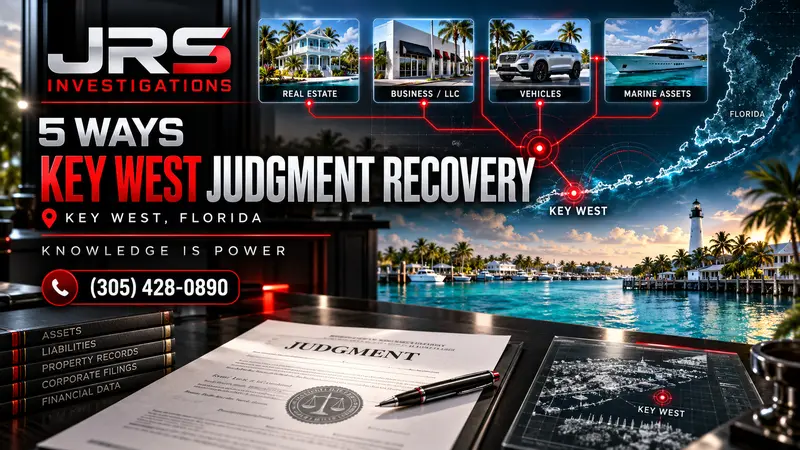
5 Ways a Key West Judgment Recovery Investigation Can Help
Winning a money judgment and collecting it are different stages. When a judgment debtor cannot be located, gives incomplete information, or appears to have shifted property or business activity, a Key West judgment recovery investigation can help organize lawful, verifiable facts for the creditor and legal counsel.
A private investigator does not issue a levy, garnish wages, freeze an account, or decide whether property can be seized. Those are legal and court-directed steps. The investigator’s role is to identify leads, verify ownership and location information, document connections, and present findings that an attorney can evaluate.
For a Caribbean-jurisdiction comparison, review our Saint John judgment-recovery and asset-research guide.
1. Locate and verify the judgment debtor
A useful investigation begins by confirming that the correct individual or business has been identified. Depending on the authorized scope, this may include reviewing address history, property records, business filings, professional records, litigation records, lawful database results, and other reliable sources.
In Key West and the Florida Keys, a person may use a seasonal residence, mailing address, registered agent, marina, business location, or property outside Monroe County. A credible location should be supported by more than one source whenever possible.
2. Identify real property and business interests
Public records may connect a judgment debtor to real estate, corporations, limited liability companies, assumed names, licenses, liens, or other ownership interests. The goal is not to assume that every connected asset is available for collection. It is to document the ownership trail accurately enough for counsel to determine what may be relevant.
Investigators may also compare names, addresses, officers, registered agents, and filing histories to distinguish a genuine connection from a person or entity with a similar name.
3. Trace transfers and ownership relationships
Changes made before or after litigation can deserve closer review. These may include property transfers, newly formed entities, changes in company leadership, or assets placed in the name of a relative or associate.
A transfer is not automatically fraudulent, and an investigator should not label it that way without legal support. The investigator can build a dated, source-based chronology; an attorney can then assess whether the facts justify discovery, supplementary proceedings, or another lawful remedy.
4. Document employment, income indicators, and high-value property
Depending on the case and lawful access, an investigation may help verify employment, business activity, vehicles, vessels, real estate, or other observable indicators that warrant further legal inquiry. In the Keys, boats, marine businesses, vacation-rental interests, and property held through entities may be relevant to the factual picture.
Private investigators do not have unrestricted access to a person’s bank, brokerage, tax, credit, or cryptocurrency records. Any nonpublic financial information must be obtained through lawful authority, consent, permissible-purpose access, discovery, subpoena, or another process directed by counsel.
5. Turn scattered leads into an actionable report
The most useful result is not a long list of unverified names. It is a clear report that separates confirmed facts, reasonable connections, unresolved leads, and limitations. Supporting material may include record citations, filing details, timelines, photographs obtained lawfully, address verification, and entity-relationship notes.
Counsel can use that organized information to decide whether additional discovery or enforcement is appropriate. Florida’s Chapter 56 procedures govern aspects of execution and proceedings supplementary, but the correct remedy depends on the judgment, exemptions, ownership, jurisdiction, and case-specific facts.
What to prepare before a Key West judgment recovery investigation
- A certified or complete copy of the judgment and any assignments
- The debtor’s full legal name, known aliases, date of birth, and entity names
- Last-known addresses, phone numbers, email addresses, and employers
- Prior discovery responses, payment records, contracts, and correspondence
- Known property, vehicles, vessels, businesses, associates, and transfers
- Your attorney’s contact information and the legal questions the investigation should support
Do not trespass, impersonate another person, attempt unauthorized account access, or contact the debtor in a way that could create legal or safety problems. Preserve existing records and coordinate enforcement decisions with a qualified attorney.
Key West judgment recovery resources
Learn more about JRS Investigations’ judgment recovery investigations, hidden asset investigations, and Florida record-search services.
For local support, visit our Key West private investigator and Florida Keys investigation pages. You can also review our related guide to judgment recovery investigations in Florida.
Discuss the judgment and investigation scope
To discuss the debtor information, known assets, jurisdiction, and the reporting your attorney may need, call JRS Investigations at (305) 428-0890 or contact us online. Knowledge is power, and effective judgment recovery starts with accurate, lawfully obtained information.
JRS Investigations in Key West: Key West TSCM bug sweeps