(888) 737-7690
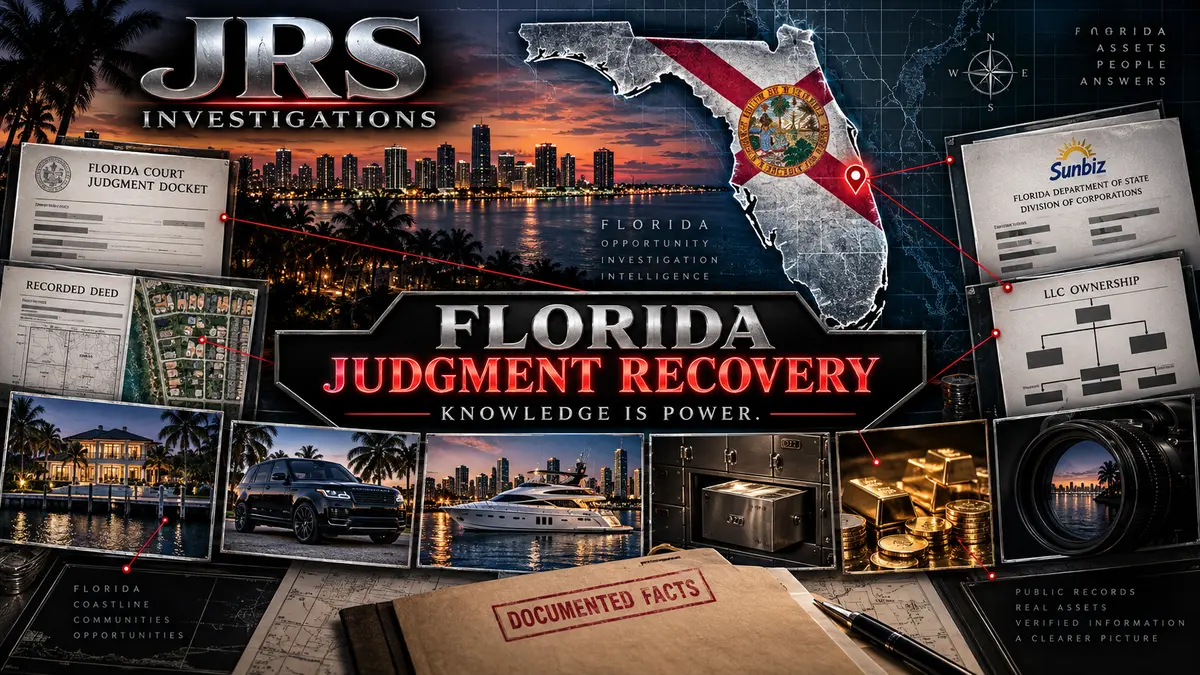
Florida Judgment Recovery Investigations: 7 Services
A Florida money judgment confirms a legal obligation, but it does not automatically identify useful assets or complete the enforcement process. A Florida judgment recovery investigator can help a creditor or attorney develop verified facts about identities, addresses, property, companies and observable business activity. JRS Investigations performs lawful public-record research, open-source analysis, field verification and organized reporting throughout Florida.
JRS is an investigative agency, not a law firm or collection agency. We do not levy property, garnish wages, freeze accounts, file liens, issue subpoenas or guarantee that a judgment will be recovered. Those decisions and procedures belong with licensed counsel, the courts, clerks, sheriffs and other authorized institutions. Our job is to locate and document information that can support an informed legal strategy.
For a confidential case review, contact JRS Investigations or call 1-888-737-7690. You can also review our complete private investigation services.
Why Florida judgment recovery starts with accurate intelligence
Florida matters can cross multiple counties and ownership structures. A person may reside in Palm Beach County, own property in Broward or Miami-Dade, operate a company registered in Tallahassee, and keep a vessel or equipment at another location. A mailing address, registered office, homestead address and business location may all be different. Similar names and outdated databases create additional risk.
Effective investigation begins with the exact judgment debtor, the correct legal entity, the court case and a defined objective. It then follows corroborated connections instead of assuming every shared address or surname proves ownership. That discipline protects the client from spending time on unrelated people, exempt property or assets already burdened by liens.
Seven investigative services that may support a Florida judgment
1. Judgment, docket and public lien verification
We begin by organizing the judgment information available to the client: court, case number, debtor and creditor names, judgment date, amount, known filings and related cases. Public docket research may reveal name variants, addresses, counsel, related litigation and procedural events that help define the investigation. We label what the record states and avoid legal conclusions about enforceability.
Chapter 55 of the Florida Statutes addresses judgments, judgment liens and related procedures. The Florida Department of State also explains that judgment liens on personal property are filed with the Department as public notice. Counsel must determine the legal effect, duration, priority and next procedural step.
2. Identity, address and association development
Records research is only useful when it is tied to the right subject. JRS can compare lawful public and commercially available information for full names, aliases, age indicators where permitted, former and current addresses, telephone references, business connections and other corroborating details. Conflicting identifiers are reported as conflicts, not forced into a convenient answer.
This process can reveal a county that was not included in the original assignment, a company connected to a residential address or a former name appearing in recorded documents. It may also eliminate a false lead belonging to someone with a similar name. Our background investigation services apply the same identity-resolution standards.
3. Real-property and recorded-instrument research
Florida real estate may include a primary residence, condominium, rental property, vacant land, commercial space or an interest held through an entity or trust. Depending on the county, JRS may examine tax-parcel information, deeds, mortgages, satisfactions, assignments, notices and other publicly available recorded instruments. The purpose is to identify ownership and relationship leads for legal review.
A property record does not establish collectible equity. Market value, mortgages, association liens, tax obligations, co-ownership and exemptions can materially change the picture. The Florida Court Clerks & Comptrollers directory helps identify the appropriate county clerk, but counsel should evaluate which official record and remedy applies.
4. Company, UCC and ownership research
A judgment debtor may be connected to corporations, LLCs, partnerships, fictitious names, professional entities or holding companies. JRS can research public filings for formation dates, status, officers or managers where shown, registered agents, principal addresses and document history. We compare those results with property, websites, licensing records and other lawful sources.
The Division of Corporations describes Sunbiz as Florida’s official business-entity index and commercial-activity website. A filing is a lead, not automatic proof that an individual beneficially owns every company asset. JRS can build an entity-and-address chart that distinguishes confirmed records, probable associations and unresolved questions.
5. Vehicle, vessel and high-value asset leads
Vehicles, boats, aircraft interests, construction equipment, inventory and other high-value property may produce useful investigative leads when they can be researched or observed lawfully. JRS does not obtain restricted motor-vehicle, banking, credit, tax or account information without a permissible purpose and proper authorization. We do not use impersonation, pretexting or unauthorized access.
When fieldwork is appropriate, an investigator may document a visible registration number, business name, location, condition or apparent use from a lawful public vantage point. Vessel and corporate associations often require comparison across multiple sources. Our hidden asset investigations focus on corroborated ownership evidence rather than speculation.
6. Lawful field verification and surveillance
Online records can be incomplete or outdated. A focused field assignment may help determine whether an address exists, whether a business appears active, what public signage is present, or whether selected assets and activity are observable at a location. Florida assignments require careful planning around private property, gated communities, access restrictions and the legitimate purpose of the investigation.
JRS does not trespass, harass a subject or misrepresent government authority. Photographs and observations are collected only from places where the investigator may lawfully be. Any continuing observation must have a defined objective and proportionate scope. Our surveillance investigators document time, location and directly observed activity without embellishment.
7. Evidence organization and counsel-ready reporting
Useful judgment research is more than a database dump. JRS organizes findings by subject, asset category, county, source, date and confidence level. A report can include a concise summary, property-lead table, company relationship chart, public-record references, relevant screenshots, field photographs, observed activity and unresolved conflicts.
Confirmed facts are separated from associations and investigative leads. Each important conclusion identifies its source and limitation so counsel can decide whether further discovery, verification or legal process is appropriate. Our judgment recovery investigation service is designed to improve the factual foundation without blurring the line between investigation and enforcement.
Florida exemptions and legal limits matter
Locating an asset does not mean that it is available to satisfy a judgment. Ownership, equity, lien priority, tenancy, statutory protection and due process can affect what happens next. Florida’s Chapter 222 addresses homestead and exemptions, including wage, insurance, retirement and personal-property provisions. Florida constitutional homestead protection can also be significant.
An investigator should not tell a creditor that identified property is collectible or nonexempt. JRS reports the record, connection and observed facts. The client’s attorney analyzes exemptions, fraudulent-transfer issues, lien priority, proceedings supplementary, discovery in aid of execution and other available remedies.
JRS does not contact a debtor to demand payment or negotiate a settlement. Collection communications can create separate legal obligations. The Consumer Financial Protection Bureau provides current federal consumer information on debt collection.
How JRS conducts a Florida judgment investigation
- Scope and conflict review: We identify the client, judgment, exact subjects, known entities, counties and expected use of the report.
- Source plan: We select relevant court, lien, property, company, licensing, open-source and authorized commercial sources.
- Identity resolution: We compare identifiers and separate the intended debtor from people or entities with similar names.
- Relationship mapping: We connect addresses, companies, properties and observable assets while labeling the strength of each connection.
- Field verification: When justified, we test defined leads through lawful observation and documentation.
- Corroboration: Important findings are compared across more than one reliable source whenever practical.
- Reporting: We deliver a clear factual package with source dates, limitations and recommended investigative follow-up.
Florida private investigators are regulated under Chapter 493 of the Florida Statutes. JRS applies licensed-investigation standards, confidentiality controls and a defined lawful purpose to every assignment.
What to provide when opening a case
Helpful intake material includes the judgment or case number, exact legal names, known aliases, date-of-birth information when lawfully held, addresses, telephone numbers, email addresses, company names, suspected properties or assets, prior research and the attorney’s contact information. Explain which identifiers are confirmed and where each one came from.
Define the immediate question. Locating a current address, checking Florida real-property leads, mapping company relationships and documenting business activity require different source plans. A clear objective makes the investigation more efficient and the report more useful.
If the matter reaches beyond Florida, JRS can coordinate research through its international asset investigations practice. Cross-border records and remedies require separate jurisdiction-specific analysis.
Frequently asked questions
Can JRS collect the judgment for me?
No. JRS investigates identities, public records, relationships, property and selected observable facts. Attorneys and authorized legal institutions handle collection and enforcement procedures.
Can you guarantee that assets will be found or recovered?
No. Results depend on available records, correct identifiers, ownership structures, exemptions, liens and facts outside an investigator’s control. No ethical investigator can guarantee recovery.
Can JRS locate bank accounts?
JRS does not obtain protected banking information through pretexting, impersonation or unauthorized account access. We can develop lawful public-record and open-source leads and coordinate with counsel regarding information that may require formal legal process.
Do you investigate throughout Florida?
Yes. JRS handles assignments throughout Florida, with the scope, counties, travel and field requirements confirmed during intake.
How long does the investigation take?
Timing depends on the number of subjects, counties, companies, record systems and field tasks. JRS defines an initial phase and reports material developments instead of promising an arbitrary result date.
Start with verified facts
JRS Investigations helps creditors, businesses and counsel replace assumptions with documented information. We can verify identities, examine public judgment and lien records, develop property and company leads, conduct targeted fieldwork and organize the evidence for legal review.
Request a confidential Florida judgment-recovery consultation or call 1-888-737-7690. Knowledge is power.