(888) 737-7690

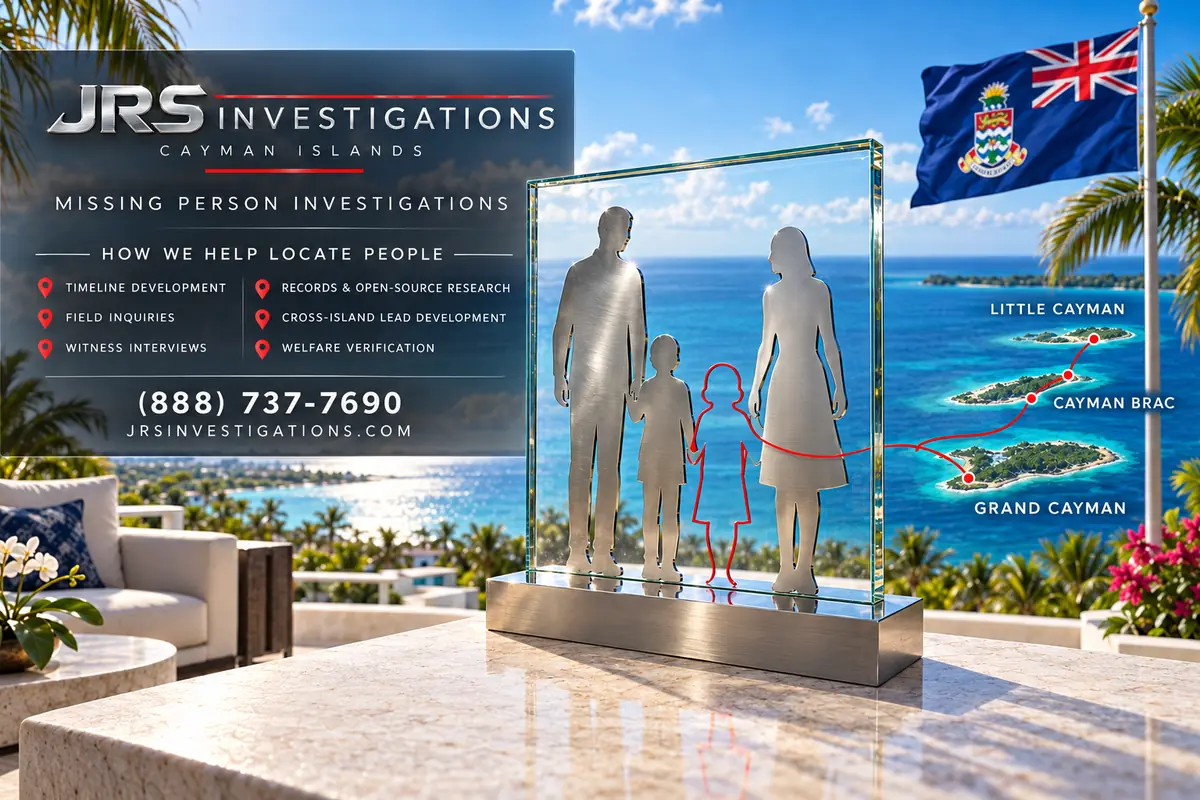
Cayman Islands Missing Person Investigator | JRS
When someone goes missing in the Cayman Islands, the first priority is safety—not waiting. If there is an immediate threat, a missing child, a vulnerable adult, a medical concern, suspected self-harm or evidence of a crime, contact the Royal Cayman Islands Police Service without delay. A private investigator can support a lawful search, but does not replace the police or emergency services.
JRS Investigations provides confidential private investigation services in the Cayman Islands for families, attorneys, businesses and authorized representatives who need structured follow-up, additional lead development or help locating a person across islands and jurisdictions.
For related regional guidance, see our practical response guide for an Ocho Rios missing-person investigation.
When a Cayman Islands missing-person investigator may help
Every disappearance has a different context. The person may be a resident, visitor, employee, debtor, witness, family member or adult who has intentionally reduced contact. Some cases begin with an emergency. Others involve a long break in communication, incomplete records or a need to locate someone for a lawful civil purpose.
A private investigation may be appropriate when the client needs dedicated case review, interviews and lead follow-up alongside an official investigation; when a historical case needs a fresh timeline; or when the matter is a non-emergency locate assignment rather than a public-safety emergency.
Situations requiring immediate police contact
- A child or vulnerable adult cannot be located.
- The person has a serious medical condition or needs medication.
- There are indications of violence, coercion, abduction or exploitation.
- The person communicated suicidal intent or appears at risk of self-harm.
- A vehicle, boat, phone or personal property was found under suspicious circumstances.
- The disappearance occurred near the water or may require search-and-rescue resources.
The Royal Cayman Islands Police Service publishes current police contacts and station information. Its directory includes George Town, West Bay, Bodden Town, East End, North Side, Cayman Brac and Little Cayman, as well as the Cayman Islands Coast Guard and Criminal Investigation Unit.
Why island geography changes the investigation
The Cayman Islands include Grand Cayman, Cayman Brac and Little Cayman. Travel between the islands and through international airports, cruise terminals, marinas and private vessels can quickly broaden the search. A last known location may be a resort, condominium, workplace, beach, restaurant, marina, hospital or rental property rather than a permanent residence.
Visitors may leave limited local records, use temporary accommodations and rely on rental vehicles or taxis. Residents may have family, business and travel connections in the United States, United Kingdom, Jamaica or elsewhere in the Caribbean. A useful strategy must separate confirmed movement from assumptions and identify which jurisdiction controls each record or lead.
Private investigators do not have unrestricted access to immigration, airline, banking, telephone or medical records. Those records generally require consent, legal process or official authority. Ethical investigators document lawful sources and do not promise access they do not possess.
Start with a verified timeline
A reliable timeline is the foundation of a missing-person investigation. Begin with the last independently confirmed contact, not a rumor or forwarded message. Record who communicated with the person, when it occurred, how the contact was made and what can be verified.
Useful starting information may include:
- Full legal name, aliases, date of birth and recent photographs.
- Physical description, medical needs and current medications.
- Phone numbers, email addresses and known social-media accounts.
- Last confirmed location, date, time and person who saw them.
- Residence, hotel, employer, school, marina or regular destinations.
- Vehicle, rental-car, boat or flight information lawfully available to the client.
- Recent travel plans, relationship changes, disputes or unusual behavior.
- Police report number and investigating officer, when applicable.
- Names and contact details for family, friends, coworkers and witnesses.
Preserve original messages, voicemails, photographs and documents. Avoid repeatedly editing screenshots or adding conclusions to the source material. A clean record helps distinguish facts, secondhand information and untested theories.
Five ways a private investigator can support the search
1. Organize the case and identify gaps
An investigator can consolidate dates, contacts, locations and prior search activity into one working chronology. That process often reveals unanswered questions, conflicting accounts and leads that have not been verified.
2. Conduct focused interviews
Witness interviews can clarify the person’s plans, emotional state, transportation, companions and last confirmed movements. The investigator should document who provided each fact and distinguish direct knowledge from rumor.
3. Review lawful records and open sources
Depending on the client’s authority and the purpose of the case, research may include public records, business information, court records, property connections, professional profiles, social-media content and other lawfully available sources. Private access to protected accounts, location data or communications is not implied.
4. Perform field inquiries
Fieldwork may include checking relevant addresses and public locations, speaking with authorized contacts, documenting vehicles or activity and following credible leads. Surveillance may be used when lawful and proportionate, but it is not appropriate in every missing-person case.
5. Coordinate information responsibly
When police are involved, the private investigator should avoid interfering with the official case. Potential evidence, urgent safety information and credible crime-related leads should be communicated through the appropriate channel. The client should identify one primary contact so information is not lost or circulated inconsistently.
Missing adult, welfare concern or civil locate?
These assignments are not interchangeable. A missing-person case involves uncertainty about someone’s safety or whereabouts. A welfare concern focuses on whether the person is safe. A civil locate seeks a current address or contact information for a lawful purpose such as estate administration, family contact, litigation support or locating a witness.
An adult generally has the right to stop communicating and may not want their location disclosed. If an investigator confirms that a competent adult is safe but requests privacy, the response may be limited to telling the client that contact occurred without revealing the person’s address. Safety, consent, legal authority and the purpose of the search should guide every step.
Cross-border leads and international coordination
A Cayman Islands case may quickly develop leads abroad. The investigator should document the connection before expanding the scope: confirmed travel, family ties, financial or business relationships, a known address, an online account or a credible witness statement.
Cross-border work can require local resources, language or cultural knowledge and compliance with the laws of each jurisdiction. A private investigator cannot ignore licensing, privacy or evidence rules simply because the client is located elsewhere. JRS can help define a lawful plan through its broader Caribbean investigations network.
What families and clients should avoid
- Do not wait to notify police when safety may be at risk.
- Do not access private accounts or devices without authorization.
- Do not publish sensitive medical, financial or identifying information unnecessarily.
- Do not confront a suspected person or follow someone in a way that creates danger.
- Do not send money to an unknown person claiming to know the missing person’s location.
- Do not treat an unverified social-media sighting as confirmed evidence.
- Do not promise rewards or make accusations without coordinating with the appropriate professionals.
Public appeals can help in some cases, but they can also create false leads, unwanted publicity and risks for a person fleeing abuse. Discuss publicity with police, counsel or the investigator before posting widely.
Questions to ask before hiring an investigator
- Who will manage the case and perform fieldwork in the Cayman Islands?
- What information is needed to evaluate urgency and scope?
- How will the investigator coordinate with police when appropriate?
- Which records and methods are lawful and realistically available?
- How are leads documented and reported?
- How are confidential information and family communications protected?
- What fees, travel costs and decision points should the client expect?
Be cautious of anyone guaranteeing that a missing person will be found, claiming unrestricted access to protected data or promising to secretly track a phone without lawful authority.
Frequently asked questions
Should I wait before reporting someone missing?
No waiting period should be assumed when safety is at risk. Contact the RCIPS promptly and explain the circumstances, especially when the person is a child, vulnerable, medically at risk or may be in danger.
Can a private investigator track a missing person’s phone?
Not simply because someone is missing. Protected location and communications data require consent, legal process or appropriate official authority. Investigators can review information lawfully provided by the client and develop other leads.
Can JRS work on a case already reported to police?
Yes, when the work is lawful and does not interfere with the official investigation. The scope can focus on case organization, interviews, open-source research, field inquiries and follow-up requested by the authorized client.
Will the located person’s address be disclosed?
Not automatically. A competent adult may choose privacy. The response depends on safety, consent, legal authority, the purpose of the locate and any applicable court order.
Can the investigation cover all three Cayman Islands?
Yes, when credible leads and the agreed scope require it. Travel, access and coordination for Grand Cayman, Cayman Brac and Little Cayman should be planned before fieldwork.
Request a confidential Cayman Islands consultation
If someone may be in immediate danger, contact the Royal Cayman Islands Police Service first. For a confidential private-investigation consultation, JRS can review the timeline, client authority, police involvement, locations and available leads before recommending a scope.
For broader planning, review our Cayman Islands private investigator guide, including lawful records, surveillance, privacy, costs, and reporting.
Call (888) 737-7690 or contact JRS Investigations.