(888) 737-7690

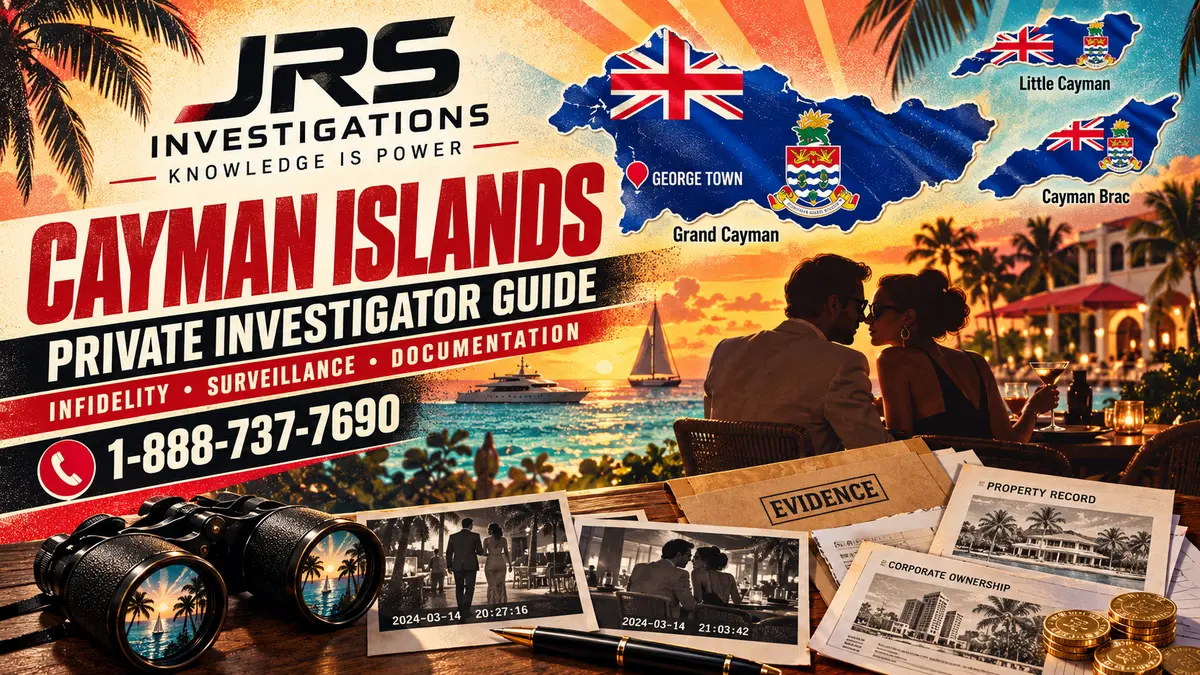
Cayman Islands Private Investigator Guide: What to Expect
Hiring a Cayman Islands private investigator requires more than choosing a familiar service name. The assignment may involve Grand Cayman, Cayman Brac, Little Cayman, or people and records spread across several countries. The right plan starts with a defined question, a lawful purpose, verified identities, and a clear understanding of what local records and fieldwork can—and cannot—establish.
JRS Investigations helps clients organize sensitive personal, corporate, and legal matters involving the Cayman Islands. Work may include infidelity surveillance, due diligence, background and locate research, asset tracing, litigation support, technical counter-surveillance, or coordination for protective services. Every matter is scoped individually because geography, privacy rules, record access, travel, and reporting needs can change the appropriate method.
What makes a Cayman Islands investigation different?
The Cayman Islands are three distinct islands rather than one continuous operating area. Grand Cayman contains George Town, the principal commercial center, and most of the population and business activity. Cayman Brac and Little Cayman require separate travel planning, limited schedules, and realistic response times. A subject who moves among resorts, marinas, offices, residences, and airports may create both logistical and identification challenges.
The jurisdiction is also closely connected to international business. A Cayman entity may have directors, service providers, counterparties, assets, or litigation in other countries. That does not make confidential banking information publicly available, and it does not mean every company relationship proves ownership or control. Investigators must distinguish verified records from leads and show how each identifier connects to the person or entity being researched.
For an overview of JRS coverage, see the dedicated Cayman Islands private investigator service page and the broader Caribbean investigations network.
Common Cayman Islands investigation services
Infidelity and travel-related surveillance
A spouse or partner may travel to Grand Cayman for business, vacation, a conference, or a private meeting. An infidelity investigation should begin with objective questions: Was the subject at a stated location? Who arrived or departed with the subject? What activities occurred in places where observation was lawful? The aim is accurate documentation, not confrontation or provocation.
Useful preparation may include a recent photograph, confirmed itinerary, hotel or event information lawfully known to the client, vehicle details, known companions, and the time window that matters. Investigators should avoid trespass, account intrusion, impersonation, and unlawful interception of private communications. JRS discusses the limits and practical uses of infidelity investigations before fieldwork begins.
Deliverables may include activity logs, time-stamped photographs or video, location notes, and a factual summary. A report should separate direct observation from client-supplied information and from any reasonable but unconfirmed inference.
Corporate due diligence
Cayman due diligence and asset verification may support an investment, joint venture, vendor relationship, executive hire, dispute, or major transaction. The work can compare what a person or company has represented with information available through corporate, regulatory, court, professional, and open-source channels.
The Cayman Islands Online General Registry is the official portal for registry information. The Registry also provides an online tool to validate certificates and stamped documents using the entity file number and authorization code. For regulated financial entities, the Cayman Islands Monetary Authority entity search can confirm whether an entity is currently licensed or registered with CIMA in a listed sector.
These checks answer specific questions; they are not a complete risk assessment on their own. Names, dates, entity numbers, status, directors where available, registered office details, related litigation, sanctions screening, public professional history, and cross-border affiliations may all need comparison. JRS due diligence investigations are built around the client’s actual decision and risk threshold.
Asset tracing and ownership research
Asset tracing is often misunderstood as direct access to a person’s bank accounts. Investigators do not receive automatic access to private account balances, confidential customer files, tax records, or sealed ownership information. A lawful asset investigation instead builds an evidence map from accessible records and corroborated sources.
Potential research areas may include companies and directorships, litigation, judgments, registered interests, property-related leads, business affiliations, vessels or aircraft when relevant registries permit access, secured transactions where recorded, professional relationships, and visible high-value property. A gold bar, vehicle, home, or yacht may be an investigative lead, but a photograph or association does not by itself prove beneficial ownership.
The official Cayman Islands Law Courts publish reported and unreported judgments, and the court site also maintains public registers. Court materials can reveal parties, claims, findings, insolvency issues, and asset-related facts, but each record must be read in context. The Caribbean international asset-search guide explains how records, source validation, and cross-border strategy fit together.
Locating an apparent asset is not the same as proving legal ownership, freezing it, seizing it, or recovering funds. Those remedies normally require counsel, legal process, and the authority of the relevant court or government body. JRS does not guarantee that an asset exists, will be located, or can be recovered.
Background and locate investigations
Identity resolution is the foundation of background and locate work. Similar names, international address formats, outdated databases, and incomplete dates of birth can produce false matches. A careful assignment compares multiple identifiers and documents both positive matches and material uncertainty.
Depending on the lawful purpose and available access, research may address addresses, companies, litigation, professional history, online activity, relatives or associates, and other jurisdiction-specific records. Employment, tenancy, credit, insurance, and other regulated decisions can trigger additional notice, consent, or permissible-purpose requirements in the client’s home jurisdiction. The intended use must be disclosed before work begins.
Technical counter-surveillance and protective coordination
Sensitive residences, offices, meeting rooms, hotel suites, and vessels may present concerns about unauthorized cameras, microphones, trackers, or data exposure. A technical surveillance counter-measures assignment is different from an ordinary visual inspection. The scope should define the spaces, equipment, network boundaries, access permissions, and follow-up reporting. No sweep can promise that a space will remain secure after the inspection.
Executive protection and security are separate services from private investigation. When a client needs protective coverage in the Cayman Islands, the plan must address risk, schedule, venues, transportation, emergency contacts, and the authorizations applicable to the personnel and activity. JRS provides a dedicated overview of Cayman Islands executive-protection coordination.
Data protection and lawful handling
The Cayman Islands Data Protection Act governs the processing of personal data. The Office of the Ombudsman’s data-protection guidance describes responsibilities such as fair and lawful processing, individual rights, security, breach handling, and statutory exemptions. An exemption should never be assumed merely because a client calls a matter an investigation.
Before collecting personal data, the investigative team should understand the client’s purpose, the categories of information needed, the source of any client-supplied material, the appropriate retention period, and who may receive the report. Data should be limited to what is relevant and secured during transmission and storage. Cross-border matters can also involve the laws of the country where the client, subject, investigator, or data system is located.
JRS may coordinate with locally appropriate resources and counsel when the assignment requires Cayman-specific field activity, permissions, or legal interpretation. Private investigators do not possess police powers. They cannot compel testimony, execute warrants, access restricted government or bank systems, or direct public authorities to use forensic resources for a private client.
The JRS investigation process
- Confidential intake: identify the client, the people or entities involved, the lawful purpose, the decision to be supported, the known facts, and any deadline.
- Scope and jurisdiction review: determine which islands and countries are involved, what records may be accessible, which field methods are proportionate, and where local counsel or authorized resources may be necessary.
- Research and fieldwork: conduct approved records research, surveillance, interviews, open-source review, technical work, or coordination while preserving source details and communicating meaningful developments.
- Corroboration: compare names, dates, addresses, entity numbers, photographs, observed activity, and independent records to reduce false matches.
- Reporting: deliver a clear chronology or findings report that distinguishes observations, records, third-party statements, and unresolved leads.
The strategy may change when initial findings identify a new company, island, address, court matter, or jurisdiction. Any material expansion should be discussed with the client rather than treated as automatic authorization.
What affects cost and timing?
There is no responsible universal price for a Cayman Islands investigation. Cost depends on the question, the number of subjects or entities, the islands involved, investigator travel, surveillance hours, staffing, urgency, registry and court fees, technical equipment, local coordination, and the required reporting format.
Infidelity surveillance scheduled around a confirmed arrival may have a different cost structure from multi-country asset tracing or corporate due diligence. Cayman Brac or Little Cayman fieldwork may require additional travel planning. A narrow first phase can sometimes test the strongest leads before the client authorizes broader work.
Clients should ask what is included, what expenses require approval, how updates will be delivered, what happens when a lead crosses into another jurisdiction, and what the final work product will contain. Avoid firms that promise a guaranteed result, claim unrestricted banking access, or quote certainty before reviewing the facts.
How to prepare for the consultation
- Write a short chronology with the most important dates, locations, and events.
- Provide correct legal names, aliases, dates of birth, entity names, and registration numbers when known.
- Share recent photographs, itineraries, addresses, and vehicle information only when lawfully obtained.
- Identify Grand Cayman, Cayman Brac, Little Cayman, or any foreign jurisdiction connected to the matter.
- Explain exactly how the findings will be used and whether an attorney is involved.
- State the deadline, preferred update schedule, and working budget.
- Disclose court orders, contact restrictions, safety concerns, or legal limitations that may affect the plan.
Frequently asked questions
Can a Cayman investigator obtain private bank balances?
Not merely because a client requests them. Private banking data is generally restricted. Lawful access may require consent, statutory authority, or court process handled through counsel.
Can surveillance be conducted at a hotel or resort?
Observation may be possible from lawful locations, but access rules, privacy expectations, property restrictions, and the method used all matter. A legitimate plan does not authorize trespass, hidden entry, account access, or unlawful recording.
Will the findings be admissible in court?
No investigator can guarantee admissibility. Counsel and the court determine how evidence rules apply. Accurate logs, source identification, preservation, and factual reporting can help counsel evaluate the material.
Can JRS recover hidden assets?
JRS can research and document leads within the agreed scope. Freezing, seizing, transferring, or recovering property normally requires legal authority and appropriate professionals. Discovery does not guarantee recovery.
How quickly can work begin?
Timing depends on verified identifiers, operational availability, island travel, permissions, record access, and urgency. A complete intake package allows JRS to assess the next practical step faster.
Discuss a Cayman Islands investigation
Tell JRS what you need to verify, where the people or entities are connected, and how the information will be used. We will discuss lawful options, likely constraints, scope, and the appropriate next step.