(888) 737-7690

Mills River NC Alimony Investigator: Evidence Guide
A Mills River NC alimony investigator can document facts that an attorney may use when evaluating a request to modify or terminate court-ordered support. The investigator does not decide whether alimony should change. In North Carolina, the legal issue belongs to counsel and the court; the investigator’s job is to observe lawfully, verify identities and locations, preserve source material, and report what the evidence does—and does not—show.
That distinction is especially important when a case involves alleged cohabitation. An occasional overnight stay, friendship, shared address, vehicle at a home or social-media post is not automatically proof of the statutory standard. A useful investigation looks for consistent, corroborated patterns over time and avoids converting suspicion into a conclusion.
For broader local support, review our Mills River private investigator services and our cohabitation investigation service.
What North Carolina law says about modification and cohabitation
North Carolina General Statute 50-16.9 provides that a North Carolina court order for alimony or postseparation support may be modified or vacated upon motion and a showing of changed circumstances. The same section addresses termination when the dependent spouse remarries or engages in cohabitation. It defines cohabitation by continuous and habitual dwelling together plus the voluntary mutual assumption of marital rights, duties and obligations.
The statute does not turn every relationship, visit or overnight stay into cohabitation. Nor does an investigator determine whether income loss, retirement, health, remarriage or another change legally warrants a reduction. A lawyer should first review the order, any incorporated agreement, jurisdiction, procedural requirements and the evidence needed for the specific motion.
The North Carolina Judicial Branch separation and divorce guide explains that a judge determines alimony based on the facts rather than a fixed formula. It also directs people with alimony questions to legal counsel. JRS provides factual investigation, not legal advice.
Seven evidence questions a focused investigation can address
1. Who is the correct subject?
Identity comes first. The intake should distinguish the dependent spouse, alleged cohabitant, household members, visitors, tenants, relatives and service providers. Useful identifiers may include lawful client-supplied addresses, vehicles, employment, public profiles and known schedules. A vehicle registered to a relative or a shared name in a public record should never be treated as a confirmed match without corroboration.
2. Is there a continuous and habitual residential pattern?
A planned series of lawful observations may document repeated overnight presence, morning departures, evening arrivals and consistency across weekdays or weekends. The investigator should state gaps, obstructed views, weather and periods when the subject was not observed. The evidence is stronger when it shows a meaningful pattern rather than one isolated event. Counsel decides how that pattern relates to the statutory language.
3. Do vehicles and access patterns support residence?
Vehicle presence can provide context when recorded accurately over time. Relevant observations may include regular overnight parking, repeated arrivals from work, use of a garage or driveway, possession of an access device, and routine entry without a host present. None proves residency alone. Rental vehicles, work vehicles, guests and changing transportation should be considered and reported.
4. Are household responsibilities visibly shared?
Lawful public-place observation may document recurring activities such as bringing groceries, maintaining the property, collecting deliveries, handling waste containers, caring for pets or coordinating contractors. These activities can have innocent explanations and should be described without speculation. An investigator does not enter a home, look through windows, search trash on private property or manufacture contact with the occupants.
5. Do public records and open sources corroborate the pattern?
Depending on the lawful purpose and available sources, research may review property records, business filings, professional licenses, civil court records, openly published contact information and public social-media content. An address in a database can be stale; a tagged photograph may be old; and an online relationship label is not a legal finding. Each record should be dated, attributed and compared with independent information.
6. Are financial or employment changes within scope?
When counsel identifies changed income, employment or business activity as relevant, an investigator may verify public business registrations, openly advertised services, professional licenses, job affiliations, commercial locations or observable operations. JRS does not obtain tax returns, protected payroll records, bank balances, medical records or credit reports without lawful authorization. Medical or earning-capacity conclusions belong to qualified professionals.
7. Can the findings be organized for legal review?
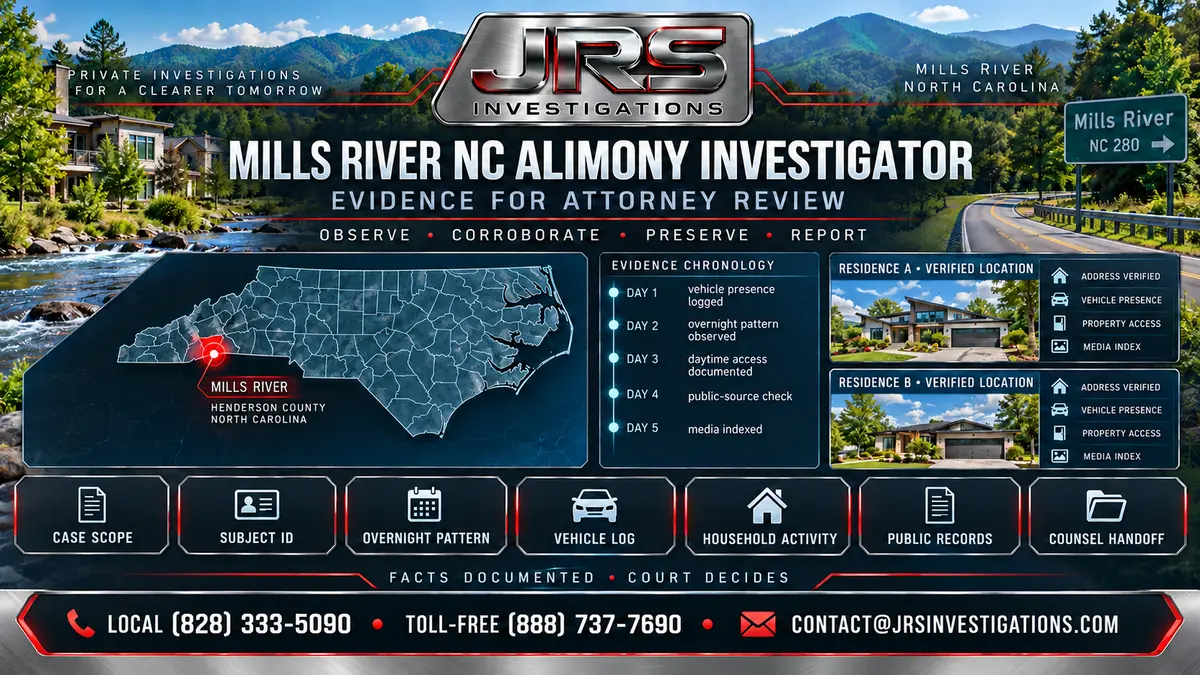
A useful report presents a chronology, observation logs, source citations, photographs or video references, relevant maps, confirmed identifiers and limitations. It separates direct observation, client-provided facts, public records and inference. The investigator should preserve original media and identify any edited excerpt. No report can guarantee admissibility, modification, reduction, termination, settlement or reimbursement of fees.
Our surveillance investigation service explains the observation component. For a related North Carolina example, see the Waynesville cohabitation evidence guide.
A seven-step attorney-directed workflow
- Review the order and objective. Counsel identifies the operative support obligation, legal theory and facts that matter.
- Confirm parties and locations. JRS resolves identities, vehicles, addresses and likely observation points before fieldwork.
- Plan proportionate coverage. Dates and times are selected to test the defined question without open-ended monitoring.
- Observe from lawful vantage points. Investigators avoid trespass, harassment and protected private areas.
- Preserve contemporaneous records. Notes, media and source captures are organized with dates, times and file references.
- Corroborate and test alternatives. Conflicting records, innocent explanations and gaps are documented rather than ignored.
- Report facts and limitations. Counsel receives a concise evidence package and decides whether further work or a motion is appropriate.
A staged plan can begin with records and limited observations, followed by targeted coverage only if the first phase produces relevant leads. This protects the budget and reduces unnecessary intrusion.
Mills River and Henderson County field planning
Mills River includes residential communities, rural properties, farms, industrial and commercial areas, airport-adjacent corridors and mountain roads. Routes such as NC 280 and nearby access toward Asheville, Hendersonville, Arden and Brevard can carry heavy commuter and seasonal traffic. Fog, rain, winter conditions, construction and limited safe pull-off areas affect what can be observed and how long repositioning takes.
A rural address may have long driveways, private roads, gates and limited public visibility. A lawful plan does not cross a boundary simply to improve a camera angle. Condominium, apartment, resort and gated-community assignments present different access rules. When visibility is limited, the report should say so instead of filling the gap with assumptions.
Cases may also involve multiple counties because a subject lives in Mills River but works, shops or spends time elsewhere. The plan should identify approved jurisdictions and realistic travel windows. The North Carolina Judicial Branch Henderson County page provides current courthouse, calendar and local-rule information for the county.
Privacy, licensing and evidence boundaries
North Carolina General Statutes Chapter 74C regulates private protective services and defines private-investigator work. Clients should verify the agency and assigned personnel and confirm that the engagement is appropriately licensed for North Carolina activity.
Lawful investigation does not include trespassing, entering a residence, placing a tracker without required authority, accessing private accounts through deception, impersonating law enforcement or recording in protected private spaces. Public posts may be preserved with their source and context; private accounts are not accessed by hacking, borrowed passwords or false pretenses.
Evidence should also be relevant and proportionate. An investigator should not contact children, neighbors, employers or relatives merely to embarrass a subject or publicize a family dispute. Witness outreach, workplace contact and unusual technical methods should be specifically approved by counsel when appropriate. Safety concerns or suspected criminal conduct should be directed to the proper authorities.
What to give the investigator
- the current order, relevant agreement and case number;
- counsel’s contact information and defined factual objective;
- accurate names, photographs and distinguishing identifiers;
- known addresses, vehicles, employment and typical schedules;
- prior observation, public records or source material;
- important dates, hearing deadlines and preservation concerns;
- approved geographic scope, budget and reporting cadence; and
- the person authorized to approve added work.
Clients can review our Mills River investigator hiring guide, Mills River locate-investigation guide and 17 questions to ask before hiring a private investigator before approving a scope.
Evidence that needs careful interpretation
A useful investigation does not overstate isolated facts. Mail at an address may be old or administrative. A vehicle may belong to a visitor. Grocery bags do not establish who paid for them. A person may maintain more than one residence, help a relative, stay temporarily because of travel or weather, or use a property for work. Social-media posts can be delayed, edited or reposted. Even a repeated pattern must be evaluated alongside the order, testimony, records and competing explanations.
JRS therefore records dates, durations, vantage points and breaks in observation. When a source conflicts with field activity, both are included. The goal is not to create a dramatic accusation; it is to give counsel a reliable chronology that can be tested.
Frequently asked questions
Can an investigator reduce my alimony?
No. An investigator documents facts. Your attorney evaluates the order and law, files any motion, and presents the matter to the court.
Does one overnight stay prove cohabitation?
No. A single event does not establish a continuous and habitual dwelling pattern or the mutual assumption of marital rights, duties and obligations described by the statute.
Can JRS investigate job loss or retirement?
JRS may verify relevant public records, business activity or observable facts within a lawful scope. Legal significance, medical capacity and income calculations require counsel and other qualified professionals.
Will the investigator confront the subject?
Usually not. Confrontation can compromise the assignment, create safety concerns and change behavior. Any direct contact should have a defined purpose and client or attorney approval.
How long does a cohabitation investigation take?
It depends on the legal question, known routines, visibility, geography and consistency of the observed pattern. JRS recommends a staged plan with review points rather than promising that a fixed number of days will prove a case.
Request a confidential Mills River case review
Call JRS Investigations locally at (828) 333-5090, toll-free at (888) 737-7690, or email contact@jrsinvestigations.com. Provide the order, counsel contact, defined question, subject identifiers, relevant dates and deadline so the first phase can be planned efficiently.
For coverage beyond Mills River, review our areas served. Observe. Corroborate. Preserve. Report. JRS documents the facts; counsel frames the issue; the court decides.