(888) 737-7690

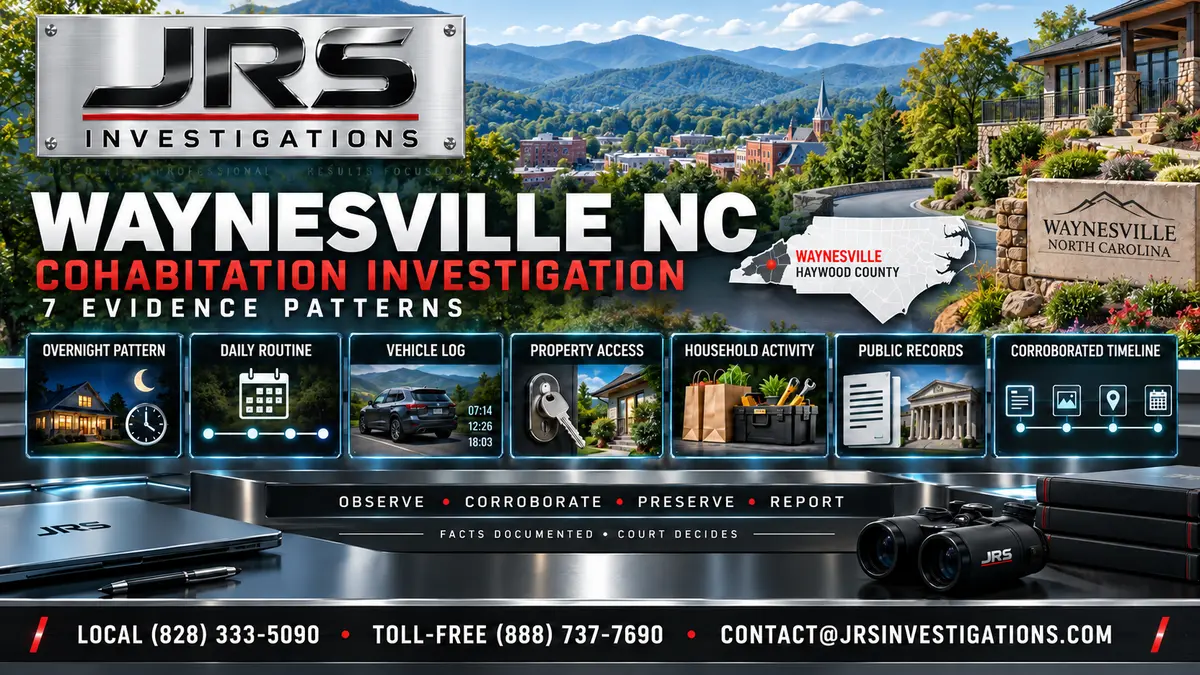
Waynesville NC Cohabitation Investigator: Evidence Guide
Waynesville NC cohabitation investigator services can help an attorney or client document observable facts when cohabitation may affect court-ordered alimony or postseparation support. JRS Investigations conducts lawful, discreet assignments in Waynesville and across Haywood County with a defined scope, documented observations and evidence-conscious reporting. The investigator’s role is to establish reliable facts—not to decide that a relationship legally qualifies as cohabitation or promise a particular court result.
North Carolina law makes the distinction important. Under N.C. General Statute 50-16.9, cohabitation involves adults dwelling together continuously and habitually in a private relationship and evidence of voluntarily assuming marital rights, duties and obligations; sexual relations are not necessarily required. A shared address, one overnight stay, a photograph or a social-media post rarely answers that full question by itself. A useful investigation develops a pattern and gives counsel traceable facts to evaluate.
For broader local capabilities, see our Waynesville private investigator services and our dedicated cohabitation investigation service.
Seven evidence patterns a cohabitation investigation may document
1. Repeated overnight presence over a meaningful period
A single late visit does not establish continuous and habitual dwelling. A professional inquiry looks for repeated, date-stamped patterns across an appropriate period selected with counsel. Observations may include an individual arriving in the evening, remaining through normal overnight hours and departing as part of the next day’s routine. The report should distinguish what the investigator directly observed from what the client suspected. It should also identify gaps caused by weather, access, scheduling or an obstructed public vantage point rather than filling them with assumptions.
2. Consistent arrival, departure and daily routines
Patterns can become more informative when they repeat around workdays, weekends, school schedules, holidays or ordinary household activity. The relevant fact is not simply that two people spend time together; it is whether observable conduct supports habitual residence and a shared life. JRS records dates, times, locations, vehicle movements and the sequence of events without editorial labels such as “obviously living there.” A clear chronology allows counsel to compare the observations with other records and explanations.
3. Vehicle presence and residential continuity
A vehicle repeatedly present overnight and during normal residential hours may contribute to a larger pattern. It is not, by itself, proof of who was present or why. Investigators should confirm vehicle identifiers carefully, document location from lawful vantage points and avoid treating a borrowed or shared vehicle as a conclusion. In mountain communities, vehicles may be parked away from a residence because of steep drives, limited access, seasonal conditions or shared lots. Local context matters when interpreting what the camera captured.
4. Regular access to the residence and property
Observable use of keys, gate codes, garages, storage areas or household equipment may be relevant when it occurs repeatedly and lawfully in view. Deliveries, mail handling and the movement of personal items can also generate leads, but private mail, closed containers and protected accounts are not invitations to search. JRS documents public-facing activity without trespassing, entering restricted property or directing unlawful access. The report describes the conduct and leaves its legal significance to counsel and the court.
5. Shared household responsibilities
Routine conduct may provide context for whether adults appear to be sharing obligations usually associated with a household. Examples can include recurring maintenance, shopping, pet care, transportation, property management or coordinated errands. These activities also have innocent explanations: relatives, friends, employees and contractors perform them every day. A responsible investigator records frequency, timing and corroborating details rather than assigning a relationship based on one task.
6. Public records and openly available information
Address records, property records, business filings, court records and public social content may help identify locations, names or relationships for further verification. They can also be outdated, incomplete or connected to a different person. JRS uses public information as a lead and compares it with source records and field observations. The North Carolina Judicial Branch Haywood County page provides official local court information; court documents and filings should be interpreted in context, preferably with the client’s attorney.
7. Corroborated timelines across independent sources
The strongest investigative work connects multiple reliable observations without overstating them. A dated field log may align with a public filing, an authorized document, a recurring vehicle pattern or information supplied by counsel. Conflicts should be disclosed, not hidden. If one source suggests residence and another provides a credible alternative address, the investigator should identify the discrepancy and recommend a proportionate next step. The objective is a defensible timeline with clear source boundaries.
What North Carolina law means for the investigation
The current statute says that postseparation support or alimony terminates when a dependent spouse receiving support under a North Carolina judgment or order remarries or engages in cohabitation. It defines cohabitation by continuous and habitual dwelling together and the voluntary mutual assumption of marital rights, duties and obligations. Because those elements require context, a surveillance photograph is only one possible piece of evidence.
Before fieldwork begins, the client should provide the operative order or agreement to qualified family-law counsel. Contractual support provisions, out-of-state orders and privately negotiated terms may present different questions. JRS does not interpret the order or offer legal advice. Counsel can identify the relevant time period, facts, locations and permissible methods so the investigation addresses the actual legal issue.
North Carolina also regulates private investigators under Chapter 74C. The North Carolina Private Protective Services Board administers licensing, education and training requirements, while N.C. General Statutes Chapter 74C defines regulated investigative services and licensing requirements. Clients should verify the agency and understand who will conduct the assignment.
A professional Waynesville cohabitation investigation process
- Attorney-directed objective. Define the legal question, relevant order, reporting deadline and facts that may matter.
- Subject and location verification. Confirm names, vehicles, known addresses and the correct property before field deployment.
- Lawful surveillance plan. Select dates, times and public vantage points that can test the stated hypothesis without trespass or harassment.
- Contemporaneous field notes. Record time, location, conditions, activity and limitations as events occur.
- Photo and video documentation. Capture relevant activity only when lawful and useful, preserving original files and context.
- Records and timeline comparison. Corroborate material observations with authorized or public information and flag conflicts.
- Clear final reporting. Separate direct observations, client-supplied information, records, limitations and unresolved questions.
Our surveillance investigation service explains how properly planned observation supports a range of civil and domestic matters. For questions about selecting an investigator, review 17 questions to ask before hiring a private investigator.
Waynesville and Haywood County field conditions
Waynesville assignments require planning around mountain terrain, curving roads, limited shoulders, changing elevations and properties that may have only one practical access route. An investigator cannot create a lawful, safe observation point where none exists. Long rural drives can also make it difficult to reposition without becoming conspicuous. JRS considers safety, public access, line of sight and the likelihood that a particular deployment will produce meaningful information.
The area includes downtown residences, subdivisions, rural homes, seasonal properties and travel between Waynesville, Maggie Valley, Clyde, Canton and the Asheville corridor. Tourism, second homes and irregular work schedules can produce activity that looks unusual in a short sample. A person may visit for a weekend, provide property care or stay temporarily during travel. Scheduling across multiple representative periods is often more useful than concentrating all resources on one dramatic date.
Weather also matters. Fog, heavy rain, winter conditions and dense vegetation can reduce visibility and change normal travel. Reports should identify these conditions because they affect what could be observed. Local planning makes the evidence more accurate and helps prevent ordinary mountain-life logistics from being mischaracterized.
Evidence handling and reporting standards
A professional report should allow another reader to understand what happened without relying on the investigator’s opinion. Entries should use consistent timestamps, identify locations, describe the observed activity and reference the corresponding media. Original files should be preserved, working copies controlled and any enhancement or excerpt disclosed. If an investigator loses visual contact or cannot confirm identity, the report should say so.
No investigator can guarantee that evidence will be admitted or that support will be modified or terminated. Courts apply evidentiary rules, evaluate credibility and interpret the law. The useful promise is narrower: JRS can use lawful methods, maintain clear records, preserve material in an evidence-conscious manner and cooperate with counsel regarding the work performed.
For regional coverage beyond Waynesville, see our Blue Ridge Mountains investigation services and areas served.
What clients should not do
- Do not trespass, enter a residence or use another person’s key or access code.
- Do not place a tracker on a vehicle without clear ownership, consent and legal authority.
- Do not access private accounts, devices, messages or location data without authorization.
- Do not confront, threaten or repeatedly contact the subject.
- Do not ask children, neighbors or employees to obtain information unlawfully.
- Do not edit original media or remove metadata that may matter later.
- Do not publish allegations online or treat suspicion as a proven fact.
Self-directed surveillance can create safety, privacy and evidentiary problems. Preserve what you already possess lawfully, write down the facts that created the concern and share them with counsel and the investigator. If there is an immediate safety risk, contact law enforcement rather than attempting to document the event yourself.
Frequently asked questions
Does one overnight stay prove cohabitation in North Carolina?
Not by itself. The statute refers to dwelling together continuously and habitually and to the mutual assumption of marital rights, duties and obligations. Counsel can explain how the current law applies to the specific order and facts.
Can JRS guarantee an alimony reduction or termination?
No. JRS documents facts; it does not decide the legal outcome. The court determines whether the law and evidence support modification or termination.
How long should surveillance continue?
There is no universal duration. The schedule should reflect the alleged pattern, the legal objective, budget, safety, access and what prior observations show. JRS and counsel can stage the work and reassess after each useful period.
Can public records replace field investigation?
Usually not. Records may identify addresses, property or filings, but they may not show current daily conduct. Field observations also have limits. The most reliable analysis often combines independent sources.
Will the report include photographs and video?
When relevant media is lawfully obtained, the report can cross-reference it with the observation log. Scope, storage, delivery and possible testimony needs should be discussed before the assignment.
Request a confidential Waynesville consultation
If counsel has identified a cohabitation question or you need help defining the evidence request, contact JRS Investigations for a confidential case assessment. Call local (828) 333-5090, toll-free (888) 737-7690, or email contact@jrsinvestigations.com. You can also review our Waynesville investigator hiring guide.
Observe. Corroborate. Preserve. Report. Knowledge is power when facts are gathered lawfully and described without exaggeration.