(888) 737-7690

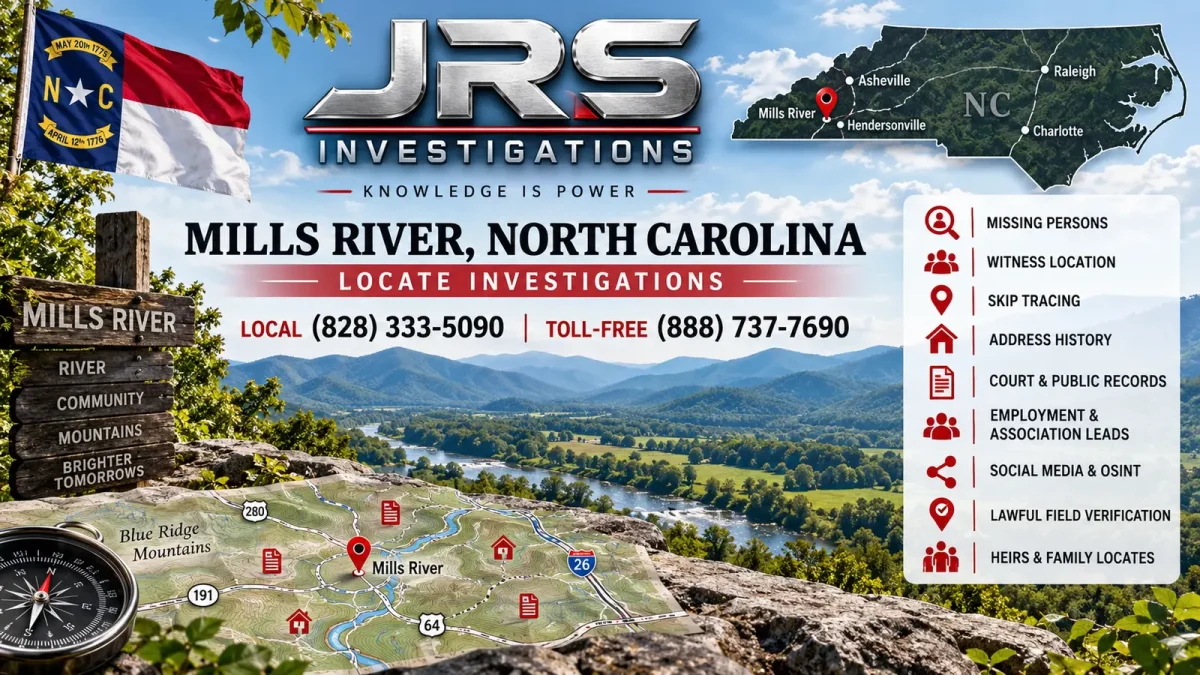
Mills River NC Locate Investigations: Lawful Search Guide
Finding a person is rarely as simple as typing a name into a search box. People move, use different names, change telephone numbers, share addresses with relatives, operate businesses, or leave records in several jurisdictions. JRS Investigations provides Mills River NC locate investigations for attorneys, families, businesses, creditors, insurers, and other authorized clients who have a lawful reason to identify a current location or reliable contact lead.
Our work combines identity resolution, address history, public-record research, authorized investigative databases, open-source intelligence, and field verification when appropriate. We do not promise that every person can be found. Instead, we document the strongest available leads, explain how they were developed, and distinguish a verified location from an unconfirmed possibility.
What Is a Locate Investigation?
A locate investigation develops information that may help identify where a person lives, works, receives mail, owns property, conducts business, appears in court, or maintains other documented connections. The scope depends on who is being located and why. Finding a missing family member requires a different plan from locating a witness, heir, judgment debtor, former tenant, or party for service of process.
JRS begins with a lawful purpose and the identifiers already available. These may include a full name, date of birth, former address, telephone number, email address, employer, business name, vehicle information supplied by the client, relatives, or court case. We then compare records and current indicators to reduce the risk of identifying the wrong person.
Our broader missing-person and skip-tracing services support cases throughout Western North Carolina and other authorized jurisdictions.
Common Reasons Clients Need a Person Located
Missing Family Members and Personal Contacts
Families may lose contact because of relocation, estrangement, illness, a name change, or a breakdown in communication. An investigator can research lawful records and recent public indicators, but a locate does not automatically authorize direct contact. Safety, privacy, protective orders, and the located person’s wishes matter. In appropriate cases, JRS may offer to forward the client’s contact information without revealing the subject’s address.
If a person is missing under suspicious circumstances, is a minor, may be in danger, or has an urgent medical vulnerability, contact law enforcement or emergency services immediately. A private investigation can supplement an official response but should not delay it.
Witnesses and Parties to Litigation
Attorneys may need a current address for a witness, former employee, defendant, beneficiary, or other party connected to a case. Research can begin with prior pleadings, depositions, incident records, contact information, employment history, and known associates. The North Carolina Judicial Branch court-records guidance explains available court-record resources and access methods.
JRS can develop and document leads for counsel or an authorized process server. We do not represent that a person has been legally served, compel a witness to speak, or evade court rules. Service and formal contact should follow counsel’s direction and applicable law.
Heirs, Beneficiaries, and Estate Matters
Probate and estate cases may require locating relatives, heirs, beneficiaries, executors, or people named in older documents. These searches often involve family connections, marriage or death records, historical addresses, obituaries, property records, court files, and interviews. The Henderson County Register of Deeds provides information about real-estate and vital-record functions relevant to local research.
Investigators develop identity and location evidence. Attorneys and courts determine legal heirship, notice requirements, and entitlement to estate property.
Debtors, Former Tenants, and Business Contacts
A creditor, property manager, attorney, or business may need a current location for an authorized legal or commercial purpose. JRS can research addresses, companies, property links, court matters, and other lawful indicators. When ownership or recovery questions are also involved, our hidden-asset investigations may support a separate, defined scope.
A locate investigation does not grant access to a private bank account, payroll system, credit file, or tax return. It also does not authorize harassment or repeated unwanted contact. Clients remain responsible for using the information lawfully.
Online Identities and Scam Subjects
An online subject may use a false name, copied photograph, temporary telephone number, or invented address. Investigators can compare usernames, email addresses, images, business claims, public profiles, domain information, and payment details supplied by the client. Our online scam investigation services focus on identity verification and evidence preservation without unauthorized account access.
Preserve original messages, profiles, email headers, payment receipts, usernames, and dates before blocking or confronting a suspected scammer. Online content can disappear quickly.
Sources Used in Lawful Locate Research
Identity and Address History
Address research may include current and former residences, mailing addresses, property records, business filings, court records, telephone history, and other authorized sources. No single record is treated as conclusive. A good match requires enough identifiers to distinguish the subject from people with similar names.
Old addresses remain useful because they can connect a person to relatives, employers, companies, property, or court matters. The report should label each address as current, historical, associated, or unverified rather than presenting every database result as a residence.
Property and Geographic Connections
Property records can show ownership names, mailing addresses, acquisition dates, deeds, parcels, and related documents. Henderson County’s official GIS and property lookup resources provide local mapping and land-record access. A property association may help develop a lead, but it does not prove that the subject currently lives at the address.
Businesses and Professional Affiliations
A current or historical company connection may identify an address, registered agent, officer, manager, or related person. The North Carolina Secretary of State business search provides interactive access to business-registration records. JRS may also research public professional licenses, assumed names, websites, advertisements, and litigation involving a business.
A listed registered agent or officer does not necessarily reveal current employment or residence. Each connection must be dated and corroborated.
Court and Public Records
Court cases can contain addresses, party names, attorneys, employers, property references, and hearing information. North Carolina’s guidance notes that online case information and official court files have different uses and access procedures. Investigators may need to consult the appropriate clerk’s office for a complete or official record.
Other public sources can include property filings, liens, judgments, corporate records, obituaries, news archives, and government notices. Our background investigation services can address a broader history when the client has a lawful purpose and the scope requires it.
Open-Source and Social-Media Intelligence
Public profiles, posts, photographs, events, marketplace listings, professional pages, and connected usernames may provide date-specific location indicators. Investigators record the source and context because a tagged location, old photograph, or friend’s comment may be inaccurate. JRS does not bypass passwords, impersonate the subject, or enter a private account without authorization.
Lawful Field Verification
When records produce a credible address or routine, a field check may help determine whether the lead remains current. Depending on the assignment, this can involve observing a location from a lawful public vantage point, confirming publicly visible information, or conducting a voluntary interview. Our surveillance services follow case-specific legal and privacy limits.
Fieldwork does not authorize trespassing, entry into private property, mailbox access, impersonation of law enforcement, or the placement of a tracking device without legal authority.
Our Five-Phase Locate Process
1. Purpose and Safety Review
We confirm the client’s identity, relationship to the subject, lawful purpose, urgency, and intended use of the information. We also ask about protective orders, threats, stalking concerns, custody disputes, mental-health emergencies, or other safety issues. JRS may decline or limit an assignment when disclosure could create harm.
2. Identifier Validation
Investigators organize the subject’s known information and resolve name variations, aliases, dates, addresses, relatives, companies, and other identifiers. Starting with the correct person prevents time and money from being spent on unrelated records.
3. Records and Open-Source Research
We search appropriate public and authorized sources, document useful results, and build a timeline of connections. Records are compared across sources rather than copied into a report without analysis.
4. Corroboration and Fieldwork
Promising leads may be checked using additional records, telephone or business verification, voluntary interviews, or lawful field observations. The scope is adjusted when a lead points to another county or state.
5. Reporting and Contact Planning
The report identifies confirmed facts, strong leads, unresolved conflicts, source dates, and limitations. When appropriate, JRS can coordinate a controlled contact plan or provide findings to counsel. Disclosure decisions consider the client’s purpose, the subject’s privacy, and any safety risk.
Important Privacy and Legal Limits
JRS does not provide real-time cellphone GPS tracking, private bank-account transactions, confidential tax information, protected driver records, or unauthorized credit reports. We do not hack accounts, intercept communications, trespass, use illegal pretexting, or guarantee a location. Driver, credit, employment, tenant, and consumer-report information may require a specific permissible purpose, consent, or legal process.
The Federal Trade Commission’s Fair Credit Reporting Act resources explain federal requirements that may apply when information is used for employment, housing, credit, or other regulated decisions. Clients should consult counsel about their intended use and any notice, consent, or adverse-action obligations.
Frequently Asked Questions
Can JRS guarantee that the person will be found?
No. Some subjects leave strong recent records, while others have limited or conflicting information. We explain the likely scope and report the evidence available, but we cannot guarantee a successful locate.
Can you track a cellphone in real time?
No. JRS does not access a person’s private device location or carrier data without lawful authorization. We develop location leads through public records, authorized sources, open-source information, interviews, and lawful fieldwork.
Will you give me the person’s address?
That depends on the client’s authority, intended use, safety concerns, and applicable law. In sensitive family or personal matters, an investigator may offer controlled contact or message forwarding instead of disclosing an address.
Can you locate someone outside Mills River?
Yes. A subject’s records may point to another part of North Carolina or another state. JRS can expand or coordinate the search where authorized and appropriate. Our Blue Ridge Mountains investigation coverage includes Mills River and surrounding Western North Carolina communities.
Discuss a Mills River Locate Investigation
If you need to locate a missing person, witness, heir, debtor, former tenant, family member, or business contact, JRS can help define a focused, lawful search. Review our Mills River private investigation coverage and complete private investigation services, then contact JRS Investigations, call the local line at (828) 333-5090, or call toll-free at (888) 737-7690.
Knowledge is power. A carefully verified lead can help the client choose the next lawful and proportionate step.