(888) 737-7690

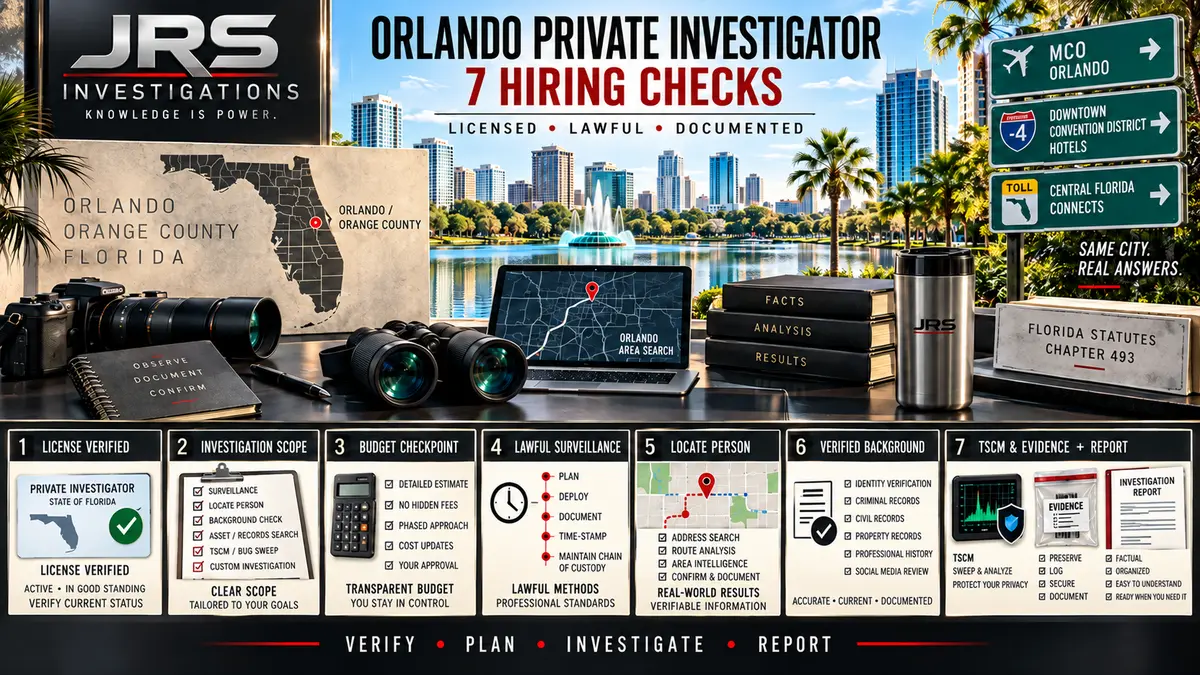
Orlando Private Investigator: 7 Hiring Checks
Hiring an Orlando private investigator should begin with verification, not urgency-driven promises. The right provider must be properly licensed for the work, understand the legal limits on surveillance and information gathering, define a proportionate scope, and explain how findings will be documented. A strong investigation answers a decision-focused question while protecting the client from unreliable data, unnecessary expense and unlawful methods.
JRS Investigations supports individuals, attorneys and organizations with lawful fact development in Orlando and Central Florida. Every matter is different. A domestic case, missing-person inquiry, workplace concern, technical inspection and litigation assignment require different authority, methods and reporting. This guide explains how to evaluate those differences before work begins.
If someone is in immediate danger, a child is missing, or an active crime is occurring, contact law enforcement or emergency services first. A private investigator supplements—not replaces—police, counsel, the courts or a regulated reporting process.
First check: Florida licensing
Florida regulates private investigators and private investigative agencies under Chapter 493, Florida Statutes. The Florida Department of Agriculture and Consumer Services administers the licensing program and provides official guidance. Before hiring, verify the agency and the person responsible for the work through the state—not solely through a website badge, social profile or business-directory listing.
Ask for the exact legal name and license number of the agency, the name and role of the case manager, and who will perform fieldwork. Confirm that the license is current and appropriate to the service. A provider’s experience, association membership or former occupation may be relevant, but none of those substitutes for a required Florida license.
Clients can also use our seven-question Orlando investigator guide when comparing providers.
Seven checks before hiring an Orlando private investigator
1. Define the question the investigation must answer
“Find everything” is not a workable scope. A better intake identifies the decision, the people and locations involved, the relevant period, the deadline and what would count as a useful finding. Examples include verifying whether a person is associated with a stated address, documenting conduct during an agreed surveillance window, locating a witness, testing a fraud hypothesis or assessing a defined space for technical anomalies.
A narrow first phase can establish whether a larger assignment is justified. It also gives the client a clear stopping point.
2. Confirm lawful authority and intended use
The investigator should ask why the information is needed and who owns or controls relevant property, devices and records. A client cannot authorize trespass, account intrusion, impersonation to obtain protected information, illegal interception or tracking that the law prohibits. Employment, tenant, credit, insurance and litigation matters can carry additional notice, authorization, disclosure or preservation duties.
If the findings may be used in court, involve counsel early. Counsel can address privilege, subpoenas, preservation, admissibility and the effect of pending orders.
3. Match the investigator to the service
Surveillance, records research, interviewing, digital forensics and technical surveillance countermeasures are different disciplines. Ask who has relevant training, what instruments or data sources are appropriate, and whether a vetted specialist will participate. A provider should be willing to state what falls outside the firm’s competence or authority.
Review JRS’s broader investigation services and Orlando private-investigator service page to compare assignment types.
4. Evaluate Orlando-specific planning
Orlando cases may move between downtown offices, Orange County neighborhoods, hotel and convention districts, airport corridors, gated communities and nearby Seminole or Osceola County locations. Toll roads, large events, tourism traffic, restricted parking and short hotel-record retention windows can affect timing. A realistic plan accounts for these conditions without treating ordinary visitor movement as suspicious.
Ask how travel time, mileage, parking, wait time, after-hours work and a subject’s movement outside the initial area will be handled. The answer should appear in the engagement terms.
5. Require a clear budget and change-control process
There is no trustworthy universal price for an Orlando investigation. Cost depends on personnel, hours, travel, data sources, equipment, urgency, reporting and specialist work. Ask for the billing unit, retainer terms, minimum blocks, reimbursable expenses, cancellation rules and the person authorized to approve additional work.
A useful estimate connects money to phases and deliverables. For example: initial research and chronology; a defined field period; validation; then a report. The investigator should stop or seek authorization when the agreed threshold is reached.
6. Inspect the evidence and reporting standard
Ask what the final report will include and how source material will be preserved. A defensible report identifies the assignment, dates, methods, observations, source records, exhibits, limitations and unresolved conflicts. It distinguishes what was observed from what was inferred. Database results should be treated as leads until identifying details and primary records corroborate them.
Original files, working copies, timestamps and transfers should be managed consistently. “No result found within the agreed sources and period” is more accurate than claiming that a person, event or asset does not exist.
7. Test confidentiality, conflicts and communication
Ask how conflicts are screened, who can access the file, which communication channels will be used and when updates will be provided. Sensitive personal and corporate cases should not be discussed casually or shared with unnecessary recipients. The investigator should also explain retention and secure disposal practices.
Common Orlando investigation services
Domestic, infidelity and family-law documentation
A lawful domestic assignment may document activity from public places or other lawful vantage points, confirm a chronology and produce neutral photographs, video and notes. It does not permit entering private property, accessing a partner’s account, installing prohibited tracking technology or using harassment. Child-custody matters should focus on conduct relevant to the court-directed issue, not broad personal exposure.
Missing persons, witnesses and contact verification
A locate investigation can combine identity resolution, address history, permitted databases, open-source research, interviews and field verification. The investigator should consider why the person is sought and whether releasing a location creates risk. Emergencies and high-risk disappearances belong with police first. JRS’s missing-person investigation guide explains the preservation and timeline steps that support a professional inquiry.
Background and due-diligence investigations
Background work may verify identity, employment or business representations, addresses, litigation, corporate affiliations and other lawfully available facts. The appropriate sources depend on the decision. For employment or another consumer-report purpose, the federal Fair Credit Reporting Act and related rules may apply. A general investigative report should not be repurposed for a regulated decision without legal review. See JRS background-check services.
Fraud, workplace and litigation support
A well-structured fraud inquiry begins with a chronology, transaction map and preservation notice. Investigators may review records provided with authority, test vendor or identity relationships, interview witnesses and identify independent corroboration. Litigation support may add witness location, scene documentation, public-record research and exhibit organization. Investigators report facts; counsel determines legal claims and discovery strategy.
TSCM and privacy-risk inspections
A technical surveillance countermeasures inspection is not a quick gadget scan. It begins with authority, a threat-informed scope and an environmental baseline, then applies appropriate physical, radio-frequency, network and electronic examination methods. Anomalies must be validated before they are described as findings. Review JRS TSCM and counter-surveillance services, its Orlando TSCM bug-sweep services, and the separate Orlando TSCM planning guide.
Florida boundaries clients should understand
Florida law places important limits on investigative methods. Section 934.03 addresses interception and disclosure of wire, oral and electronic communications. Section 934.425 addresses installation of tracking devices or tracking applications, subject to the statute’s terms and exceptions. Section 810.145 addresses video voyeurism.
These links are starting points, not case-specific legal advice. Facts such as consent, ownership, location, reasonable expectations of privacy and the type of equipment can change the analysis. An ethical investigator will decline an unlawful request and recommend counsel where the boundary is uncertain.
A practical Orlando investigation workflow
- Intake and conflict check: identify the client, subject, purpose, urgency and sensitive relationships.
- Authority review: confirm who controls relevant property, devices, accounts and records.
- Preservation: retain original messages, images, documents and devices without editing or unnecessary handling.
- Scope and budget: state questions, approved methods, exclusions, locations, timing, deliverables and cost controls.
- Baseline research: resolve identities, entities, addresses, dates and competing explanations before expensive fieldwork.
- Field or technical work: use the least intrusive lawful method reasonably suited to the question.
- Validation: corroborate material findings and review apparent inconsistencies or false positives.
- Reporting and closeout: deliver facts, exhibits, limitations, retention terms and recommended next actions.
What to prepare for the consultation
- a one-page chronology with dates and locations;
- full names, known aliases, phone numbers, emails, vehicles and company names;
- original files rather than screenshots when available;
- relevant court dates, orders, contracts or attorney instructions;
- the decision the investigation must support;
- the geographic area and deadline; and
- a budget range and approval contact.
Do not send passwords or unnecessary private records through ordinary email. Do not confront a subject or alter a suspected device before discussing safety and preservation.
Frequently asked questions
How do I verify an Orlando private investigator’s license?
Use the official FDACS licensing resources and match the legal names and license numbers to the agency and person involved. Ask the provider to explain each participant’s role.
Can an investigator guarantee results?
No. A professional can commit to an agreed process, communication and reporting standard. Whether evidence exists, is accessible or supports the client’s concern cannot be guaranteed.
Can a private investigator use GPS tracking?
Only when the specific use is lawful. Florida section 934.425 must be considered, along with ownership, consent and other facts. Do not install a device or application based on informal advice.
Will surveillance evidence be admissible in court?
Admissibility depends on how the evidence was obtained, authenticated, preserved and used. If litigation is likely, have counsel shape the scope before work begins.
How long does an Orlando investigation take?
Timing depends on the question, records, subject movement, legal process, field conditions and specialist availability. A phased assignment provides clearer checkpoints than an open-ended promise.
Choose clarity over claims
A capable Orlando private investigator should make the assignment more precise before making it larger. Verify the license, define the question, approve lawful methods, control the budget and require a report that separates facts from inference. Contact JRS Investigations to discuss the issue, locations, deadline and intended use of the findings.