(888) 737-7690

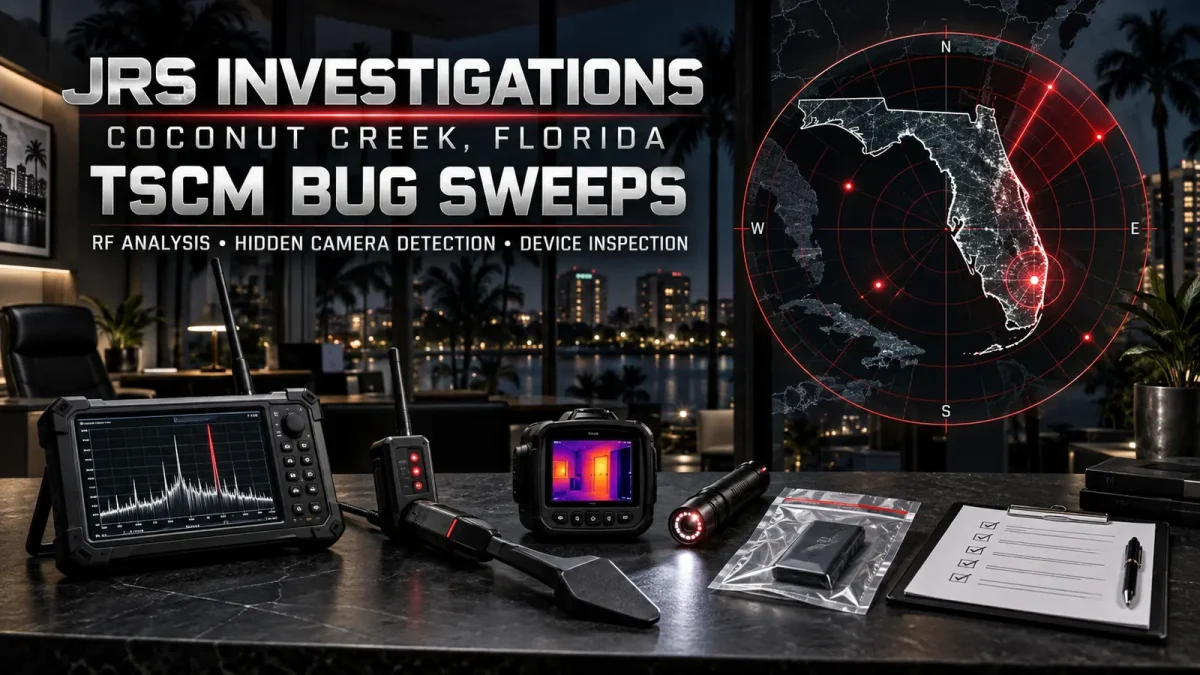
Coconut Creek TSCM Bug Sweeps: How Hidden Devices Are Detected
A Coconut Creek TSCM bug sweep is a structured inspection for unauthorized surveillance risks in a home, office, conference room, vehicle, or other controlled environment. The work combines threat assessment, physical inspection, specialized electronic testing, and professional interpretation. It is not a quick scan with one handheld device, and no responsible provider should guarantee that every possible threat will be found.
JRS Investigations provides Technical Surveillance Countermeasures services in Coconut Creek and other authorized Florida locations. Our scope is designed around the client’s concerns, the space, access history, equipment, and intended use of the findings. For a confidential assessment, call (888) 737-7690.
Clients in neighboring northwest Broward County may also find our guide to warning signs that may justify a Parkland bug sweep useful.
What Is a TSCM Bug Sweep?
Technical Surveillance Countermeasures, commonly called TSCM, is the process of identifying and evaluating possible eavesdropping, hidden-camera, tracking, or related surveillance risks. A professional sweep looks for indicators across several categories rather than relying on one signal or one piece of equipment.
Potential threats may transmit by radio frequency, connect to a wired or networked system, store information locally, activate only at selected times, or remain dormant. Some commercial devices are small enough to be concealed in ordinary objects or building fixtures. These differences are why a credible inspection combines complementary methods and a careful review of the environment.
For location-specific service information, review JRS’s Coconut Creek TSCM bug-sweep services.
When a Bug-Sweep Assessment May Be Appropriate
A single unusual noise, battery problem, or unfamiliar electronic signal does not prove that surveillance is occurring. Modern buildings contain Wi-Fi equipment, Bluetooth accessories, smart devices, security systems, cellular signals, and neighboring electronics that can create innocent anomalies. The strongest reason for an assessment is usually a pattern involving information, access, timing, and unexplained physical or technical changes.
Confidential Information Appears Outside the Intended Group
Repeated leaks involving negotiation positions, legal strategy, business plans, personnel decisions, or private conversations may justify a closer review—especially when only a small group had access to the information.
Unexplained Changes to a Sensitive Space
A new object, replaced charger, moved ceiling tile, altered wall plate, unfamiliar cable, modified smoke detector, or unexpected maintenance visit may deserve documentation. Many changes will have ordinary explanations, but the combination of access and timing can help define a rational scope.
Privacy Concerns Follow a Relationship or Employment Dispute
Separation, contentious litigation, a workplace conflict, termination, or access by a former vendor can increase concern about unauthorized monitoring. The assessment should remain evidence-led and lawful, not driven by accusation alone.
A High-Value Meeting or Project Requires Additional Assurance
Attorneys, executives, investors, and organizations may schedule a sweep before a confidential meeting, transaction, product discussion, or sensitive interview. Preventive work is most useful when paired with access control and post-sweep room discipline.
What a Professional TSCM Sweep May Include
The exact process depends on the threat model and the environment. JRS may recommend some or all of the following methods where appropriate.
Pre-Sweep Consultation and Threat Assessment
The specialist asks what raised concern, what information may be exposed, who has had access, which rooms or vehicles matter, and whether recent construction, cleaning, maintenance, or technology changes could explain anomalies. This step determines priorities and prevents an unfocused inspection.
Physical and Visual Inspection
Many surveillance risks leave physical indicators. Inspectors may examine furnishings, wall plates, ceiling areas, vents, lighting, power sources, chargers, decorative objects, telephone equipment, network hardware, and other locations appropriate to the space. The goal is to identify unexplained modifications, concealment opportunities, and items inconsistent with the environment.
Radio-Frequency Spectrum Analysis
RF analysis evaluates signals in and around the target space. A specialist distinguishes expected activity—such as Wi-Fi, Bluetooth, cellular, building systems, and legitimate wireless devices—from transmissions that require further examination. Spectrum data must be interpreted in context; signal detection alone does not establish that a bug is present.
Nonlinear-Junction Detection
A nonlinear-junction detector can help locate semiconductor components even when a device is not actively transmitting. This method can be useful when evaluating objects, walls, furnishings, or fixtures, but ordinary electronics and construction materials may also produce responses. Follow-up inspection and professional judgment remain essential.
Optical, Thermal, and Detailed Electronic Checks
Depending on the environment, a sweep may include optical techniques for suspected camera lenses, thermal observations, inspection of wiring or telephone infrastructure, or other targeted tests. Each method has limits. Layering tools with physical inspection reduces dependence on any single result.
Network and Device-Security Coordination
A physical TSCM sweep is not the same as a forensic examination of a phone, computer, or cloud account. If the concern involves malware, account access, network intrusion, or device compromise, the client may also need a qualified digital-forensics or cybersecurity specialist. JRS defines those boundaries clearly rather than presenting one service as a solution to every privacy problem.
Why Phone Apps and Consumer Detectors Are Not Enough
Consumer tools may identify a strong signal, reflected light, or a nearby Bluetooth device, but they also produce false alerts and can miss threats that are wired, dormant, shielded, intermittently active, or storing data locally. A smartphone cannot reliably inspect every relevant frequency, building component, power source, optical path, or concealment location.
A professional sweep adds calibrated equipment, baseline comparison, systematic coverage, and experienced interpretation. The value is not simply possessing a detector; it is knowing how to investigate an anomaly and document why it is benign, suspicious, or unresolved.
How to Prepare for a Coconut Creek TSCM Sweep
- Do not announce the sweep to people who do not need to know.
- Avoid moving, opening, unplugging, or discarding suspicious objects.
- Write a factual timeline of information leaks, access events, repairs, visitors, and unusual observations.
- Identify the rooms, vehicles, devices, meetings, or conversations that matter most.
- Gather floor plans, equipment lists, access logs, maintenance records, or photographs when available.
- Keep normal electronics in place unless the specialist gives different instructions.
- Arrange authorized access to locked rooms, cabinets, vehicles, and infrastructure included in the scope.
If a suspicious item is found before the appointment, photograph it in place if that can be done safely, limit handling, and call the investigator. Do not confront a suspected person or attempt to disable, destroy, or publicly expose the item. The appropriate response depends on safety, ownership, evidence needs, and applicable law.
Residential, Business, and Vehicle Sweeps
Homes and Private Residences
Residential concerns may involve bedrooms, home offices, common areas, smart-home devices, exterior access points, or objects recently brought into the home. The client must have authority to authorize inspection of the property and included items.
Offices and Conference Rooms
Business sweeps may focus on executive offices, conference rooms, interview rooms, legal departments, reception areas, server or telecom spaces, and locations where sensitive conversations occur. The sweep should be paired with practical controls for keys, visitors, cleaning, maintenance, and unattended rooms.
Vehicles
A vehicle assessment may include a structured physical and electronic inspection of accessible interior, exterior, power, and communication areas. Ownership and authorization must be confirmed before work begins. Some vehicle concerns overlap with telematics, account access, or manufacturer systems and may require additional expertise.
Learn more about JRS’s broader TSCM bug-sweep capabilities and counter-surveillance services.
What a TSCM Report Should Explain
Before hiring a provider, ask what deliverables are included. A useful report should identify the inspected areas, date and conditions, general methods, relevant observations, unresolved limitations, findings, and recommended next steps. It should avoid claiming certainty beyond what the inspection supports.
Also confirm rates, travel, equipment charges, reporting time, rescheduling terms, and procedures if an item requiring additional analysis is identified. A written scope protects both the client and the investigator.
Licensing, Privacy, and Evidence Considerations
Florida regulates private investigative agencies and investigators. Clients can review licensing information through the Florida Department of Agriculture and Consumer Services. Ask who will conduct or supervise the work and verify that the proposed services fall within the provider’s qualifications.
Florida law also addresses interception of wire, oral, and electronic communications. The Florida Legislature’s current Chapter 934 is an official starting point, but it is not a substitute for legal advice about a specific device, recording, property, or communication. Consult qualified counsel when evidence may be used in litigation or when ownership and consent are disputed.
After the Sweep: Reduce Future Exposure
A clean sweep is a point-in-time assessment, not a permanent guarantee. Reduce future risk by controlling access to sensitive rooms, supervising vendors, documenting repairs, inventorying equipment, protecting keys and credentials, reviewing smart devices, and limiting confidential conversations to appropriate spaces.
Organizations should consider follow-up work after renovations, leadership changes, terminations, unexplained leaks, high-risk travel, or major confidential meetings. The schedule should reflect actual risk rather than an arbitrary promise that every client needs the same frequency.
Frequently Asked Questions
Can a bug sweep find every hidden device?
No provider can responsibly guarantee detection of every possible device under every condition. A layered, well-scoped inspection improves coverage and documents the limitations that remain.
What happens if a suspicious device is found?
The investigator should document the item and discuss safe next steps. Depending on the circumstances, the client may need legal counsel, law enforcement, a digital examiner, property management, or another specialist. Avoid destroying or altering potential evidence.
Does a TSCM sweep check my phone?
A physical sweep may identify relevant signals or nearby risks, but a forensic examination of a phone is a different service. Suspected account compromise, stalkerware, or malware should be evaluated by an appropriately qualified device or cybersecurity specialist.
How long does a Coconut Creek sweep take?
Time depends on square footage, room contents, construction, number of vehicles, infrastructure, access, and the threat model. A pre-sweep consultation allows JRS to estimate the scope more accurately.
Schedule a Confidential Coconut Creek Assessment
JRS Investigations provides scope-driven TSCM services for authorized residential, business, and vehicle environments in Coconut Creek, Florida. We combine physical inspection, technical testing, and clear reporting without exaggerated guarantees. Call (888) 737-7690 or review our complete private investigation services to discuss the right starting point.