(888) 737-7690

Coconut Creek FL TSCM Bug Sweeps | JRS Investigations
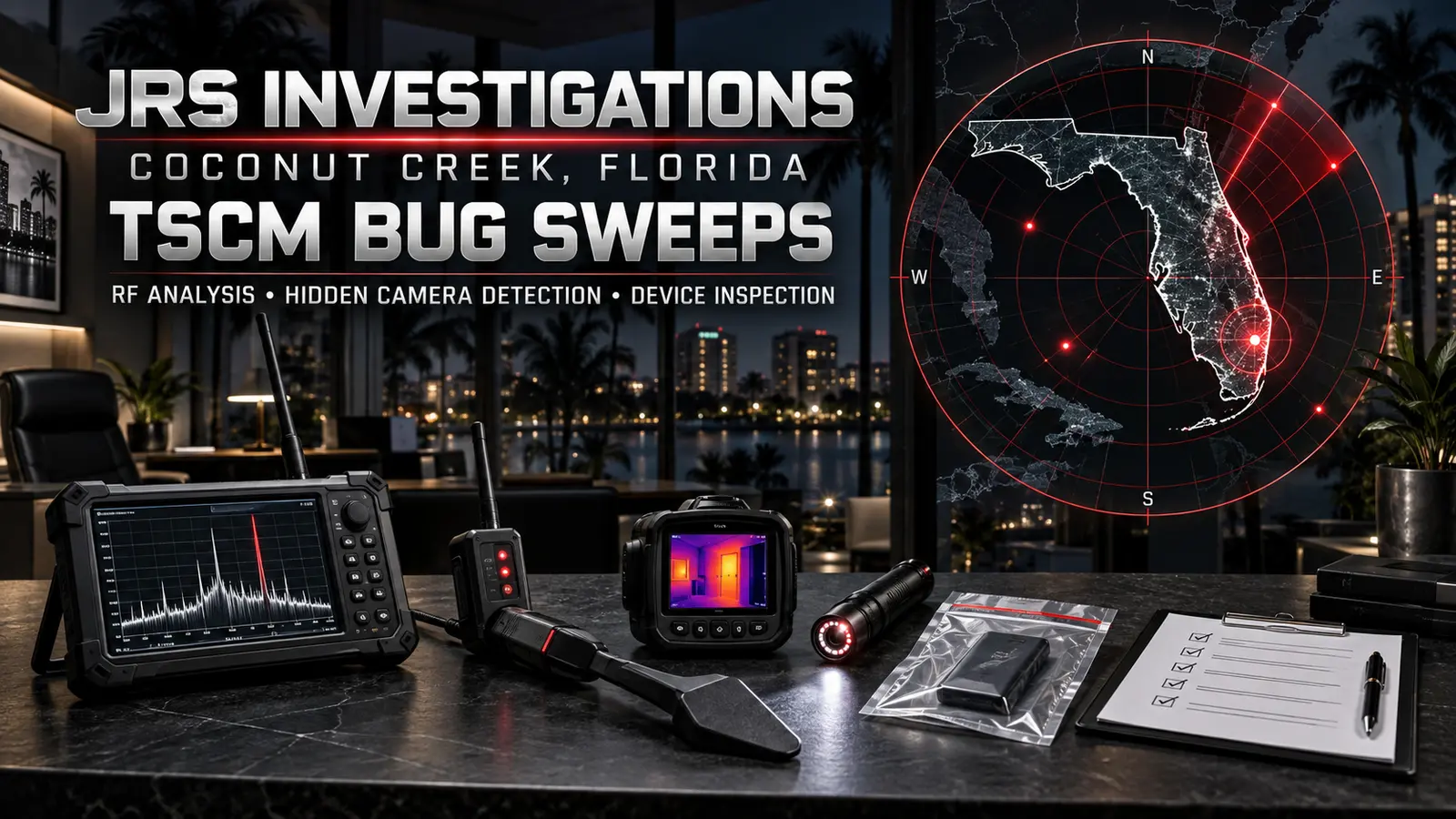
Coconut Creek TSCM Bug Sweeps
Confidential inspections for Broward County properties and vehicles
Call (888) 737-7690
Free Consultations
A Coconut Creek Sweep Starts With the Privacy Event
JRS Investigations conducts technical surveillance countermeasures for authorized residential, business, meeting-space, and vehicle assignments in Coconut Creek and surrounding Broward County. The work begins by identifying the event that created concern: an unexplained disclosure, suspicious access, a disturbed room, a new object, a personnel change, or knowledge of a route or conversation that should have remained private.
Coconut Creek includes single-family homes, condominium communities, gated developments, active-adult properties, professional offices, retail areas, and shared facilities. Assignments near Winston Park, Regency Lakes, Centura Parc, Banyan Trails, Coral Gate, Wynmoor, Lyons Road, Coconut Creek Parkway, and the Copans Road corridor can present different access and scheduling conditions. Community gates, property managers, association rules, staff access, shared walls, contractors, and visitor records may all affect the inspection plan.
What Technical Surveillance Countermeasures Examine
The NIST definition of TSCM centers on techniques used to address technical surveillance technologies and hazards that can allow unauthorized access to information. A private-sector sweep may combine a physical search with technical methods chosen for the property and the reported threat.
- Concealed or disguised cameras and optical openings
- Audio recorders, microphones, or unauthorized transmitters
- Unfamiliar wiring, power sources, adapters, and modified fixtures
- Accessible tracking equipment attached to or concealed in a vehicle
- Objects introduced after a visitor, vendor, employee, tenant, or contractor had access
Why the Access Timeline Matters
A detector cannot explain who entered a home, who knew an alarm code, or when confidential information escaped. We ask the client to identify keys, codes, cleaning visits, repair work, deliveries, guests, employee access, property-management activity, and the rooms where important conversations occurred. That timeline helps prioritize the places and objects most closely connected to the concern.
Residential, Community and Business TSCM in Coconut Creek
Homes, Condominiums and Shared-Building Conditions
Privacy concerns in a home can involve bedrooms, home offices, common living areas, garages, outdoor access points, network equipment, chargers, clocks, smoke alarms, power strips, décor, and items left by another person. Condominium and multi-unit settings may also contain ordinary neighboring signals, shared infrastructure, association equipment, and maintenance access that must be distinguished from suspicious activity.
Gated and Association-Controlled Properties
A gate or controlled entrance does not establish who accessed an individual unit. Vendor lists, guest records, smart-lock histories, camera coverage, alarm activity, and maintenance schedules may help define the opportunity window. Clients should preserve those records when available and obtain any required authorization before the inspection.
Offices, Professional Practices and Sensitive Meetings
A business sweep may focus on executive offices, conference rooms, administrative workspaces, records areas, reception zones, accessible wiring, shared furnishings, or a temporary meeting location. Relevant triggers can include a confidential proposal becoming known, unusual competitor knowledge, a departing employee with continued access, an unauthorized entry, or a sensitive negotiation held in an uncontrolled room.
Vehicles and Location Awareness
Vehicle checks may be included when someone repeatedly knows the client’s route, destination, or schedule and there is a credible opportunity to access the vehicle. Florida law regulates interception of communications, and clients can review the current text of Florida Statute §934.03. JRS does not provide legal advice. Ownership, consent, evidence handling, stalking, or immediate safety concerns may require an attorney or law-enforcement agency.
Physical TSCM Is Not Digital Forensics
Phone compromise, account intrusion, malicious applications, email access, cloud-account exposure, and router configuration can overlap with a surveillance concern but may require cybersecurity or digital-forensics services. We define that boundary during intake so a physical sweep is not presented as a cure for every privacy problem.

Patterns That May Justify a Professional Inspection
An isolated electronic symptom is not proof of surveillance. Static, battery drain, dropped calls, unfamiliar Wi-Fi names, and ordinary device heat often have harmless causes. The concern becomes more specific when access, timing, and information loss line up.
- Private conversations, pricing, strategy, or travel details become known without a clear source
- A room, residence, office, or vehicle shows evidence of unexplained entry or disturbance
- An unfamiliar charger, cable, adapter, sensor, fixture, adhesive mount, or small opening appears
- A former partner, employee, tenant, guest, vendor, or contractor retained access unexpectedly
- A sensitive meeting took place in a room that was not secured before use
- Location awareness continues after normal phone-sharing and account settings are reviewed
What Not to Do With a Suspicious Object
Do not automatically remove, power down, connect to, pair with, open, or destroy an unfamiliar device. Its placement, condition, serial information, orientation, nearby objects, and discovery context may be important. Photograph the scene only if that can be done safely and without moving the item. When criminal conduct or immediate danger is suspected, contact law enforcement.
For additional context, read how hidden-device concerns are evaluated in Coconut Creek.
Preparing for a Coconut Creek Bug Sweep
Preserve the Timeline
Write down the dates of suspicious disclosures, access events, repairs, guests, personnel changes, vehicle use, and anything that appeared or moved. Save relevant messages, access logs, invoices, smart-lock histories, or building records without editing the originals.
Protect the Appointment
Do not discuss the planned inspection in the room, vehicle, phone, or account you believe may be compromised. Use a safer communication method and limit the details to people who need to know.
Confirm Lawful Access
The client must have authority to authorize the inspection. Rental units, shared offices, employer-owned areas, association property, and vehicles with disputed ownership may require additional documentation or legal guidance.
Reduce Unnecessary Activity
When practical, avoid cleaning, rearranging furniture, replacing chargers, discarding unfamiliar objects, or allowing nonessential visitors before the sweep. Ordinary occupancy requirements can be discussed during scheduling.
A Scope-Based Inspection Process
- Confidential intake: define the privacy event, property, vehicle, timing, and authorization.
- Threat review: connect access opportunities with the information or movement that became known.
- Environmental baseline: identify authorized electronics, building systems, and normal wireless activity.
- Physical and technical examination: apply appropriate visual, physical, optical, radio-frequency, wiring, power, and vehicle methods.
- Documentation: record relevant observations and distinguish confirmed facts from unresolved conditions.
- Client briefing: explain findings, limitations, preservation options, and appropriate referrals.
Learn more about JRS counter-surveillance services and our broader TSCM capabilities.
Coconut Creek TSCM Frequently Asked Questions
How long does a sweep take?
The time depends on square footage, room count, furnishings, construction, signal density, access, the number of vehicles, and the reported threat. A consultation is required to define the scope before scheduling.
Can JRS inspect a condominium or gated-community residence?
Yes, when the client has authority over the areas to be inspected. Shared systems, neighboring signals, association equipment, and property-management access are considered during planning.
Can the inspection cover only a home office or conference room?
Yes. A focused scope may be appropriate when the timeline points to a particular room or event. We explain what a limited inspection can and cannot establish.
Can a sweep find a hidden camera, recorder, or tracker?
The examination can look for physical, optical, radio-frequency, wiring, power, and installation indicators associated with those devices. Some equipment records locally, sleeps between transmissions, uses authorized networks, or is concealed beyond accessible areas. No responsible provider can guarantee perfect detection.
What happens if something unusual is found?
JRS documents what was observed and discusses preservation and referral options. Further analysis, cybersecurity work, legal advice, or law-enforcement involvement may be appropriate depending on the item and circumstances.
Will the consultation remain confidential?
Discretion is incorporated into communications and scheduling, subject to legal obligations and the practical requirements of property access. Clients should avoid announcing the sweep where they believe monitoring may occur.
Related Coconut Creek Resources
- How to detect hidden-device concerns in Coconut Creek
- Common categories of surveillance devices
- Coconut Creek private-investigation services
- JRS service areas
Request a Confidential Consultation
Call (888) 737-7690 or contact JRS Investigations to discuss the access history, property type, vehicle, timing, and desired scope. Knowledge Is Power. Get the Facts.
No inspection can certify that a location is permanently free of surveillance. TSCM does not replace legal advice, cybersecurity, mobile-device forensics, or emergency law-enforcement assistance.