
(888) 737-7690
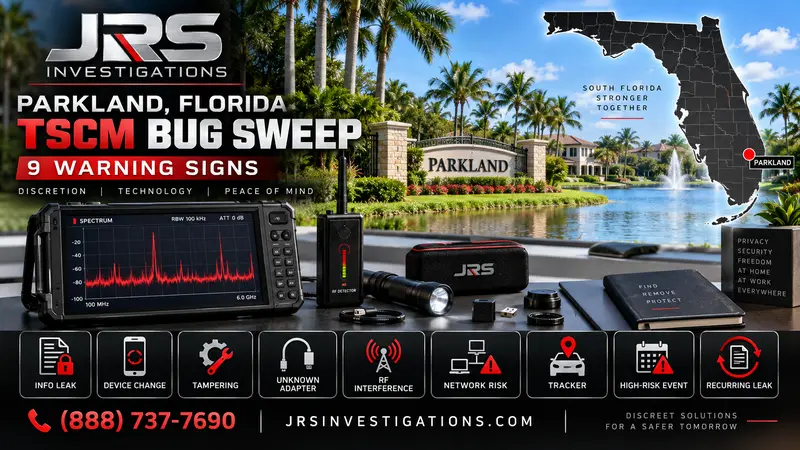
9 Signs You May Need a Bug Sweep in Parkland, Florida
When private conversations, business plans, legal strategy or family information appears to be reaching the wrong person, it is natural to wonder whether a room, vehicle or device is being monitored. A professional technical surveillance countermeasures inspection—often called a TSCM inspection or bug sweep—can help evaluate that concern. For Parkland residents and businesses, the key is to respond methodically instead of assuming that every odd sound, dropped call or unfamiliar object proves surveillance.
The following nine signs may justify a closer look. None is proof by itself. Many have ordinary explanations, and some problems belong to cybersecurity or digital forensics rather than a physical bug sweep. JRS Investigations can help define the right scope through its Parkland TSCM bug-sweep service and broader Florida TSCM services.
1. Confidential information is known unexpectedly
One of the most meaningful warning signs is not a strange noise but a pattern: another person repeatedly knows details that were discussed only in a limited setting. Examples include a competitor reacting to an unannounced bid, an opposing party anticipating legal strategy, or a former partner referring to a private conversation. Before concluding that a listening device exists, document who knew the information, where it was discussed, which devices were present and who had legitimate access. Email forwarding, shared cloud accounts, unsecured notes, ordinary workplace gossip and compromised passwords can produce the same result.
2. A device or room component has changed without explanation
Pay attention when an everyday object looks different after unauthorized access, maintenance or a period when the space was unattended. A smoke detector, power strip, charger, conference-room accessory, wall plate or network component may be moved, replaced or newly installed. The important factor is a verifiable change, not simply that an object looks technical. Photograph the item from a safe distance and compare it with invoices, maintenance records or prior photos. Do not dismantle it or interrupt power if preservation of evidence may matter.
3. There are signs of tampering after unexpected access
Loose outlet covers, fresh tool marks, disturbed ceiling tiles, unfamiliar adhesive, displaced furniture or a changed access-control log can justify further review—especially after an unauthorized visitor, disputed contractor visit, employee termination or break-in. These conditions also arise from ordinary repairs, cleaning and building work. A useful assessment starts with a timeline and a list of everyone who could enter the property. JRS can coordinate physical observations with the broader investigative options described on its Parkland private investigator page.
4. Unfamiliar adapters, cables or network equipment appear
Modern surveillance concerns are not limited to a classic hidden microphone. Unknown USB chargers, adapters, small inline devices, cables, Wi-Fi extenders or network hardware deserve identification when nobody authorized them. Inventory model numbers, serial numbers and the ports involved without logging into or resetting the equipment. A device may be harmless or belong to an internet provider, alarm company or previous occupant. Verification is the first step; conclusions come later.
Network equipment can create risks that a room-focused RF inspection alone may not resolve. The U.S. Cybersecurity and Infrastructure Security Agency has documented how compromised routers can be used to capture or redirect network traffic and recommends measures such as changing default credentials, using encrypted management protocols and keeping supported equipment updated. That is why a well-scoped TSCM review may need to be coordinated with qualified cybersecurity support. See the CISA network-security advisory.
5. Radio-frequency interference is persistent and repeatable
Buzzing speakers, recurring interference or unexplained radio-frequency activity can prompt concern, but consumer electronics, wireless cameras, routers, smart-home devices, faulty wiring and nearby transmitters are common benign causes. A professional survey does not rely on a phone app or a single detector. It examines the environment systematically, compares signals with known equipment and looks for repeatable anomalies. The goal is to identify and explain activity, not to turn ordinary electronic noise into proof of eavesdropping.
6. Account or network compromise continues
Repeated password resets, unrecognized logins, changed forwarding rules, new device sessions or unusual data use may indicate a digital compromise. These symptoms can explain information leaks even when no physical transmitter is present. TSCM and digital forensics are related but different disciplines: a bug sweep evaluates the physical and radio-frequency environment, while digital analysis may be needed for computers, phones, cloud accounts and logs. JRS can help discuss the investigative path, but clients should not expect a physical sweep by itself to diagnose every cyber incident.
Software-based monitoring is another distinct risk. The Federal Trade Commission explains that stalkerware can secretly track a device, access communications or activate a microphone, and it advises people in potentially abusive situations to consider personal safety before changing or removing anything. If domestic abuse is possible, use a safer device to seek help and avoid actions that could escalate danger. Review the FTC’s stalkerware safety guidance.
7. A vehicle shows possible tracker indicators
An unfamiliar object, disturbed trim, repeated unknown-device alerts or another person’s unexplained knowledge of a vehicle’s movements may warrant inspection. Built-in telematics, family-sharing settings, insurance devices, fleet systems and manufacturer apps are also common sources of location data. Do not crawl beneath a vehicle in an unsafe location or remove a suspected device. Record what you observed and arrange a controlled review. If you feel followed or face an immediate threat, move to a safe public place and contact law enforcement.
8. A high-risk event changes the threat picture
The need for a sweep often depends on context. A merger, sensitive negotiation, lawsuit, contentious separation, employee departure, trade-secret dispute, campaign, celebrity visit or executive meeting can increase both the value of private information and the number of people seeking access. A survey scheduled before and after a high-risk event can establish a cleaner baseline than a vague search performed months later. Parkland clients planning a wider inquiry can also review the guide to hiring JRS Investigations in Parkland.
9. Information leaks continue after ordinary security fixes
If confidential details keep escaping after access permissions, passwords, meeting practices and document handling have been reviewed, a physical-environment assessment may be a reasonable next step. Recurrence matters. Record each incident, the information exposed, who possessed it and which rooms, vehicles, phones or accounts were involved. That timeline helps an investigator distinguish a single coincidence from a pattern and prevents the survey from becoming an unfocused search of everything.
What a professional Parkland bug sweep examines
A responsible TSCM engagement begins with a confidential intake and a defined scope. The examiner needs to understand the rooms or vehicles involved, the type of information at risk, relevant dates, known equipment and who had access. This preparation affects where, when and how the inspection is performed. It also helps determine whether the concern is primarily physical, wireless, network-based or mobile-device related.
Depending on the authorized scope and conditions, the work may include a detailed physical inspection, review of accessible cabling and communication points, evaluation of radio-frequency activity and examination of suspicious objects or installations. The process should account for legitimate building systems, Wi-Fi, Bluetooth, alarm equipment, smart-home devices and nearby transmitters. Findings should be documented in plain language, including what was examined, what could not be examined and any recommended mitigation.
No ethical provider should promise that every form of surveillance will always be found. Devices may be powered off, intermittent, concealed outside the agreed area or based entirely in software or cloud accounts. Some require specialist digital forensics; others may be inaccessible without the property owner’s permission. The value of a professional survey lies in a disciplined search, defensible documentation and a candid explanation of limitations.
Homes, offices, vehicles and meeting locations
Parkland assignments may involve a residence, home office, executive workspace, conference room, vehicle or temporary meeting site. Each environment has different legitimate electronics and access patterns. A residence may contain smart speakers, cameras, mesh-network nodes and household accounts. An office may have managed Wi-Fi, access-control systems and audiovisual equipment. A vehicle may have factory telematics and paired phones. The survey plan should match the environment instead of treating every location alike.
JRS also serves nearby South Florida communities, allowing a matter to be scoped across more than one location when necessary. Related service pages include Coconut Creek TSCM bug sweeps and Weston TSCM bug sweeps. Broader investigative offerings are summarized on the JRS services page.
What to do before an inspection
Avoid announcing the planned sweep in the space you believe may be monitored. Use a different trusted device and location when first making contact. Do not destroy, disconnect, reset or move a suspicious object unless safety requires it. Preserve photographs, dates, access logs, invoices, account alerts and the names of people who may have relevant knowledge. Limit sensitive conversations in the affected area until the situation is assessed.
Florida law restricts the intentional interception and disclosure of wire, oral and electronic communications except where the statute provides otherwise. A professional inspection should respect ownership, consent, privacy and lawful access boundaries. Clients with questions about recording, evidence use or litigation should consult qualified legal counsel. The governing provision is available in Florida Statutes section 934.03.
Schedule a confidential Parkland TSCM consultation
If one or more of these signs fits a documented pattern, JRS Investigations can discuss a lawful, focused Parkland Florida bug sweep. The initial conversation helps identify the locations, devices, time frame and immediate safety considerations so the right service can be selected. Call (888) 737-7690 or use the confidential JRS contact page.
This page provides general information, not legal advice. Warning signs are not proof of surveillance, and no inspection can guarantee detection of every physical, wireless, digital or cloud-based threat. Contact law enforcement immediately if you believe anyone is in danger.