(888) 737-7690

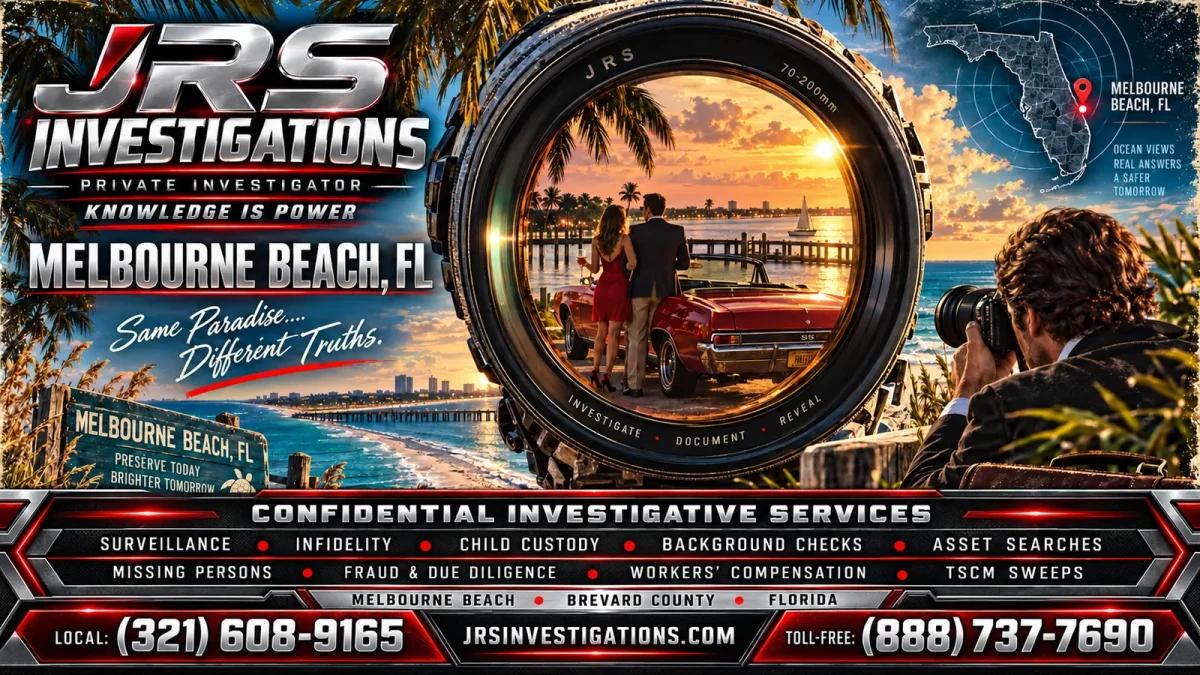
How to Hire a Private Investigator in Melbourne Beach, FL
When a personal, family, or business concern reaches the point where facts matter more than suspicion, choosing the right private investigator can determine whether you receive clear, lawful evidence or an expensive collection of guesses. JRS Investigations provides discreet investigative services in Melbourne Beach and throughout Brevard County, with case planning tailored to the area’s coastal geography, residential neighborhoods, businesses, and travel patterns.
This guide explains what a private investigator in Melbourne Beach, Florida can legally do, which services may fit your situation, how local fieldwork is planned, and what to ask before authorizing an investigation. To discuss a confidential matter, call JRS Investigations locally at (321) 608-9165 or toll-free at (888) 737-7690.
Why Melbourne Beach investigations require local planning
Melbourne Beach sits on a narrow barrier island between the Atlantic Ocean and the Indian River Lagoon. State Road A1A, Ocean Avenue, nearby causeways, beach access points, residential streets, hotels, condominiums, marinas, and waterfront properties all influence how lawful surveillance can be conducted. A plan that works in a large inland city may fail quickly in a coastal community with fewer practical routes and more visible vehicles.
Effective fieldwork begins with route analysis, timing, lawful observation points, likely destinations, and contingency planning. Depending on the facts, an assignment may extend into Indialantic, Melbourne, Palm Bay private-investigator coverage, Satellite Beach private-investigator coverage, or other parts of Brevard County. Investigators must also account for weather, seasonal visitors, bridge traffic, special events, and changing daylight without compromising safety or discretion.
Local knowledge does not replace evidence. It helps an investigator decide where lawful observation is feasible, when additional personnel may be justified, and how to document activity without trespassing or interfering with the subject.
Private investigation services in Melbourne Beach
No two cases should begin with the same package. The right scope depends on the client’s objective, the legal setting, the available starting information, and how the findings may be used.
Surveillance and activity documentation
Surveillance can establish patterns, verify locations, document meetings, or answer a specific factual question. A professional investigator should define the objective before fieldwork begins. “Find out everything” is rarely a useful instruction; “document whether the subject visits a particular location during a defined period” is measurable.
Investigators may observe and record activity that is lawfully visible from public areas or other authorized locations. They may not trespass, enter private property without permission, or use unlawful methods to obtain information. A clear field report should separate direct observations from interpretation and identify the date, time, location, and supporting photographs or video.
Infidelity and relationship investigations
Suspected infidelity is emotionally difficult, and impulsive confrontation can destroy useful information or create unnecessary risk. A discreet investigation can document relevant activity while the client maintains distance from the situation. Before starting, the investigator should discuss the specific concern, important dates, typical routines, vehicle information, known locations, and the decision the client expects the evidence to support.
The goal is not to manufacture drama. It is to provide objective documentation so the client and, when appropriate, legal counsel can make informed decisions. JRS Investigations can structure surveillance around realistic windows rather than spending the client’s budget on broad, unfocused coverage.
Child custody and domestic investigations
In a child custody or domestic investigation, useful evidence usually relates to the child’s safety, care, supervision, living conditions, or compliance with court-ordered arrangements. Investigators should focus on observable conduct and avoid conclusions that belong to attorneys, evaluators, or the court.
Clients should provide current court orders, parenting schedules, exchange locations, known safety concerns, and attorney guidance when available. Reports and media must be organized carefully because they may later be reviewed in litigation. An investigator should never encourage a client to violate an order or involve a child in evidence gathering.
Background checks and due diligence
A professional background investigation goes beyond entering a name into a consumer website. The appropriate search may include identity resolution, address history, court records, business affiliations, civil litigation, professional credentials, and other lawful public or authorized sources. The scope must match the permitted purpose and applicable privacy and consumer-reporting rules.
Background research can help individuals evaluate a new relationship, families assess a caregiver, attorneys develop case information, or businesses examine a potential partner. Similar names and incomplete databases can produce false matches, so significant findings should be verified against multiple identifiers and primary records whenever possible.
Fraud, assets, and property research
Fraud and asset investigations may involve businesses, real property, court filings, liens, judgments, ownership connections, and documented financial indicators available through lawful sources. Investigators do not have unrestricted access to private bank accounts, tax returns, credit reports, or other protected financial data.
Brevard County resources can be part of a properly scoped search. The Brevard County Property Appraiser provides property-search tools, while the Brevard County Clerk of the Circuit Court and Comptroller explains access to recorded documents. Online entries should be treated as research leads and verified through the appropriate official source when the distinction matters.
Missing persons and skip tracing
Missing-person and skip-tracing investigations can involve relatives, witnesses, former tenants, debtors, beneficiaries, or other people with a legitimate reason to be located. Strong starting information—full legal name, age or date of birth, prior addresses, phone numbers, relatives, employers, vehicles, and social identifiers—can reduce both time and mistaken identity.
If someone is missing under urgent or suspicious circumstances, contact law enforcement first. A private investigator can sometimes supplement the search, but should not delay an emergency report or interfere with an active police investigation.
Insurance and workers’ compensation investigations
Law firms, insurers, employers, and third-party administrators may need documented activity, statements, scene information, or other case-specific evidence. These matters require a defined assignment, attention to statutory and contractual obligations, and neutral reporting. The investigator’s role is to document facts, not to predetermine whether a claim is valid.
TSCM bug sweeps in Melbourne Beach
For a focused equipment overview, review the five device types evaluated during a Melbourne Beach TSCM sweep.
When there is a credible concern about hidden cameras, unauthorized audio devices, tracking equipment, or compromised communications, JRS Investigations offers TSCM bug-sweep services in Melbourne Beach. Technical Surveillance Countermeasures may combine a physical inspection with radio-frequency analysis, non-linear junction detection, thermal or optical examination, network review, and an assessment of the environment.
A professional sweep is not a quick pass with a low-cost detector. The property owner or another authorized person must approve access, and the scope should identify the rooms, vehicles, devices, network components, and threat indicators to be examined. Findings should be documented along with practical recommendations for reducing future exposure.
Florida licensing and legal boundaries
Florida regulates private investigative work under Chapter 493 of the Florida Statutes. The Florida Department of Agriculture and Consumer Services explains that individuals performing private investigative work generally hold a Class “C” license and agencies operate under a Class “A” license. Clients can review requirements and use the department’s licensee search before hiring.
A license is important, but it does not authorize hacking, impersonating law enforcement, opening private accounts, placing a tracking device without lawful authority, trespassing, or recording communications in violation of applicable law. Access to a vehicle does not automatically establish legal authority to track it. Any proposed GPS use should be reviewed for ownership, consent, court orders, and current law before equipment is considered.
Investigators also are not attorneys. If evidence may affect divorce, custody, employment, criminal exposure, or other litigation, coordinate the investigation with qualified legal counsel so the assignment supports the legal strategy and preserves relevant evidence.
How to choose a private investigator
A professional consultation should leave you with a clearer objective, not more pressure. Before retaining an investigator, ask:
- Are the investigator and agency properly licensed for the work?
- Have they handled this type of matter and this geographic area?
- What facts are realistically obtainable through lawful methods?
- What information do they need from you before starting?
- How are retainers, hourly rates, mileage, travel, equipment, and additional investigators billed?
- How often will you receive updates, and who is your point of contact?
- What will the final report include?
- How are photographs, video, notes, and sensitive client information secured?
- Can the investigator explain what they will not do and why?
Be cautious of guaranteed outcomes, vague claims of special database access, promises to obtain protected records, or unusually low prices that omit travel and reporting. Ethical limitations are a sign of professionalism, not a weakness.
What to prepare for the initial consultation
You can make the first conversation more productive by organizing the information already in your possession. Bring a concise timeline, the subject’s correct identifying details, recent photographs, vehicle descriptions, known addresses, important dates, relevant court orders, and the names of attorneys or agencies already involved. Explain what decision you need to make and the deadline, if any.
Do not obtain material by accessing another person’s password-protected account, installing spyware, entering private property, or impersonating someone else. Preserve existing texts, emails, photographs, and records in their original form when possible. Tell the investigator how each item was obtained so admissibility and reliability concerns can be identified early.
What professional reporting should include
The investigation is only as useful as its documentation. A professional report should identify the assignment, dates and hours worked, locations, factual observations, relevant media, and any limitations that affected the work. It should distinguish confirmed facts from information supplied by the client or another source.
For litigation-related work, consistent timestamps, original media, secure retention, and a clear chain of custody may be important. For a background or asset matter, the report should identify the records consulted and note where a primary-source confirmation is still needed. Good reporting allows an attorney or decision-maker to understand what was done without relying on assumptions.
Frequently asked questions
How much does a private investigator in Melbourne Beach cost?
Cost depends on the service, number of investigators, anticipated hours, travel, equipment, research fees, and reporting requirements. Surveillance is often billed hourly with a retainer, while some research assignments may have a defined scope. Request a written explanation of charges and authorization limits before work begins.
Can a private investigator obtain text messages or bank records?
Not simply because a client asks. Private messages, account data, financial records, and other protected information generally require the account holder’s authorization, lawful process, or another valid legal basis. An investigator should never promise illegal access.
Can an investigator follow someone across county lines?
Lawful surveillance may continue beyond Melbourne Beach when the assignment, licensing, safety conditions, and applicable laws permit it. The investigator should explain how added distance, travel time, or additional personnel could affect the budget.
Will the subject know an investigation is taking place?
Discretion is a core objective, but no ethical investigator can guarantee that surveillance will never be noticed. Local road design, restricted access, traffic, subject awareness, and weather can affect operations. A responsible investigator will discontinue or adjust activity when continuing would create an unreasonable risk.
How quickly can an investigation begin?
Timing depends on urgency, investigator availability, the quality of the starting information, and whether legal or logistical questions must be resolved first. Contacting the agency early allows time to confirm the objective and prepare a lawful plan.
Speak with JRS Investigations
JRS Investigations provides private investigation services for Melbourne Beach and the surrounding Melbourne area. We approach each assignment with discretion, realistic planning, and a focus on documented facts. Available services include surveillance, infidelity investigations, child custody and domestic matters, background investigations, fraud and asset research, missing-person searches, insurance-related investigations, and authorized TSCM inspections.
For a confidential consultation, call (321) 608-9165 or (888) 737-7690. You may also review our complete private investigation services before contacting us. Share the essential facts, your objective, the location, and any deadline; JRS Investigations can then discuss a practical next step.