(888) 737-7690

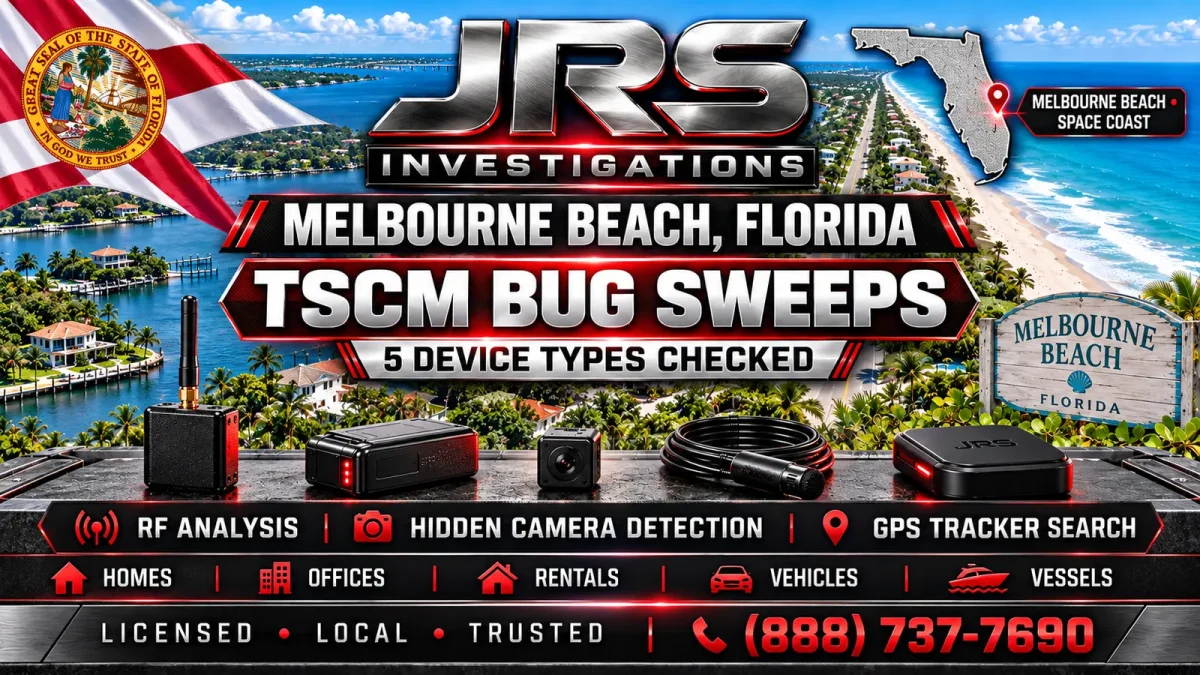
Melbourne Beach TSCM Sweep: 5 Device Types Checked
When private conversations, business information or a person’s movements appear to be known by someone who should not have access, guessing rarely provides a dependable answer. A professional Melbourne Beach TSCM sweep evaluates the environment systematically, documents relevant findings and helps the client understand what should happen next.
JRS Investigations provides confidential technical surveillance countermeasures for authorized homes, condominiums, rental properties, offices and vehicles. Melbourne Beach presents a distinctive mix of barrier-island residences, vacation properties, home offices and coastal travel routes. Those settings can contain ordinary electronics, shared networks and unfamiliar devices that deserve careful evaluation without immediately assuming that every signal is a threat.
This guide explains five broad device categories that may be considered during a properly scoped inspection. The exact methods depend on the property, the client’s concerns and the lawful access available at the time of service.
1. Radio-Frequency Audio Transmitters
Traditional listening devices can transmit captured audio over radio frequencies to a nearby receiver. Some remain active continuously; others transmit only when they detect sound. They may be concealed inside common objects, connected to power or operated by batteries.
A professional inspection does more than look for a single suspicious frequency. The surrounding spectrum can contain legitimate signals from Wi-Fi equipment, Bluetooth accessories, alarm components, smart-home products, marine electronics and neighboring properties. The examiner must collect, compare and interpret those signals in context. A signal becomes meaningful only after it is evaluated against its source, behavior, location and the conditions present during the sweep.
JRS combines RF analysis with physical inspection and source verification. This reduces the chance of treating an ordinary electronic device as evidence while helping isolate transmissions that warrant additional attention.
2. Cellular and Internet-Connected Listening Devices
Cellular audio devices can use mobile networks to communicate beyond the immediate area. Internet-connected devices may use Wi-Fi, Ethernet or another network path. Because these threats do not always behave like a simple short-range transmitter, a sweep may require more than a basic handheld detector.
The assessment can include a review of unexpected electronics, power sources, network-connected hardware and relevant wireless activity. Where authorized and technically appropriate, the examiner may compare visible equipment with the devices expected to be present. Unrecognized network activity is not proof of surveillance by itself; televisions, printers, cameras, appliances, routers and guest devices can all create legitimate traffic.
Careful documentation matters. If a suspicious item is identified, clients should avoid unnecessary handling or removal until the circumstances, ownership and potential evidentiary value are considered.
3. Hidden Cameras and Video-Capture Devices
Hidden cameras range from small self-contained recorders to Wi-Fi or cellular devices that allow remote viewing. They can be concealed in objects with a view of bedrooms, living areas, offices, entrances, workspaces or other sensitive locations. Some transmit video; others store footage locally on a memory card.
A Melbourne Beach inspection may include visual and technical examination of objects and fixtures that have a useful line of sight. The examiner considers unusual apertures, unexplained wiring, modified housings, misplaced objects and components that do not match the surrounding environment. Optical inspection tools and appropriate detection methods can support the physical review, but no single tool replaces a disciplined room-by-room process.
Rental properties and recently occupied residences deserve particular care because the client may not recognize every installed device. At the same time, smoke detectors, motion sensors, smart speakers, thermostats and security products may be legitimate. Identification and verification are essential before drawing conclusions.
4. Hardwired and Building-System Devices
Not every surveillance device relies on a visible wireless transmission. A microphone or camera can be hardwired into power, telephone, data or other building infrastructure. Some carrier-current devices may use existing wiring as part of their communication path. These threats can be difficult to evaluate because they may remain quiet during a brief scan or resemble ordinary components.
Physical inspection is therefore a central part of a professional TSCM assignment. Depending on the agreed scope and access, the examiner may assess outlets, adapters, cables, communication equipment, furnishings, fixtures and other relevant locations for unexplained alterations. The work should remain controlled and non-destructive unless the client has authorized a more invasive step and the circumstances justify it.
Coastal humidity, salt exposure, previous renovations and aging electrical components can create irregularities that have innocent explanations. Experienced interpretation helps distinguish maintenance issues from indicators that require escalation.
5. Passive Recorders, Trackers and Bluetooth Tags
Some devices do not transmit continuously. A passive audio recorder may store information for later retrieval, while a GPS data logger can retain location history without sending a live signal. Bluetooth tags and compact tracking products may also be misused to monitor movement, vehicles, luggage or personal property.
These devices illustrate why an RF scan alone is not a complete sweep. The assessment may require targeted physical inspection, review of accessible vehicle areas, comparison of installed components and attention to unfamiliar objects. Smartphone safety alerts can be useful for certain consumer trackers, but they do not identify every product or replace a professional evaluation.
Vehicle work must be performed with the owner’s permission or other lawful authority. The scope should be defined in advance because a vehicle inspection differs from a residential or office assignment and may require separate time, access and equipment.
How JRS Structures a Melbourne Beach TSCM Sweep
A productive assignment begins before equipment is deployed. JRS first discusses the client’s concerns, the locations involved, recent access to the property, known electronics, unusual events and the outcome the client needs. That consultation helps establish priorities and prevents the inspection from becoming a generic scan.
The on-site work may combine several methods:
- RF spectrum review and signal evaluation;
- physical inspection of accessible rooms, objects and fixtures;
- examination of relevant network and communication equipment when authorized;
- hidden-camera and optical checks appropriate to the environment;
- inspection for passive, hardwired or non-transmitting devices;
- documentation of observations, findings and recommended next steps.
The combination is important because one method can identify what another misses. The work is also adjusted to the site. A private residence may emphasize bedrooms, home offices and common areas. A company may prioritize conference rooms, executive offices and communications equipment. A rental property may require a careful inventory of unfamiliar electronics. A vehicle assessment follows a different inspection plan.
What a Sweep Can and Cannot Establish
A professional sweep can identify suspicious devices, signals, alterations and vulnerabilities present or detectable during the inspection. It can also help document normal equipment and reduce uncertainty. It cannot honestly guarantee that a property has never been monitored or that no future device will be introduced.
Conditions can change after the examiner leaves. A device may be removed before the appointment, activated only at selected times or located outside the authorized inspection area. Digital compromise involving accounts, phones, cloud services or credentials may also require separate cybersecurity or forensic work rather than a physical TSCM sweep.
JRS explains these limitations clearly so the client receives practical findings instead of exaggerated promises. When an item requires specialized testing, law-enforcement involvement, legal advice or another discipline, the recommendation should reflect that reality.
When to Consider a Professional Inspection
One odd sound or unfamiliar network name does not automatically mean that surveillance is occurring. A confidential consultation may be appropriate when several specific facts point to a privacy concern, such as confidential details repeatedly reaching an unauthorized person, evidence of unexplained access, an unfamiliar device in a sensitive area or a credible threat connected to a domestic, corporate or legal matter.
Before the appointment, avoid confronting a suspected person or posting the concern publicly. Do not unplug, open or discard a questionable item unless safety requires immediate action. Preserve relevant dates, messages, photographs and access information. These steps can protect both the inspection and any later investigation.
Related Melbourne Beach and Florida Resources
Clients seeking a location-specific service overview can review the Melbourne Beach TSCM bug sweep service page. For statewide coverage, see Florida TSCM bug sweeps. JRS also explains its broader counter-surveillance and debugging services and provides additional local support through its Melbourne Beach private investigator page.
Melbourne Beach TSCM Sweep FAQs
How long does a TSCM sweep take?
The time depends on the size and complexity of the property, the number of rooms or vehicles, the amount of electronic equipment and the concerns being evaluated. JRS discusses the scope before scheduling so expectations are clear.
Should I turn off Wi-Fi before the inspection?
Do not change the environment unless the examiner gives specific instructions. Normal operating conditions can provide useful information. JRS will explain any preparation steps during the confidential consultation.
Can JRS inspect a rental or condominium?
Yes, when the client has lawful authority to authorize the inspection. Shared systems, common areas and property belonging to another person may require separate permission and may fall outside the assignment.
Does a TSCM sweep include phones and online accounts?
A physical sweep and a digital-forensic or cybersecurity examination are different services. The initial consultation helps determine whether the concern involves the property, a vehicle, a device, an account or more than one area.
Request a Confidential Melbourne Beach Consultation
JRS Investigations provides licensed, trusted investigative support with a clear scope, appropriate technical methods and evidence-aware documentation. If you need to discuss a residence, office, rental property or vehicle in Melbourne Beach or the surrounding Space Coast, call (321) 608-9165. Knowledge is power, and the first step is a focused, confidential conversation about the facts.