
(888) 737-7690

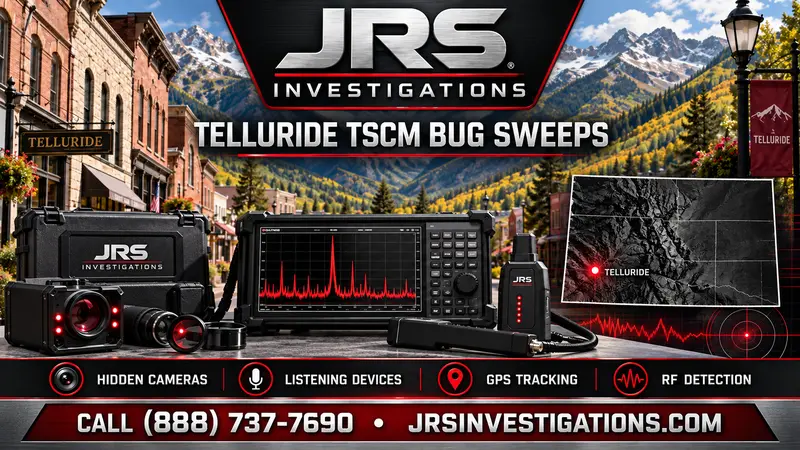
Telluride TSCM Bug Sweeps: A Complete Detection Guide
Privacy concerns can arise anywhere confidential conversations take place—from a mountain residence or vacation property to an executive retreat, conference room, professional office, or hospitality suite. A professional Technical Surveillance Countermeasures inspection, commonly called a TSCM bug sweep, is a structured way to evaluate a space for hidden cameras, unauthorized microphones, transmitters, recorders, and related surveillance risks.
JRS Investigations provides TSCM bug sweeps in Telluride, Colorado for clients who need a discreet, methodical assessment. A sweep does not begin with the assumption that spying has occurred. It begins with the facts: who had access, what information may be at risk, which rooms matter, what changed, and which technical and physical checks fit the situation.
Safety notice: If you believe you are in immediate danger, call 911. If stalking, domestic abuse, or coercive control may be involved, use a device the suspected person cannot access when seeking help. Do not confront anyone or dismantle a suspected device before discussing safety and evidence preservation with the appropriate professionals.
What Is a TSCM Bug Sweep?
TSCM is a coordinated inspection of a defined environment for signs of technical surveillance and security weaknesses. It is more than walking through a room with a handheld detector. A responsible inspection combines advance risk assessment, a detailed visual examination, radio-frequency analysis, electronic-component detection where appropriate, review of accessible communications infrastructure, and documentation of relevant findings.
The exact scope should match the client’s concern. An office used for confidential negotiations may require different preparation than a furnished rental, private residence, vehicle, boardroom, or hotel meeting suite. The JRS TSCM service overview explains the broader purpose of professional bug-detection work and the questions clients should consider before scheduling.
No ethical provider should promise that one tool can locate every possible surveillance method. Some devices transmit continuously, some transmit only at intervals, and some store information without producing an obvious radio signal. That is why layered testing and a careful physical inspection matter.
Why Telluride Requires a Location-Specific Plan
Telluride’s mix of private homes, luxury vacation properties, resort accommodations, event spaces, executive gatherings, and frequently serviced buildings creates distinctive access patterns. Cleaning crews, contractors, property managers, guests, technology installers, event staff, and maintenance personnel may legitimately enter a space. That does not establish wrongdoing, but it can make an accurate access timeline important when planning a sweep.
Mountain properties may also contain detached rooms, mechanical areas, smart-home controls, extensive audiovisual systems, wireless access points, and construction features that affect how an inspection is performed. A professional plan identifies priority areas before technicians arrive so that time is not wasted scanning low-risk space while overlooking the rooms where sensitive conversations actually occur.
Telluride clients may also benefit from reviewing the related article on four situations that may justify a Telluride TSCM sweep. The guide is educational; a consultation is what converts a general concern into a defined inspection scope.
Warning Signs: Indicators Are Not Proof
People often request a sweep after private information appears to be known by someone who should not have it, after a contentious separation or business dispute, or after unauthorized access to a home or office. Other concerns include an unfamiliar object, altered outlet or fixture, unexplained device on a network, unusual account activity, or a vehicle or room that appears to have been disturbed.
None of these observations proves that a hidden device exists. Battery drain, interference, unfamiliar network names, and electronic noises can have ordinary explanations. A sound process records what happened, when it happened, who had access, and which information was exposed without converting suspicion into a conclusion.
Concerns centered on a phone, online account, or app may require a different specialist. The Federal Trade Commission explains that stalkerware can secretly monitor a device and advises people facing possible abuse to consider safety and evidence preservation before making changes. A physical room sweep and mobile-device forensics are related security disciplines, but they are not interchangeable.
Seven Stages of a Professional Telluride TSCM Inspection
- Confidential consultation: The client explains the concern, relevant dates, access history, rooms, devices, and information at risk. The provider defines what is and is not included.
- Operational planning: The inspection is scheduled discreetly. The client receives instructions about occupancy, electronics, cleaning, repairs, and who should know about the visit.
- Baseline and visual inspection: Technicians examine priority areas, fixtures, furnishings, accessible voids, cables, power sources, and objects that could conceal a device.
- Radio-frequency assessment: Appropriate instruments are used to evaluate signal activity and investigate emissions that require closer analysis. Ordinary Wi-Fi, Bluetooth, cellular, and building systems must be distinguished from anomalies.
- Electronic-component detection: Where conditions and scope support it, specialized equipment may help identify electronic circuitry, including components that are not actively transmitting.
- Targeted infrastructure review: Accessible telephone, audiovisual, network, and smart-building elements may be examined within the agreed scope. This is not a substitute for a full cybersecurity assessment.
- Findings and recommendations: Relevant observations are documented, suspicious items are handled carefully, and the client receives practical next steps for remediation or additional specialist review.
Clients can also compare the process with JRS guides for Aspen TSCM sweeps, Vail TSCM sweeps, and Boulder TSCM sweeps. Related pages help property owners and security teams plan consistent privacy procedures across multiple Colorado locations.
What Types of Devices and Risks May Be Evaluated?
A properly scoped inspection may evaluate the environment for concealed microphones, wireless audio transmitters, hidden video cameras, recording devices, modified consumer electronics, unauthorized tracking equipment, and suspicious connections to communications or audiovisual systems. The tools and sequence depend on the site, construction, available access, and threat profile.
Modern surveillance risks are not limited to an obvious “bug.” Everyday items can contain cameras or microphones, while legitimate smart devices may be misconfigured or controlled through accounts the current occupant does not fully manage. JRS has a separate overview of common hidden-camera formats encountered in Colorado investigations.
A sweep should not be described as a guarantee that a location will remain secure forever. New access, new equipment, renovation, staff turnover, rental turnover, or a changed dispute can alter risk immediately after an inspection. The useful outcome is a documented assessment of the space under the conditions present during the examination, together with recommendations that reduce future exposure.
How to Prepare Without Destroying Evidence
Before the appointment, avoid announcing the sweep broadly. Keep a simple chronology of incidents, access, repairs, guests, vendors, and the confidential information that appears to have been exposed. Photograph a suspicious object in place if doing so is safe, but do not open, move, disable, reset, or discard it unless law enforcement or counsel directs you to do so.
Clients should preserve texts, emails, access-control records, invoices, visitor logs, network alerts, photographs, and relevant video in their original form. Do not install random “detector” applications, factory-reset devices, or make extensive changes that could erase useful information. If a phone may be monitored, seek help from another device.
For business and executive environments, identify the rooms where privileged, financial, personnel, legal, or strategic conversations occur. Prepare an accurate list of approved wireless devices and ask IT staff to be available without unnecessarily circulating the reason for the review.
What Happens If a Suspicious Device Is Found?
The correct response depends on safety, ownership, legal strategy, and the apparent device. The first priority is to document the item and its condition. Handling it casually can alter fingerprints, stored data, installation details, or other evidence. Immediate removal may also alert the person responsible and change the client’s risk.
JRS can help the client coordinate next steps, but decisions about seizure, criminal reporting, litigation, or admissibility belong with law enforcement and qualified legal counsel. Colorado statutes address wiretapping and eavesdropping, and the official Colorado Revised Statutes are the appropriate starting point for current law. This article is general information, not legal advice.
A finding is only as useful as its documentation. Photographs, location notes, time, condition, device characteristics, and a clear chain of custody may matter later. Even when no covert device is confirmed, a sweep can identify practical weaknesses such as uncontrolled keys, exposed cabling, default smart-device credentials, or poor meeting-room procedures.
TSCM, Cybersecurity, and Digital Forensics Are Different
Physical TSCM focuses on the environment and technical surveillance risks within the agreed scope. Cybersecurity examines systems, networks, identities, accounts, software, and data controls. Digital forensics preserves and analyzes information on computers, phones, and storage media. A comprehensive privacy response may require more than one discipline.
For example, a room may be clear of an unauthorized microphone while confidential information is still exposed through a shared cloud account, compromised email, weak password, malicious mobile application, or improperly managed smart-home account. NIST’s finalized mobile-device security guidance explains why personal devices used for work create distinct security and privacy challenges. Those risks should be evaluated by the appropriate IT or forensic professional rather than treated as proof of a physical bug.
How Often Should a Sweep Be Scheduled?
There is no universal calendar. Timing should follow risk. A sweep may be appropriate after unauthorized access, before or after a sensitive meeting, during a high-conflict legal or business matter, following renovation or vendor work, when occupancy changes, or when a documented event changes the threat picture.
Organizations with recurring confidential meetings may choose periodic reviews combined with access control, approved-device policies, secure storage, visitor procedures, and staff education. Residential and vacation-property clients may schedule around turnover, extended absence, or a change in who can enter the property. The goal is a proportionate security program, not constant fear.
Questions to Ask Before Hiring a TSCM Provider
- What rooms, vehicles, devices, and infrastructure are included in the proposed scope?
- Which inspection methods are appropriate for this site, and what are their limitations?
- How should the property be prepared before arrival?
- How will findings be documented and communicated?
- What happens if a suspicious item is located?
- Does the provider distinguish physical TSCM from cybersecurity and phone forensics?
- How is confidentiality protected during scheduling and onsite work?
- Will recommendations address access control and prevention as well as detection?
Professionalism also means avoiding dramatic promises, unsupported statistics, and claims that a quick scan can certify a property as permanently secure. Learn more about the team and its approach on the JRS Investigations About Us page.
Schedule a Confidential Telluride Consultation
If you need a carefully planned TSCM bug sweep in Telluride, begin with a confidential conversation about the space, access history, timing, and information at risk. JRS Investigations can help define a practical inspection scope for a residence, vacation property, office, meeting room, hospitality setting, or other authorized location.
Call JRS Investigations at (888) 737-7690 or visit the JRS Investigations home page to request service. Preserve the existing conditions when it is safe to do so, avoid confronting a suspected person, and explain any immediate safety concern at the start of the call.
JRS Investigations performs authorized investigative and security work. Service scope depends on the facts, access permission, location, and applicable law. No inspection can guarantee detection of every surveillance method or future condition.