(888) 737-7690

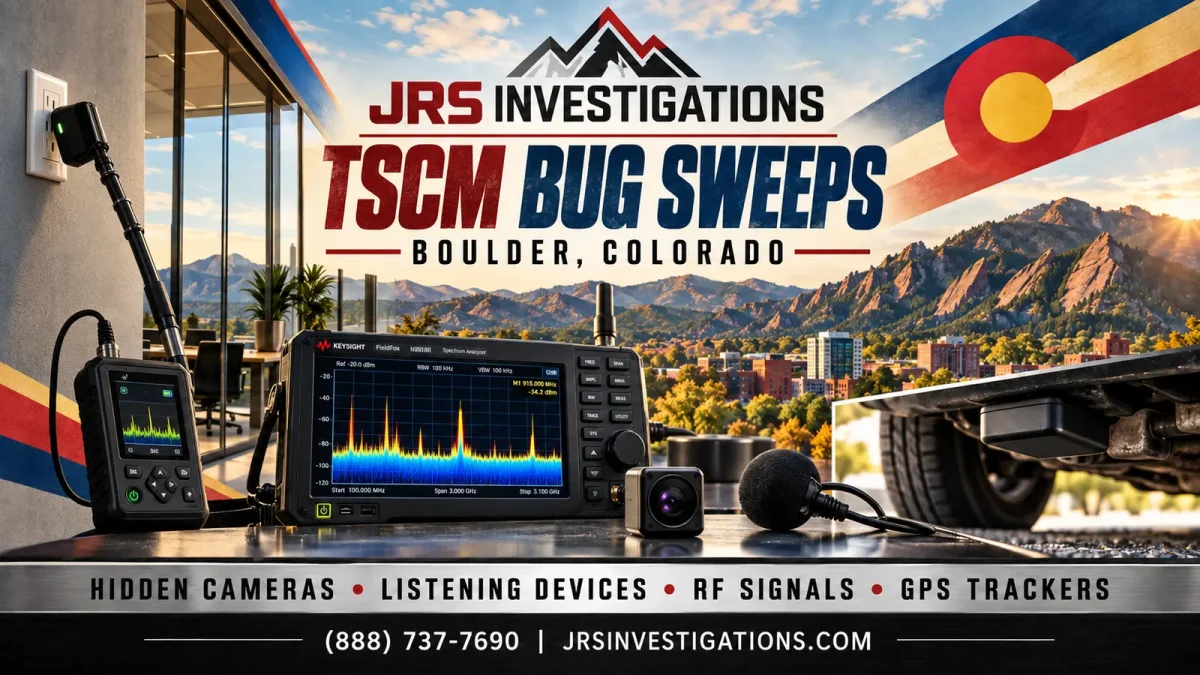
TSCM Bug Sweeps in Boulder, Colorado: Complete Guide
TSCM Bug Sweeps in Boulder, Colorado: A Complete Guide
When a private conversation, business strategy, legal matter, or family issue must remain confidential, a suspected listening device or hidden camera can create immediate concern. A professional TSCM bug sweep in Boulder is a structured technical inspection designed to identify electronic surveillance risks in offices, homes, meeting spaces, and vehicles.
JRS Investigations approaches technical surveillance countermeasures as a disciplined evidence and security process. The objective is not to create fear or make unrealistic promises. It is to assess the environment, evaluate credible indicators, examine likely concealment points, analyze the radio-frequency environment, and explain the findings in clear language. To discuss availability, jurisdiction, and the correct scope for a Boulder assignment, call (888) 737-7690 for a confidential consultation.
What Is a TSCM Bug Sweep?
Technical Surveillance Countermeasures, commonly called TSCM, combines specialized equipment, physical inspection, technical knowledge, and investigative judgment. A complete sweep looks beyond a single handheld detector. It considers how an unauthorized device could be powered, concealed, connected, activated, and used to capture or transmit information.
Threats a professional sweep may examine
- Wireless microphones and audio transmitters
- Hidden cameras and disguised recording devices
- Cellular, Wi-Fi, Bluetooth, and other radio-frequency devices
- GPS trackers and vehicle surveillance equipment
- Hard-wired microphones or modified electronics
- Unauthorized network hardware and suspicious access points
- Devices that are dormant, intermittent, or remotely activated
No single instrument detects every threat. That is why a credible inspection uses several complementary methods and compares technical readings with the physical environment.
Why Boulder Organizations and Residents Request TSCM Services
Boulder combines technology companies, research activity, professional services, university-connected innovation, executive residences, and a steady flow of sensitive meetings. Confidential information may involve intellectual property, investment decisions, litigation, employee matters, product development, personal relationships, or private negotiations.
A request for a sweep does not automatically mean that surveillance has occurred. In many cases, the purpose is preventive: confirming that a location is suitable before a critical meeting, establishing a baseline after employee turnover, or reviewing a space following an unusual security event.
Common reasons to schedule an inspection
- A confidential discussion became known to an unexpected person
- Unfamiliar electronic equipment appeared in a room or vehicle
- An executive, attorney, or business owner is preparing for sensitive negotiations
- A workplace is managing a dispute, termination, merger, or acquisition
- A residence has unexplained devices, wiring, interference, or signs of entry
- A client wants a preventive review before an important event
- A traveler or public-facing professional has elevated privacy concerns
How a Professional Boulder Bug Sweep Is Planned
Preparation begins before equipment enters the property. The investigator should understand what changed, who had access, which conversations may have been exposed, when the concern began, and whether any suspicious item has already been handled or removed. These details help define the inspection area and prioritize the most plausible risks.
1. Confidential intake and threat assessment
The initial consultation establishes the type of property, approximate size, rooms or vehicles involved, access history, network environment, and reason for concern. A careful intake also distinguishes between a preventive inspection and a response to a specific incident.
2. Scope and site preparation
The client and investigator identify the spaces to be examined and determine the best time to work. Limiting unnecessary disclosure can help preserve confidentiality. Clients should avoid discussing the planned sweep inside the location being inspected and should not disturb a suspicious device unless safety requires immediate action.
3. Technical and physical examination
The inspection may include radio-frequency analysis, non-linear junction detection, optical examination, network review, thermal or electrical observations, and a systematic physical search. The exact combination depends on the property, threat profile, construction, and devices present.
4. Findings and next-step guidance
At the end of the assignment, the client should receive an understandable explanation of findings, anomalies, limitations, and recommended actions. If an item may have evidentiary value, the response should protect the scene and preserve documentation rather than casually dismantling or discarding it.
Specialized Equipment Used During TSCM Inspections
Radio-frequency spectrum analysis
A spectrum analyzer helps examine active transmissions across relevant frequency ranges. The operator evaluates signal behavior, strength, modulation, persistence, and relationship to known devices in the environment. A signal is not suspicious simply because it exists; modern buildings contain Wi-Fi, Bluetooth, cellular, security, and smart-device traffic. Interpretation matters as much as detection.
Non-linear junction detection
A non-linear junction detector can help locate electronic components even when a device is not actively transmitting. It is useful when inspecting walls, furnishings, fixtures, containers, and objects that may conceal semiconductor components. Findings still require careful physical evaluation because legitimate electronics can produce similar responses.
Optical and physical inspection tools
Hidden-camera detection, borescopes, magnification, lighting, and methodical visual inspection may reveal lenses, altered fixtures, unusual openings, wiring, or concealment. Common objects can be modified to contain recording equipment, so the room must be examined as a whole rather than as a collection of obvious hiding places.
Network and wireless review
Where authorized, the team may assess connected devices, unfamiliar access points, and wireless activity. Network review is only one layer of the inspection; a covert device may record locally, transmit on a schedule, or operate independently from the property’s normal network.
TSCM Sweeps for Boulder Offices and Meeting Spaces
Corporate inspections often focus on conference rooms, executive offices, boardrooms, legal work areas, research spaces, and locations where pricing, strategy, personnel, or intellectual property is discussed. The process should be discreet and coordinated with a small number of authorized decision-makers.
For higher-risk situations, a sweep can be paired with stronger information-security practices: controlling access, inventorying electronics, limiting unattended visitors, securing meeting materials, and reviewing who knows the time and location of sensitive discussions. A technical inspection is most effective when it is part of a broader privacy plan.
Residential Bug Sweeps in Boulder
Residential concerns can involve hidden cameras, audio recorders, smart-home devices, former occupants, contractors, domestic disputes, or unauthorized access. Homes contain large numbers of legitimate electronics, so random detector use often produces confusing alerts. A professional inspection separates ordinary signals and components from items that deserve closer examination.
Clients should provide relevant access information and identify recent repairs, new appliances, gifts, borrowed objects, or changes in the household. That context can save time and improve the quality of the assessment.
Vehicle GPS Tracker and Surveillance Inspections
A vehicle inspection may examine accessible interior and exterior areas, power sources, diagnostic connections, aftermarket equipment, and common attachment locations. GPS trackers vary widely: some transmit continuously, some report intermittently, and others store information for later retrieval.
Finding an unfamiliar object does not by itself establish who placed it or whether its use was illegal. If a suspicious device is located, photograph it in place and obtain professional guidance before removing, activating, or damaging it. Evidence handling can affect later investigative or legal options.
What a TSCM Sweep Can and Cannot Establish
A properly conducted sweep can document the condition of the inspected environment at a specific time, identify suspicious or unauthorized equipment, evaluate anomalies, and recommend ways to reduce exposure. It can also provide reassurance when no threat indicators are found within the agreed scope.
However, a sweep cannot guarantee that a space will remain secure forever. Devices can be introduced after the inspection, access conditions can change, and some threats require additional digital-forensic, cybersecurity, or legal analysis. Responsible providers explain these limitations instead of advertising impossible guarantees.
How to Choose a TSCM Provider
Ask how the provider plans the assignment, which inspection methods may be used, how findings are documented, and what experience supports the work. Be cautious of anyone who relies on one inexpensive detector, guarantees a device will be found, or makes conclusions before inspecting the property.
Questions to ask before hiring
- How will the scope be defined for my property and concern?
- What technical methods and physical inspection procedures are available?
- How do you distinguish normal signals from potential threats?
- Will I receive a clear explanation or written documentation?
- How will confidentiality and evidence handling be protected?
- Are there jurisdictional or access requirements for this assignment?
JRS Investigations is a licensed private investigation agency serving its authorized jurisdictions. Boulder assignments are reviewed individually so the team can confirm availability, define the lawful scope, and coordinate appropriate professional resources when needed.
Frequently Asked Questions About Boulder TSCM Sweeps
How long does a bug sweep take?
Timing depends on square footage, construction, furnishings, electronic density, the number of rooms or vehicles, and the level of concern. A focused inspection may take several hours; larger or more complex environments can require additional time.
Should I turn off Wi-Fi or electronics before the sweep?
Do not change the environment unless instructed. Active devices and normal network conditions can provide useful context. The investigator will explain any preparation needed after reviewing the assignment.
Can a sweep find a device that is turned off?
Some non-transmitting electronics may be found through physical inspection or non-linear junction detection, but no technique detects every possible device in every condition. Multiple methods improve coverage.
Can you inspect both a building and a vehicle?
Yes, when both are included in the agreed scope. Each environment requires different access, equipment, and inspection procedures, so they should be discussed during intake.
What should I do if I find a suspicious device?
Avoid handling it unnecessarily. Photograph the item in place, restrict access, and call for guidance. If there is an immediate safety concern, contact the appropriate authorities.
Request a Confidential TSCM Consultation
If you need a preventive privacy review or have a specific concern about hidden cameras, listening devices, wireless transmitters, or vehicle tracking, JRS Investigations can evaluate the situation and recommend an appropriate next step. Every assignment begins with a confidential discussion of the location, concern, access, and jurisdiction.
Call JRS Investigations at (888) 737-7690 or visit the contact page to discuss a TSCM bug sweep in Boulder, Colorado.
JRS Investigations in Colorado: Colorado TSCM bug sweeps