(888) 737-7690

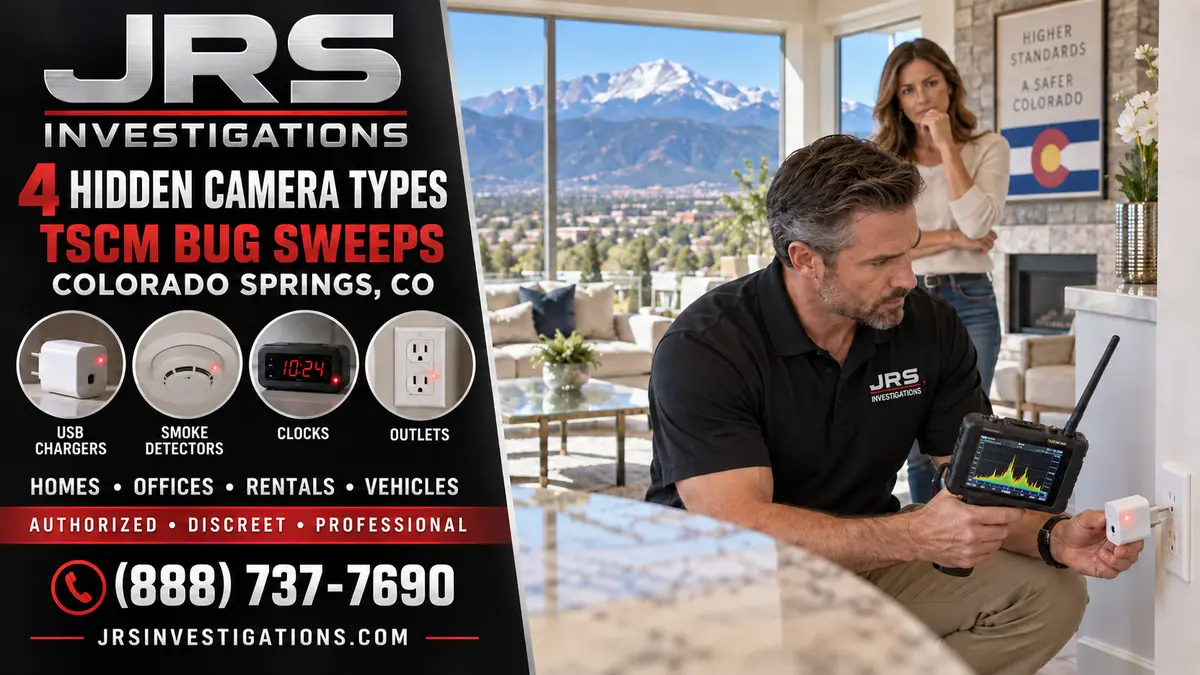
4 Hidden Camera Types Checked During Colorado Springs TSCM Sweeps
Hidden cameras can be disguised as ordinary household or office objects, which makes a casual visual check unreliable. JRS Investigations provides authorized Technical Surveillance Countermeasures, commonly called TSCM or a professional bug sweep, for clients concerned about covert video, listening devices, location trackers, or other unauthorized surveillance.
A suspicious object does not automatically contain a camera. Chargers, smoke detectors, clocks, routers, outlets, and smart-home devices all contain normal electronics. A professional inspection combines context, physical examination, and technical methods to distinguish expected components from something that requires closer attention.
Confidential consultation: Call (888) 737-7690 to discuss an authorized TSCM bug sweep in Colorado Springs, Colorado.
Four Common Hidden-Camera Disguises
1. USB chargers and wall adapters
USB chargers and wall adapters are common in bedrooms, home offices, conference rooms, and short-term rentals. They have access to continuous power and can be positioned with a clear view of a room. A covert camera may use a very small opening in the housing while the device continues to appear or function like an ordinary charger.
Not every unfamiliar adapter is a surveillance device. Model numbers, construction, weight, ports, internal components, cable routing, and placement all provide context. A methodical inspection also considers who introduced the item, when it appeared, whether it belongs with the surrounding equipment, and whether it communicates through Wi-Fi, another radio frequency, local storage, or a wired connection.
2. Smoke detectors and ceiling fixtures
Smoke detectors, motion sensors, alarm components, and other ceiling-mounted fixtures naturally overlook large areas. Their housings may also contain legitimate electronics, sensors, LEDs, and vents. That combination makes a visual judgment difficult, especially when the property has changed occupants, contractors, security vendors, or maintenance personnel.
A professional examiner looks for inconsistent hardware, unfamiliar openings, disturbed mounting points, added wiring, mismatched equipment, and components that do not correspond with the installed system. Safety equipment should not be dismantled casually. If a fixture is connected to a building alarm or managed system, inspection access may require coordination with the owner, association, landlord, or property manager.
3. Alarm clocks, weather stations, and smart devices
Clocks, weather stations, speakers, air-quality monitors, streaming devices, and other connected products are often placed where people sleep, work, or meet. Their displays and dark plastic surfaces can conceal a small lens, while internal power and wireless capability may allow recording or transmission.
These devices can also generate entirely normal Wi-Fi, Bluetooth, infrared, or radio activity. The inspection must identify expected equipment before treating a signal as suspicious. Account access matters too. A legitimate camera, speaker, doorbell, or baby monitor can create a privacy problem if an unauthorized person controls the account, password, sharing settings, or cloud access.
4. Power outlets, power strips, and extension devices
Outlets, power strips, surge protectors, and extension devices are common throughout homes and offices and can be placed near desks, beds, entryways, or meeting tables. A modified component may use building power or conceal electronics inside a housing that rarely receives attention.
Electrical safety comes first. Clients should not remove outlet covers or open powered equipment without the appropriate knowledge and authorization. A TSCM examination can identify areas requiring a closer look and determine whether a qualified electrician, property representative, law-enforcement officer, or evidence professional should be involved.
Why Hidden Cameras Are Not Always Detected by an RF Scanner
Consumer RF detectors can react to many legitimate signals and may miss threats that are not transmitting at the time of the scan. A covert camera may record to a memory card, use a wired connection, remain dormant, transmit intermittently, or communicate through a familiar network. Dense wireless activity from neighboring homes, offices, vehicles, and personal devices can further complicate interpretation.
No single tool finds every surveillance device. A reliable process combines the client’s access history and risk indicators with a disciplined physical search and appropriate technical methods. JRS explains what was checked, what the equipment can and cannot establish, and what limitations remain after the inspection.
What a Colorado Springs TSCM Inspection May Include
Risk assessment and authorized scope
The first step is a confidential discussion of the concern. Useful details include when information began leaking, who had access to the property, whether there was a relationship or workplace dispute, which rooms contain sensitive activity, and whether any unfamiliar equipment appeared. JRS also confirms that the client can authorize access to the residence, office, rental unit, or vehicle being examined.
Physical and visual examination
A structured inspection looks for altered fixtures, unexplained openings, unusual wiring, modified housings, inconsistent model information, objects placed at useful viewing angles, and signs of tampering. The examiner pays particular attention to spaces where people sleep, change clothes, hold confidential meetings, or handle sensitive information.
Optical and technical checks
Optical techniques can help identify lens reflections when conditions allow. RF spectrum analysis can evaluate active wireless transmissions and compare them with expected devices in the environment. Depending on the scope, a non-linear junction detector may help locate electronic components even when they are not actively transmitting. Network review can identify unfamiliar connected devices or unauthorized access points. Thermal or other targeted methods may support the inspection when appropriate.
Documentation and response planning
If an item requires further attention, the next step depends on the facts. Documentation, evidence preservation, law enforcement, counsel, property management, corporate security, or a qualified technical specialist may be appropriate. Removing, powering, resetting, or publicly discussing a suspected device without a plan can affect evidence or alert the responsible person.
For more information about the overall process, review JRS TSCM bug-sweep services and the Colorado Springs TSCM service page.
Situations That May Justify a Professional Sweep
- Private conversations, travel plans, legal strategy, or business details repeatedly reach an unauthorized person.
- A former partner, roommate, employee, tenant, contractor, or service provider had unsupervised access.
- An unfamiliar charger, clock, sensor, power device, or smart-home component appears in a sensitive area.
- A fixture looks disturbed, crooked, mismatched, newly drilled, or inconsistent with similar equipment.
- A property has experienced stalking, harassment, coercive control, a contentious separation, or a serious workplace dispute.
- A short-term rental, furnished property, home office, executive residence, or meeting space handles sensitive activity.
- New devices or access points appear on the network without a clear explanation.
- An unexplained entry or maintenance visit is followed by the disclosure of private information.
These signs do not prove that a camera is present. Static, battery drain, warm electronics, unfamiliar network names, and ordinary maintenance changes can have innocent explanations. JRS focuses on facts and a proportionate inspection plan rather than assuming that every anomaly is surveillance.
Residential, Commercial, Rental, and Vehicle Concerns
Colorado Springs includes single-family homes, apartments, military-connected households, short-term rentals, home offices, professional buildings, and commercial spaces. Properties in Briargate, Broadmoor, Old Colorado City, Downtown Colorado Springs, Monument, and surrounding communities present different access histories, building systems, and wireless environments.
Shared walls and dense Wi-Fi activity can produce signals from neighboring units. Furnished properties may contain equipment owned by a landlord or management company. Offices may have legitimate cameras, access-control systems, conference equipment, and network hardware. The inspection plan must account for these expected systems before identifying something as suspicious.
Vehicle concerns may involve cameras, audio devices, GPS trackers, Bluetooth tags, or factory-installed telematics. Ownership and lawful access must be established before an inspection. The methods used for a vehicle differ from those used in a residence or office, so the scope should be discussed in advance.
How to Prepare for a Hidden-Camera or Bug Sweep
- Limit discussion of the appointment. If monitoring is possible, do not announce the sweep in the suspected space.
- Preserve normal conditions. Avoid moving furniture, unplugging devices, resetting the router, or opening unfamiliar equipment unless safety requires it.
- Create an incident timeline. Record dates, leaked information, unexplained access, account alerts, tracker notices, and recent maintenance visits.
- List expected electronics. Include routers, cameras, speakers, alarm devices, smart-home products, and equipment supplied by a landlord or employer.
- Confirm authorization. Be ready to document your right to request an inspection of the property, room, office, or vehicle.
- Identify priority areas. Note bedrooms, bathrooms, changing areas, meeting spaces, home offices, and other places where privacy is especially important.
Frequently Asked Questions
Can a hidden camera record without Wi-Fi?
Yes. Some devices store video locally, use a wired connection, transmit only at selected times, or remain dormant until activated. That is why an RF scan alone cannot rule out every camera.
Can JRS inspect an apartment or rental property?
Yes, when the client has authority to authorize the inspection of the unit or specific area. Common spaces, building systems, or equipment owned by another party may require additional permission.
Does a network scan find every hidden camera?
No. A network review can identify certain connected devices, but a camera may use local storage, a separate hotspot, a wired connection, another network, or no active connection at all. It is one part of a broader inspection.
How long does a TSCM sweep take?
Timing depends on the number and size of rooms or vehicles, the amount of electronics, building access, the reported threat, and the methods required. A consultation allows JRS to recommend a focused initial scope.
What should I do if I find a suspicious device?
Do not destroy, reset, activate, or publicly discuss it. Photograph the surrounding condition if it is safe to do so, leave it in place when practical, and obtain guidance. The appropriate response may involve law enforcement, an attorney, property management, corporate security, or a qualified evidence professional.
Request a Confidential TSCM Consultation
If you have a specific reason to believe a home, office, rental, or vehicle contains unauthorized surveillance, JRS Investigations can help define the next step. Each assignment begins with the objective, access history, authorization, location, timing, and the areas of greatest concern.
Call (888) 737-7690 or contact JRS Investigations to discuss a Colorado Springs TSCM bug sweep. Learn about JRS private investigation services and how an authorized technical inspection can help you get clear, documented answers.