(888) 737-7690

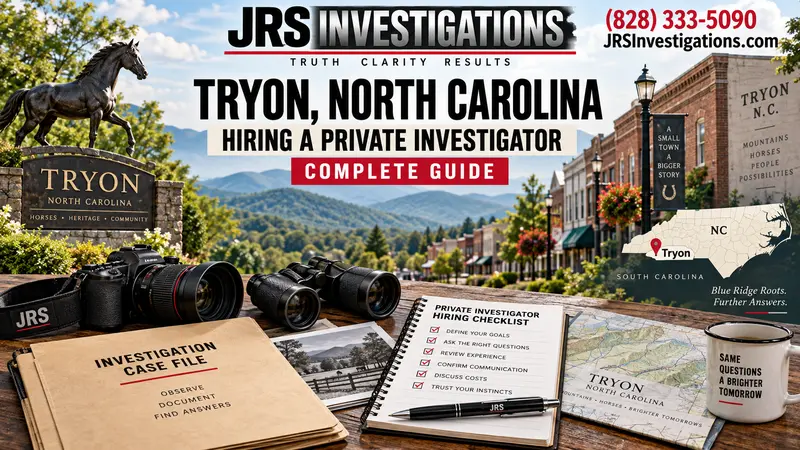
Complete Guide to Hiring a Private Investigator in Tryon NC
Hiring a private investigator is easier when you begin with a defined question, a realistic objective and a clear understanding of lawful limits. In Tryon, North Carolina, local geography can also shape the work. The town sits at the base of the Blue Ridge Escarpment near the South Carolina line, with rural roads, mountain terrain, seasonal visitors and regular travel toward Columbus, Saluda, Hendersonville, Asheville, Spartanburg and Greenville. A sound case plan accounts for those conditions without promising a result before the facts are known.
This guide explains how to compare investigators, prepare for a confidential consultation and decide whether a Tryon private investigator is the right resource for your concern. JRS Investigations serves clients with discreet, assignment-specific investigative work. For a private consultation, call (828) 333-5090.
Start with the question you need answered
A useful investigation does not begin with “find everything.” It begins with a specific question that can be addressed through lawful observation, records research, interviews or another appropriate method. Examples include whether a custody exchange is occurring as ordered, whether a person is regularly visiting a particular location, whether a job applicant’s stated history can be verified or whether a business loss is connected to an identifiable pattern.
Before calling, write a short timeline. Include names, known addresses, vehicles, dates, relevant court deadlines and the facts you can document. Separate what you personally observed from what someone else told you. Bring copies rather than surrendering your only originals. A focused intake helps the investigator assess feasibility, identify conflicts and recommend a proportionate scope.
Also decide what would make the assignment useful. You may need a written report for counsel, dated photographs, a verified address, a concise background summary or simply enough information to decide the next step. An investigator can document facts, but cannot guarantee a court ruling, locate every hidden asset or prove a suspicion that the evidence does not support.
Verify licensing and relevant experience
North Carolina regulates private investigators through Private Protective Services. Ask for the agency or investigator’s legal business name and license information, then verify it through the state’s Private Protective Services licensing portal. The state describes experience requirements for private investigator licensing and maintains an active-licensee search. A professional should answer licensing questions directly rather than asking you to rely on a badge-style graphic or a claim on a website.
Licensing is the starting point, not the entire evaluation. Ask whether the investigator has handled the type of matter you have, who will perform fieldwork, how supervision works and what the final deliverable will contain. Experience in surveillance investigations is different from experience in public-record research, interviews, digital forensics or technical counter-surveillance. The person you hire should be able to explain which discipline fits your question and when another specialist or attorney should be involved.
Match the service to the assignment
Private investigations cover several distinct services. A consultation should narrow the options instead of bundling unrelated work.
- Surveillance: Lawful observation may document movements, routines, meetings or activities from public or otherwise authorized locations. Coverage should be planned around known time windows and reviewed as information develops.
- Child custody matters: A child custody investigation may document observable conduct tied to safety, supervision, exchanges or compliance with a parenting arrangement. Investigators do not decide custody and should coordinate objectives with counsel when litigation is active.
- Infidelity concerns: Infidelity investigations focus on verifiable activity rather than rumor. A good plan limits emotional confrontation and avoids unsafe self-surveillance.
- Background research: Background checks may involve identity resolution, address history, court records, employment or education verification and other sources appropriate to the purpose. JRS also explains common background checks used in Tryon.
- Missing persons and skip tracing: Missing-person and skip-tracing work can combine database research, records and interviews. Emergency or endangered-person situations should be reported to law enforcement immediately.
- Fraud and business matters: Fraud investigations may organize transactions, timelines, records and witness information for counsel, insurers or internal decision-makers.
Technical surveillance countermeasures, computer or phone forensics, process service and asset research each require their own authority, tools and scope. Ask what is included. Do not assume that hiring a general investigator automatically authorizes access to a device, account, protected database or private property.
Account for Tryon’s location
The Town of Tryon’s official government site places the community near Interstate 26 and describes its Blue Ridge setting, rural character and proximity to both western North Carolina and upstate South Carolina. Those facts can affect scheduling and cost. Mountain roads may limit safe observation points. A subject may cross a state line during ordinary travel. Equestrian, arts and community events can change traffic and visibility. Long rural routes can add travel time without adding useful coverage.
A local plan should identify the most productive locations and time windows before fieldwork begins. If an assignment crosses into South Carolina or another jurisdiction, the investigator should evaluate licensing, reciprocity and other legal requirements before continuing. Ask how cross-border travel, mileage, lodging or additional personnel would be authorized. You should receive a chance to approve a meaningful expansion rather than discovering it after the budget is spent.
Ask these questions before signing
- Who will work the case? Learn whether the person conducting the intake will also perform or supervise the assignment.
- What is the lawful objective? Ask the investigator to restate the question and explain the permitted methods in plain language.
- What information do you need from me? Accurate identifiers, timelines and case documents can reduce wasted time and mistaken identity.
- How will updates work? Agree on a contact person, update schedule and emergency-notification rule.
- What will I receive? Confirm whether the deliverable includes a written report, photographs, video, source notes, invoices or an attorney-ready chronology.
- How is the budget controlled? Request the retainer, hourly rates, travel terms, expenses, minimum blocks and the point at which fresh authorization is required.
- How is sensitive information protected? Ask how evidence, personal data and communications are stored, transferred and retained.
Understand legal and ethical limits
A legitimate investigator should decline unlawful requests. That includes trespassing, breaking into accounts, obtaining protected records without authority, impersonating law enforcement, installing a tracker without a lawful basis or recording communications in violation of applicable law. Surveillance should be conducted from lawful public or authorized locations. The investigator should pause when a situation becomes unsafe or when the assignment would exceed the agreed scope.
Background screening also depends on purpose. When an employer uses a third-party consumer report for hiring, retention, promotion or reassignment, the Federal Trade Commission’s FCRA guidance describes disclosure, written authorization and adverse-action requirements. A public court-record search alone is not a substitute for a compliant employment-screening process. North Carolina court records still require careful identity matching and context.
An investigation is not legal advice. If your matter involves a pending custody case, restraining order, employment decision, criminal allegation or urgent deadline, tell your attorney about the proposed work. Counsel can help define relevance and protect the way evidence is requested and used.
Plan for usable evidence
Good evidence practices begin before the first field hour. The investigator should preserve original files, record dates and locations, maintain notes and distinguish direct observation from inference. Reports should use neutral language and a clear sequence. Relevant media should be retained in its original form rather than repeatedly edited, compressed or forwarded through messaging apps.
Your role matters too. Do not alter source documents, coach witnesses, confront the subject or post active-case details online. Send new information through the agreed channel and explain where it came from. If your attorney has requested a particular format or chain-of-custody practice, share that requirement before work begins.
Set a budget with decision points
Investigation cost depends on the method, time, travel, number of investigators, reporting requirements and how predictable the subject’s schedule is. Ask for a written agreement that explains rates and likely expenses. A retainer is a funding arrangement, not a promise that every dollar will be used or that a result will be achieved.
For surveillance, it may be sensible to authorize an initial block and review the observations before scheduling more. For records research, define the jurisdictions, identifiers and depth of verification. For a fraud matter, begin with the records most likely to establish or disprove the key transaction. Milestones and stop points keep the investigation tied to decisions instead of allowing the scope to expand indefinitely.
Watch for hiring red flags
Be cautious if someone guarantees proof, promises illegal access, refuses to identify the licensed agency, will not provide a written agreement or pressures you to fund an undefined assignment immediately. Other warning signs include vague expense terms, advice to confront a subject, a plan built around invasive technology without a legal basis, or claims that evidence is automatically admissible in court.
Professional investigators discuss uncertainty. They explain what can be attempted, what may limit results and how they will report both productive and unproductive work. You can learn more about the agency’s background on the About JRS Investigations page and review the full range of private investigation services before deciding what fits your situation.
Request a confidential Tryon consultation
Bring your timeline, the names of involved parties, any court or business deadlines and the outcome you need to inform. JRS Investigations can assess whether the objective is feasible, identify an appropriate starting scope and explain the next steps. Call (828) 333-5090 to discuss a private investigator assignment in Tryon, North Carolina.