(888) 737-7690
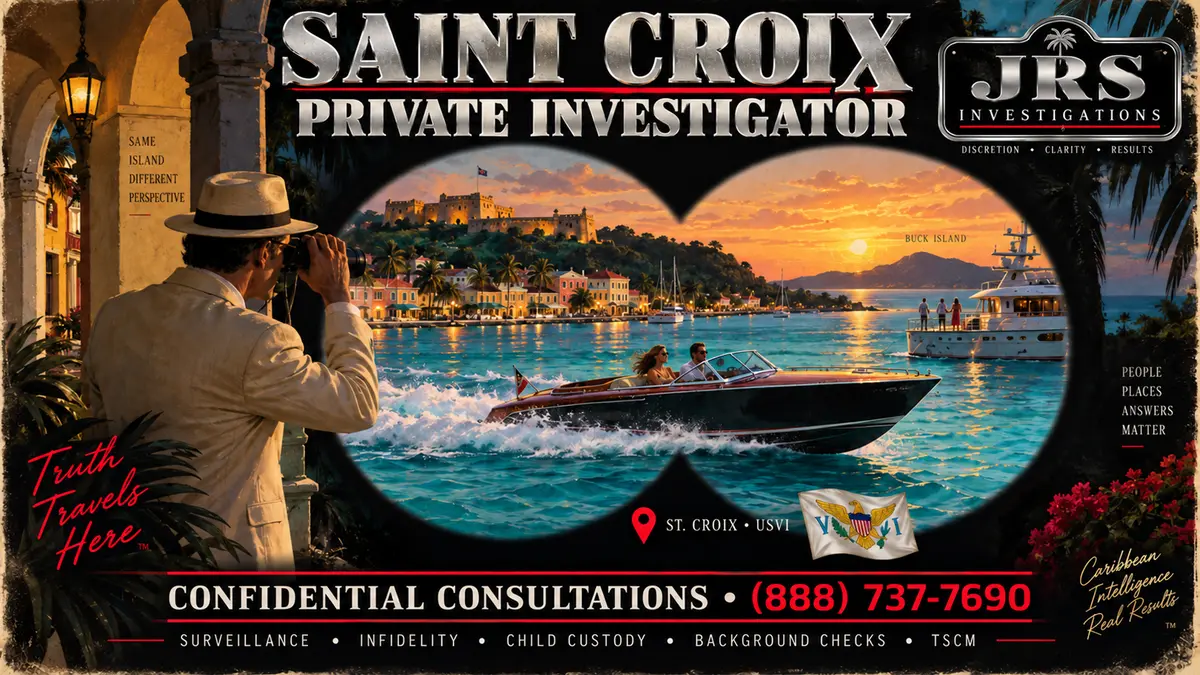
How to Hire a Private Investigator in Saint Croix, USVI
How to Hire a Private Investigator in Saint Croix, USVI
Hiring a private investigator in Saint Croix, USVI, starts with a clear question: what fact do you need to verify, and what decision will the answer support? A focused assignment may involve surveillance, a relationship concern, a child-custody matter, business due diligence, fraud, a missing person, property research, or a suspected listening device. The right investigator turns that concern into a lawful, documented plan.
Saint Croix is compact, but investigations here are not generic island work. Christiansted, Frederiksted, residential estates, resort areas, industrial sites, shoreline roads, the airport, and ferry or seaplane connections create different timing and visibility challenges. Good planning matters more than dramatic promises. This guide explains how to compare investigators, protect your privacy, control costs, and request work that can withstand careful review.
Why Saint Croix Investigations Require Local Planning
Useful fieldwork depends on knowing how people actually move through Saint Croix. Traffic patterns, limited approach roads, parking, tourism activity, weather, and the difference between town centers and less-developed areas can all affect an assignment. A plan that works in a large mainland city may be conspicuous or inefficient on an island.
Christiansted, Frederiksted, and island travel
Christiansted and Frederiksted have distinct street layouts, business districts, waterfront activity, and event schedules. Assignments may also extend to mid-island neighborhoods, hotels, marinas, beaches, workplaces, or Henry E. Rohlsen Airport. Ask how the investigator will account for travel time, observation points, and transitions between locations without creating unnecessary exposure.
Territorial authority and coordination
Before work begins, confirm what Virgin Islands business or professional licensing and local authorization apply to the agency and to the person performing the assignment. The Virgin Islands Department of Licensing and Consumer Affairs administers territorial business licensing and offers a license-search resource. If an investigation may continue beyond Saint Croix, ask how the firm handles work in another island or jurisdiction and whether a properly authorized local professional will be involved.
Private Investigation Services in Saint Croix
The service name is less important than the lawful objective. A reputable investigator should be able to explain what can be observed or researched, what cannot be obtained legally, and what type of report you will receive.
Surveillance and activity verification
Surveillance investigations document conduct visible from lawful vantage points. Depending on the facts, that may include time-stamped notes, photographs, or video. The plan should identify the most useful dates, likely locations, known vehicles, and the decision the evidence must inform. It should never promise a particular outcome.
Infidelity and relationship concerns
A cheating-spouse investigation should answer defined questions discreetly, not inflame a painful situation. Useful preparation may include a current photograph, routine, vehicle information, travel plans, and specific dates of concern. Investigators should not impersonate you, break into accounts, trespass, or access private communications without lawful authority.
Child custody and domestic matters
In a child-custody investigation, the child’s welfare and the attorney’s case strategy should guide the scope. Documentation might address compliance with an existing order, caregiving patterns, exchanges, or conduct occurring in public. Coordinate with counsel before fieldwork when litigation is pending, and avoid involving or questioning a child without appropriate direction.
Background checks and due diligence
Background and due-diligence research may help evaluate a potential employee, tenant, caregiver, romantic partner, investment, or business relationship. The permissible records and required consent depend on the purpose. Ask the investigator to distinguish verified records from database leads, explain identity matching, and document the source and date of each material finding.
Fraud, business, and asset research
Fraud investigations can organize transaction records, identify inconsistencies, interview willing witnesses, and trace public corporate or property information. The Virgin Islands Division of Corporations and Trademarks provides an online registry with general entity and trade-name details. The Recorder of Deeds maintains recorded deeds, mortgages, and liens. These official records can support research, but they are not a substitute for subpoenaed bank, tax, or private account records.
Missing persons and difficult locates
A missing-person or locate investigation may combine public records, authorized databases, interviews, address history, and field verification. Provide full identifiers, the last confirmed contact, known associates, and the lawful reason for the search. If there is an immediate safety concern, danger, or suspected crime, contact law enforcement first.
Authorized TSCM and debugging
Technical surveillance countermeasures may be appropriate when an owner or authorized occupant suspects hidden audio, video, tracking, or transmitting equipment in a residence, office, vehicle, or vessel. A legitimate inspection requires clear authority to examine the location or property. It should define the spaces covered, equipment used, limitations, and how potential findings will be preserved.
How to Choose a Saint Croix Private Investigator
1. Verify identity, licensing, and insurance
Ask for the agency’s legal name, physical business details, the name of the investigator assigned, applicable license information, and proof of insurance. Independently check information through the DLCA license-search portal and the territorial corporate registry when relevant. If the firm uses a subcontractor, ask who supervises that person and which rules govern the work.
2. Look for relevant case experience
Experience should match the assignment. Domestic surveillance, corporate due diligence, a difficult locate, and an electronic countermeasures inspection require different preparation. Ask for an anonymized explanation of the investigator’s process rather than confidential client stories or unverifiable success rates.
3. Require a lawful written scope
The engagement agreement should identify the objective, approved methods, geographic area, start conditions, hourly rates, minimum hours, travel charges, expenses, retainer, reporting schedule, and stopping point. It should also explain what happens if the subject leaves Saint Croix or the facts change.
4. Define the deliverable before work starts
Ask whether you will receive a written chronology, images, video, record copies, source notes, or an oral briefing. Discuss secure delivery, retention, and who may receive the report. If an attorney may use the work, let counsel help define the format and evidence-handling expectations.
5. Evaluate communication and discretion
A good investigator sets realistic update intervals and uses a safe contact method. Tell the agency whether voicemail, text, or email is permitted and whether shared devices or accounts create a privacy risk. Avoid discussing operational details with friends, family members, or anyone who could alert the subject.
Official Records That May Support an Investigation
Public records can confirm or challenge a lead, but every record must be matched to the correct person or entity. Names may be common, addresses may be outdated, and a database entry may lack context.
Business and property records
The Office of the Lieutenant Governor oversees corporate filings, recorded property instruments, tax-assessment resources, and territorial GIS services. Corporate-search results may show entity status, registration date, resident agent, and principal office. Recorder and property resources may identify deeds, mortgages, liens, parcels, or tax information. An investigator should preserve the source, search date, identifiers, and any uncertainty.
Court information
The Superior Court of the Virgin Islands publishes court information, rules, opinions, calendars, forms, and division contacts, including St. Croix contacts for civil, family, criminal, probate, and small-claims matters. Availability varies by record and case type. Sensitive or sealed material is not public, and a similar name alone does not establish identity.
Evidence, Privacy, and Lawful Boundaries
Professional investigation does not create permission to trespass, hack, pretext for protected information, intercept private communications, or enter another person’s account. Access to financial, medical, communications, credit, employment, and government records may require consent, a permissible purpose, a court order, or another legal basis. Location tracking, recording, drones, and electronic monitoring can raise fact-specific legal questions; the investigator should evaluate authority before using any such method.
No ethical investigator can guarantee a confession, a specific discovery, or that every item will be admitted in court. What the investigator can promise is a documented process, honest reporting, preservation of original files, and a clear distinction between direct observation, official records, third-party statements, and inference.
Private Investigator Costs in Saint Croix
Cost depends on the service, urgency, number of investigators, hours in the field, travel, equipment, record fees, and reporting needs. Island logistics can create expenses that a simple hourly rate does not reveal. Request a written estimate or budget range and ask which costs require advance approval.
Questions to ask about fees
- Is there a retainer, minimum block, or after-hours rate?
- How are mileage, inter-island travel, lodging, parking, and record fees charged?
- Is report preparation included in field time?
- When will the investigator pause and request authorization to continue?
- What unused portion of the retainer is refundable?
A lower estimate is not a bargain if the scope is vague. A phased assignment—research first, targeted fieldwork second—can sometimes answer the core question with less waste.
Warning Signs When Hiring an Investigator
- Guaranteed results or promises of “conclusive” evidence before work begins
- Offers to obtain passwords, private messages, bank records, or live phone data without lawful authority
- No written contract, unclear billing, or pressure to pay an unusually large amount immediately
- Refusal to identify the agency, assigned investigator, license information, or local field plan
- Claims that laws do not apply because the work is private or occurs on an island
- Reports that mix rumor, database leads, and verified facts without labeling the difference
How to Prepare for the First Consultation
Organize the facts before the call. Bring a short chronology, names and confirmed identifiers, recent photographs, known addresses, vehicle details, relevant court orders, and copies of lawful records already in your possession. Identify the dates that matter and the decision you need to make. Do not alter devices, confront the subject, create a false account, or obtain information through someone else’s login.
Tell the investigator what has already happened, including prior surveillance, confrontations, police reports, attorneys involved, or safety concerns. Complete information helps the agency assess conflicts, legal limits, staffing, and whether the assignment should proceed at all.
Frequently Asked Questions
Can a Saint Croix investigator work elsewhere in the USVI?
Possibly, but the scope, travel plan, licensing, and local authority should be confirmed in advance. JRS also maintains a broader U.S. Virgin Islands private investigator service page. Ask who will conduct each part of the assignment and how added travel affects the budget.
Will the other person know an investigator was hired?
Discretion is a core objective, but no investigator can promise invisibility in every setting. Island familiarity, repeated routes, and limited observation positions can increase the risk of recognition. A realistic plan balances discretion, safety, cost, and the value of continuing.
Can the findings be used in court?
That depends on how the information was obtained, preserved, authenticated, and presented, as well as the rules and issues in the case. Tell your attorney before commissioning litigation-related work. The attorney can help shape the scope and decide how any report or testimony may be used.
How quickly can an investigation begin?
Scheduling depends on urgency, investigator availability, conflicts, travel, and the information you provide. A planned assignment generally benefits from a complete intake and written scope. An immediate threat, active crime, or missing vulnerable person should be reported to the appropriate authorities without waiting for a private investigation.
Speak With JRS Investigations About Saint Croix
JRS Investigations provides private investigation services for Saint Croix and coordinates assignments around the facts, lawful authority, and client objective. We will discuss the location, timeline, available information, reporting needs, and practical limits before recommending a scope.
For a confidential consultation, call (888) 737-7690 or review our complete private investigation services. If the matter is urgent or involves immediate danger, contact emergency services or law enforcement first.