(888) 737-7690
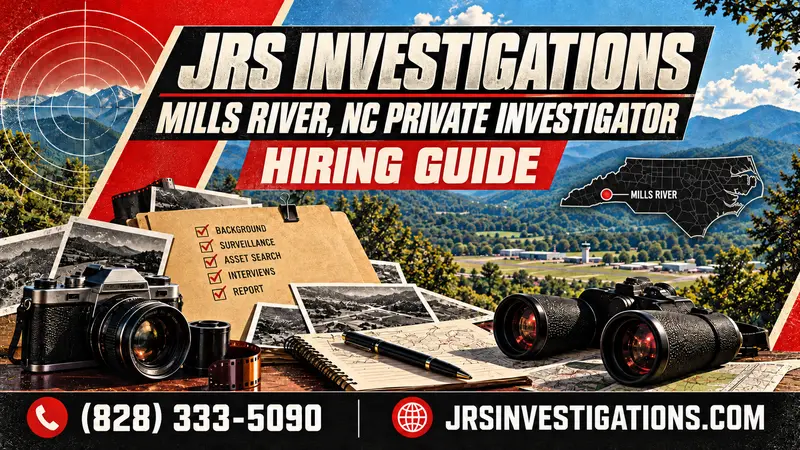
Mills River NC Private Investigator: Hiring Guide
Hiring a private investigator in Mills River should begin with a clear question, lawful authority, and a practical plan for how the information will be used. The right investigator is not simply someone with a camera or database access. A well-scoped investigation connects the client’s objective to appropriate fieldwork, public-record research, documentation, and reporting.
This guide explains how to choose and prepare for a private investigation in Mills River, North Carolina. It covers licensing, case types, evidence quality, costs, privacy limits, local logistics, and the questions to ask before signing a retainer. To discuss a matter confidentially, visit the Mills River private investigator service page or call JRS Investigations’ North Carolina line at (828) 333-5090.
Start with the decision you need to make
A useful investigation has a defined purpose. You may need to document conduct for an attorney, locate a person, verify information before a business decision, identify assets connected to a dispute, or understand whether a relationship concern warrants further action. “Find out everything” is rarely an efficient or lawful scope. A better opening question is: what fact needs to be verified, and what would change if it were confirmed?
Share the known timeline, names, addresses, vehicles, court-file information, prior reports, and the reason the matter is important. Separate what you personally observed from what another person told you. An investigator can then identify realistic objectives, explain limitations, and recommend a phased plan rather than spending time on low-value leads.
Match the investigator to the case
Surveillance and activity documentation
Lawful surveillance may help document movement, associations, routines, or conduct visible from places where the investigator is legally permitted to be. It is commonly considered in domestic, insurance, workplace, and civil matters. Results depend on access, timing, weather, traffic, and the subject’s activity; no ethical investigator should guarantee that a particular event will occur. JRS outlines the fieldwork process on its surveillance investigations page.
Infidelity and domestic investigations
A domestic investigation should be designed to answer a specific concern without escalating conflict. Field observations, photographs, time-stamped notes, and a clear chronology can be more useful than rumor or repeated confrontation. Review the purpose with counsel when separation, property, support, or safety issues may be involved. The infidelity investigation overview explains common objectives and boundaries.
Child custody support
Child custody work should focus on observable conduct that may affect a child’s welfare, care, routine, or compliance with an existing order—not on labeling a parent. The North Carolina Judicial Branch explains that courts decide custody based on the child’s best interests and may consider living arrangements, caregiving ability, relationships, and other welfare factors. An investigator documents facts; the court and attorneys determine their legal significance. JRS provides more detail on child custody and domestic investigations.
Alimony and cohabitation concerns
When support obligations or alleged cohabitation are at issue, counsel should help define the legally relevant facts before surveillance begins. A focused plan may document recurring overnight patterns, shared activities, or other observable circumstances without promising a legal conclusion. Mills River clients can review the related Mills River alimony investigation article.
Background, due-diligence, and business inquiries
Background research can involve identity resolution, address history, court and public records, business affiliations, credential verification, or other lawfully available information. The permissible scope depends on the purpose. Employment, housing, credit, and other eligibility decisions may trigger consumer-reporting requirements. The FTC’s background-check guidance for employers describes federal notice, authorization, nondiscrimination, and adverse-action responsibilities. Obtain legal or compliance advice for your specific use. JRS also maintains a dedicated background checks service page.
Locate and asset-related investigations
A locate assignment may support service of process, family contact, witness outreach, debt or judgment work, or another legitimate purpose. The investigator should confirm the requester’s identity and lawful reason before disclosing sensitive location information. The related Mills River locate investigation article explains how identifiers and records can be developed into verified leads. Asset work similarly distinguishes ownership indicators from assumptions; a database hit alone does not establish current ownership or recoverability.
Verify North Carolina licensing
North Carolina regulates private investigators through the Private Protective Services Board. The North Carolina Department of Public Safety provides license information and a licensee search. Its license guidance states that a private protective services firm must employ a license holder designated as its qualifying agent to operate lawfully in the state.
Ask for the agency name, responsible license holder, and the credentials relevant to the assignment. Also confirm who will perform fieldwork and who supervises it. A license establishes authorization to operate; it does not replace the need to evaluate relevant experience, communication, reporting, and ethical judgment.
Understand Mills River and regional logistics
Mills River assignments may move among residential neighborhoods, agricultural areas, commercial corridors, workplaces, and nearby communities in Henderson and Buncombe counties. Travel toward Hendersonville, Arden, Fletcher, Asheville, or the airport area can quickly change traffic, parking, and observation conditions. Rural roads, private property boundaries, limited public staging areas, mountain weather, and seasonal daylight can also affect a field plan.
A locally informed estimate should account for the likely route, number of investigators, start time, travel, potential dead time, and whether activity may cross county or state lines. If several locations matter, prioritize them. A targeted first phase often produces better information than trying to cover every address at once. JRS lists nearby coverage through its areas served page.
Set lawful boundaries before work begins
A client cannot authorize an investigator to trespass, hack an account, impersonate someone unlawfully, obtain protected records without a permissible purpose, or place tracking technology where ownership and consent do not allow it. Investigators also should not promise access to sealed records, private messages, live phone locations, or financial accounts merely because a client requests them.
Be candid about property ownership, vehicle ownership, existing court orders, workplace policies, and how the information will be used. If an attorney is involved, coordinating the scope early can reduce wasted work and help preserve privilege and evidence strategy. For a broader view of available and excluded work, review JRS Investigations’ private investigation services.
Evaluate evidence quality, not just volume
A strong investigative record identifies who observed an event, when and where it occurred, what equipment was used, and how photographs or records were preserved. Field notes should distinguish direct observation from inference. Reports should be factual, chronological, and understandable to someone who was not present.
Ask how original media will be retained, whether copies preserve useful metadata, how records are sourced, and what happens if an item may become evidence. When litigation is possible, do not edit screenshots, rename original files, or circulate sensitive material unnecessarily. Your attorney can advise on discovery obligations, admissibility, and case-specific preservation.
Private investigators are not courts, prosecutors, or forensic laboratories. They gather and organize lawfully obtainable information. They do not decide guilt, custody, liability, or the outcome of a claim.
Build a realistic budget and phased plan
There is no meaningful universal hourly average for every Mills River case. Cost can change with the number of investigators, travel, surveillance hours, database or record fees, overnight or weekend work, equipment, report complexity, and whether activity moves beyond the original area. A low advertised rate may exclude travel, mileage, administrative time, or reporting.
Ask for a written retainer or engagement agreement that identifies the objective, billing method, required deposit, expense treatment, communication schedule, cancellation terms, and deliverables. When the facts are uncertain, use phases:
- Verify identities, addresses, records, and known activity.
- Conduct focused fieldwork during the highest-value time window.
- Review findings before authorizing additional hours or locations.
- Prepare the report, media package, or attorney briefing required for the purpose.
This approach creates decision points and keeps the budget tied to useful information rather than an open-ended promise.
Questions to ask before hiring
- Are you properly licensed for this work in North Carolina?
- Who will perform and supervise the investigation?
- What objective do you recommend, and what is outside the scope?
- Which facts or documents do you need from me before starting?
- How will hours, travel, expenses, and reports be billed?
- How often will I receive updates, and who is my point of contact?
- How will photographs, video, notes, and records be preserved?
- What limitations or safety issues could affect the assignment?
- Will you coordinate with my attorney if the matter may go to court?
Be cautious of guaranteed results, claims of unrestricted database access, pressure to authorize a large open-ended budget, or advice to take actions that appear unsafe or unlawful. JRS provides company background and professional contact information on its About JRS Investigations page.
Prepare for the first confidential consultation
Create a short chronology and gather the most reliable identifiers and documents. Note any upcoming court dates, travel, custody exchanges, business deadlines, or periods when useful activity is most likely. Identify the decision-maker, attorney, and anyone authorized to receive updates. If personal safety is involved, use a safe device and location to communicate and contact emergency services when there is an immediate threat.
Do not confront a subject, follow a vehicle, enter private property, install software, or access an account to “help” the investigation. Those actions can create danger, contaminate evidence, or expose the client to legal risk.
Speak with a Mills River private investigator
JRS Investigations provides confidential consultation and professionally scoped investigations for individuals, attorneys, families, and businesses in Mills River and Western North Carolina. Available assignments may include surveillance, infidelity and domestic matters, child custody support, alimony or cohabitation concerns, locate research, backgrounds, fraud, and asset-related inquiries, subject to lawful purpose and authorization.
Call the North Carolina line at (828) 333-5090 or visit the JRS Investigations homepage to discuss the objective, timeline, and safest way to proceed. Knowledge is power, and a clear investigative plan puts that knowledge to work.