(888) 737-7690

Online Dating Scam Investigator: 8 Verification Steps
An online relationship can feel genuine while key details remain difficult to verify. When identity, location, employment, financial requests or repeated emergencies do not add up, an online dating scam investigator can organize the facts, test specific claims and document what can be verified through lawful sources.
That work has limits. A private investigator cannot hack an account, secretly obtain protected subscriber data, guarantee a real identity, promise recovery of money or make evidence automatically admissible. A well-scoped investigation can still help a client stop further loss, preserve records, assess inconsistencies and prepare a clearer report for a bank, platform, attorney or law-enforcement agency.
JRS Investigations provides private investigation services for authorized matters in Florida, North Carolina and selected Caribbean jurisdictions. This guide explains when professional assistance may be useful and how a responsible inquiry should proceed.
If money or account access is at risk, act first
Do not wait for a private investigation before taking urgent protective steps. Stop sending money. Do not share passwords, verification codes, account numbers, identification documents or intimate material. If you made a payment, contact the bank, card issuer, wire service, payment app, gift-card company or cryptocurrency platform immediately and ask what protective or recall steps may still be available.
The Federal Trade Commission’s romance-scam guidance recommends stopping contact, speaking with someone you trust, checking images and reporting the profile. The FBI’s romance-scam page directs victims to the Internet Crime Complaint Center. Complaints can be filed through IC3’s official complaint form. Notify the dating or social platform as well.
If there is a threat of violence, stalking, blackmail or publication of intimate material, contact local law enforcement or emergency services as appropriate. Do not confront a suspected scammer or travel to meet the person based on an unverified story.
What an online dating scam investigator can examine
The right question is usually not “Can you prove this person is a scammer?” It is a series of narrower questions: Has the image appeared under other names? Does the claimed occupation exist? Are dates, locations and contact details internally consistent? Is the named company or property real? Who appears in public or lawfully available records connected to a phone number, email, address, business or payment recipient? What remains unverified?
Depending on authority, jurisdiction and available facts, an investigation may include:
- profile, username and contact-point research;
- reverse-image and image-context checks;
- public-record and open-source identity research;
- employment, company, credential or property-claim verification;
- timeline and location-claim analysis;
- research into named payment recipients or business entities;
- preservation and organization of client-supplied communications; and
- a factual report separating confirmed facts, inconsistencies and unresolved questions.
A background inquiry is not unlimited. Access to records depends on the source, permitted purpose, jurisdiction and the accuracy of identifying information. Learn more about JRS background checks and the questions to ask before hiring a private investigator.
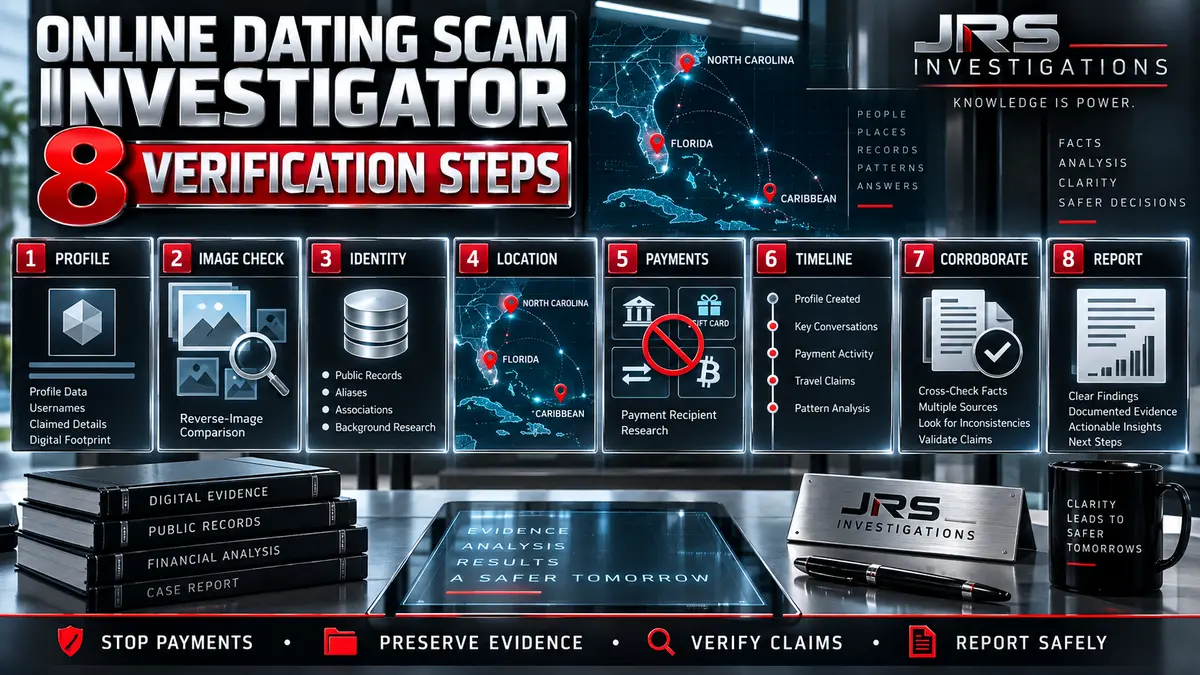
8 steps in a responsible online dating scam investigation
1. Define the decision you need to make
Start with an answerable objective. Examples include deciding whether to stop financial contact, whether a claimed identity is consistent with lawful records, whether a business opportunity is connected to a real entity, or whether a report should be prepared for counsel or authorities. A narrow decision produces a more efficient first phase than a request to “find everything.”
2. Preserve the original communications
Keep the dating profile, messages, emails, usernames, phone numbers, images, voice notes, URLs, transaction receipts, wallet addresses, account names and delivery information. Preserve dates and time zones. Export or capture material before blocking or reporting a profile if it is safe to do so, because accounts can disappear.
Do not edit screenshots, annotate originals or forward files repeatedly. Keep a working copy separate from the original material and record where each item came from.
3. Map the claimed identity
Create a simple profile of what the person claims: name, age, occupation, employer, family, education, residence, travel, military service, business interests and reasons for being unavailable. The investigator can compare these claims with one another and with lawful sources. Contradictions matter, but a single mismatch may also result from an error, outdated information or an innocent privacy choice.
4. Examine images and profile reuse
Reverse-image searches and contextual checks may show that a photo appeared elsewhere, under another name or in unrelated public material. Metadata may be absent or altered after an app processes an image, so it should not be treated as decisive by itself. New generative tools also make images, video and audio harder to evaluate. Verification should rely on several independent facts, not appearance alone.
5. Test contact, employment and location claims
A phone number, email address, domain, social profile, company, professional credential or property may be checked against reliable sources when lawful. The investigator should state whether a result confirms the specific person or merely connects to a shared, recycled or uncertain identifier.
Private investigators generally cannot obtain an IP address or protected platform subscriber data simply because a client requests it. Providers normally disclose protected records only through their own legal processes, consent or valid legal authority.
6. Review financial requests and recipient details
Document each request: date, amount, stated reason, payment method, recipient, destination and any promised repayment or investment return. Gift cards, wire transfers, payment apps and cryptocurrency may move quickly and can be difficult to reverse. The investigator can research lawfully available facts and organize the trail, but should not promise to “trace every dollar” or recover funds.
For suspected fraud, the Consumer Financial Protection Bureau advises contacting relevant agencies and financial institutions through trusted contact information. Do not pay a second person who promises guaranteed recovery; recovery scams often target people who have already lost money.
7. Corroborate before drawing conclusions
Strong findings come from multiple independent sources. A reused image, a disconnected number or an inconsistent job story may raise concern, but the report should explain the strength and limits of each point. Facts, reasonable inferences and unresolved questions should be clearly separated.
8. Deliver an action-oriented report
The final report should state the scope, identifiers examined, sources used, significant findings, limitations and recommended next steps. Recommendations may include stopping contact, securing accounts, speaking with a bank, reporting to the platform, filing with the FTC or IC3, consulting counsel, or requesting a separate digital-forensics review.
Common patterns that deserve independent verification
- A rapid emotional commitment followed by secrecy or pressure.
- Repeated reasons a live meeting or independently arranged video call cannot occur.
- A request to move communication off the original platform immediately.
- Requests for money, gift cards, cryptocurrency, account access or package forwarding.
- An “investment” platform recommended by the online contact.
- A request to receive and move funds for another person.
- A claimed emergency that prevents ordinary verification.
- Images, documents or credentials that do not match independent sources.
- A link to a supposed dating-safety or identity-verification service requesting card data.
- Threats involving intimate images or private information.
The FBI’s warning about fake online-dating verification services describes schemes that collect personal or card information and enroll users in unwanted subscriptions. Use official websites you locate independently rather than links supplied by an unverified contact.
What a private investigator cannot promise
A responsible investigator will not promise a guaranteed identity, a guaranteed criminal-history match, access to private messages, account passwords, confidential platform data or the return of funds. The investigator also should not impersonate the client, create unlawful pretexts, access accounts without permission or encourage retaliatory contact.
Results may be limited when the subject uses fabricated names, virtual numbers, shared devices, money mules, foreign accounts, encrypted communications or compromised identities. Cross-border matters can require additional time, local resources, translations and jurisdiction-specific legal review. For financial or ownership questions beyond the profile itself, JRS may define a separate international asset investigation. Research does not equal collection or recovery.
Private investigation versus digital forensics
An online dating investigation often begins with client-supplied records, public information and lawful database research. Digital forensics is different. It may involve preserving and examining a phone, computer, storage device or account under appropriate authority. If you clicked a suspicious link, installed software, shared remote access or believe an account was compromised, secure the account through the provider and consult a qualified cybersecurity or digital-forensics professional.
Do not give a private investigator your passwords merely to speed up research. Access should be authorized, necessary, documented and handled through an appropriate method.
How to prepare for the investigator
- Write a factual chronology with dates, time zones and major claims.
- List every username, email, phone number, website, wallet and recipient.
- Preserve original messages, images, documents and transaction records.
- Separate what you personally observed from what the contact told you.
- Identify immediate safety, blackmail, financial or account-security concerns.
- State the decision you need the investigation to support.
- Set a first-phase budget and require approval before expanding the scope.
If the matter includes a missing or potentially endangered person rather than an online persona, the scope may belong under a missing-person investigation. JRS can help determine the correct investigative lane during intake.
Questions to ask before hiring
- Who will manage and perform the investigation?
- What licensing applies to the work and jurisdiction?
- Which facts can be checked lawfully, and which cannot?
- What information do you need from me?
- How will you protect messages, images, financial records and the report?
- What is included in the first phase and fee?
- How will you distinguish confirmed facts from possible matches?
- What happens if the matter requires counsel, law enforcement or digital forensics?
- Will you provide a written report with sources and limitations?
Frequently asked questions
Can an investigator identify someone from a photo?
Sometimes an image can be connected to a public source or a reused profile, but that does not always identify the person communicating with you. Other identifiers and independent sources are needed.
Can a private investigator trace an IP address?
Not merely from a request. Protected platform or service-provider records generally require consent or valid legal authority. Public technical indicators may be reviewed, but they have important limits.
Can an investigator recover money sent to a romance scammer?
Recovery cannot be guaranteed. Contact the financial institution or payment provider immediately, report the fraud and consult counsel about realistic options. Investigation may document recipients or related entities when lawful.
Should I keep talking to gather evidence?
Continuing contact can increase manipulation, financial loss and safety risk. Follow guidance from law enforcement or counsel. Preserve existing material and avoid confrontation.
Will the report be admissible in court?
Admissibility is decided under applicable law and procedure. A factual, well-documented report may assist counsel or authorities, but no investigator should guarantee a court outcome.
Request a confidential case review
JRS serves clients through its Florida, North Carolina and Caribbean coverage. To discuss an identity, catfish or romance-fraud concern, contact JRS Investigations with the profile link, chronology, identifiers, payments and the specific question you need answered.