(888) 737-7690

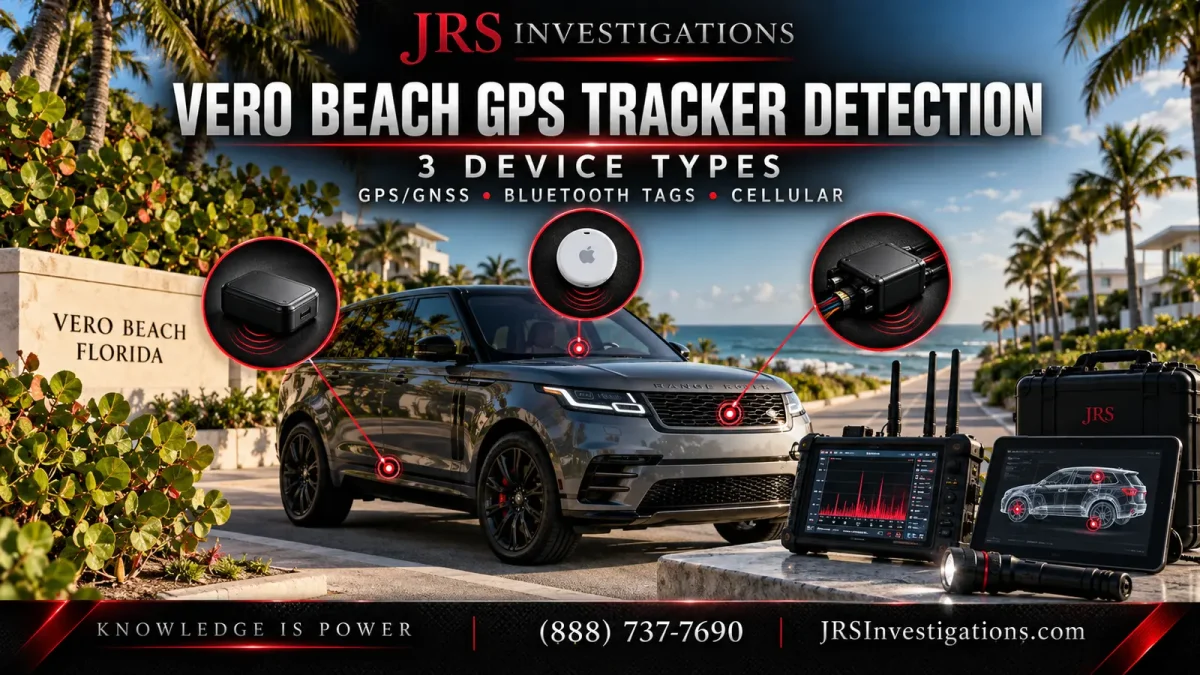
Vero Beach GPS Tracker Detection: 3 Device Types
When someone believes a vehicle, bag, or personal property may be revealing its location, the first question is usually simple: what kind of device could be involved? A professional Vero Beach GPS tracker detection assessment begins by separating three different technologies that people often group together under the word “tracker.” Each category communicates differently, leaves different clues, and requires a different inspection strategy.
JRS Investigations approaches these concerns as a scope-and-evidence problem. The goal is not to promise that one handheld scanner will find everything. The goal is to identify the property that may lawfully be inspected, understand the suspected timeline, select appropriate technical and physical methods, and document what is found without damaging equipment or compromising possible evidence.
Three tracker categories a Vero Beach assessment may address
Location monitoring can involve a self-contained satellite tracker, a short-range tag that relies on nearby consumer devices, or a cellular unit that reports through a mobile network. Some devices combine more than one method. Understanding the category helps explain why an inspection may include a detailed physical search, radio-frequency observations, device-account review, and follow-up testing rather than a single sweep.
1. GPS and GNSS vehicle trackers
A GPS tracker determines its location from navigation satellites. GPS is the familiar name, while GNSS is the broader term for satellite-navigation systems. The device still needs a way to store or transmit the location it calculates. Some units log data internally for later retrieval. Others add a cellular modem, radio link, or Wi-Fi capability so information can be viewed remotely.
Vehicle trackers vary considerably in size and installation style. A unit may be magnetic and battery powered, connected to an onboard diagnostic port, wired into a vehicle electrical system, or concealed within an accessory. Placement affects both performance and accessibility. An exterior unit may face water, road debris, heat, and vibration. A wired interior unit can operate longer but may require more planning to install.
That variation is why a professional vehicle assessment does not rely on a quick glance underneath the car. The inspection scope may include accessible exterior areas, the passenger compartment, storage spaces, power and diagnostic connections, and areas justified by the history provided by the client. Vehicle type, ground clearance, aftermarket equipment, recent repairs, and authorized access all affect the plan.
2. Bluetooth and crowdsourced location tags
Consumer tags are designed to help owners locate keys, luggage, and other property. Many do not contain a full GPS-and-cellular package. Instead, they transmit a short-range Bluetooth identifier. Compatible phones and devices nearby can detect that signal and help report an approximate location through a manufacturer’s network.
Modern mobile operating systems may issue an unwanted-tracker alert, but an alert is a lead rather than a complete technical conclusion. A notification can help narrow the time and area of concern. It may also require careful review to determine whether the tag is traveling with the person, attached to property, inside shared luggage, or associated with a legitimate nearby item.
Short-range tags can be small, common, and easy to confuse with authorized accessories. The assessment should document alert details, dates, screenshots, audible-find attempts, ownership information, and the location where a suspected item is discovered. Resetting or discarding a device too early can eliminate useful identifying information. If immediate safety is a concern, the priority is personal safety and prompt contact with law enforcement.
3. Cellular and hybrid tracking devices
A cellular tracker uses a mobile network to transmit location or status information. Many vehicle-tracking products combine satellite positioning with cellular reporting. Other connected devices may derive location from cellular networks, Wi-Fi observations, or data supplied by the host equipment. Reporting intervals can be continuous, scheduled, motion-activated, or triggered by an event.
These devices may be silent for long periods. A battery-saving unit can remain dormant until movement occurs or until a scheduled check-in. A scanner used at one moment may therefore show little activity even when a device is present. Coverage conditions, shielding, parking structures, power state, and network availability also change what can be observed.
For that reason, Vero Beach GPS tracker detection may require a combination of physical inspection and RF analysis performed under suitable conditions. A responsible examiner explains the limits of each test and avoids treating a quiet spectrum as proof that no device exists.
Warning signs that help define the inspection
Concern usually begins with a pattern: another person appears to know private travel details, a phone produces an unwanted-tracker notification, an unfamiliar item is found near a vehicle, or something changes after service or unauthorized access. These observations matter because they help determine where to begin and which technologies are plausible.
They are not proof by themselves. Location information can also come from shared accounts, vehicle apps, family plans, social posts, cloud-photo metadata, delivery and ride histories, or voluntary location sharing that was never disabled. A careful intake distinguishes physical tracker concerns from account-level exposure so the inspection does not focus on the wrong source.
How JRS scopes a lawful tracker-detection assignment
Before an inspection, JRS confirms who owns or controls the property and whether the client can authorize access. A vehicle owned by an employer, rental company, spouse, business, or third party can create different legal and practical issues. The same is true for jointly used luggage, company equipment, and shared accounts. When authorization is unclear, the client may need guidance from counsel or law enforcement before technical work begins.
A useful intake normally addresses:
- the vehicle, bag, room, or other property involved;
- ownership, possession, and permission to inspect;
- the dates and locations connected to the concern;
- who had physical or account access;
- phone alerts, screenshots, messages, or unusual account activity;
- recent repairs, detailing, towing, valet parking, or accessory installation;
- whether litigation, domestic conflict, employment issues, or immediate safety concerns exist.
This information allows the examiner to design a proportionate inspection. It also helps preserve a clean timeline if an item is later identified.
What a professional inspection may include
No single procedure is appropriate for every case. Depending on the authorized scope, a tracker assessment may combine several methods.
Detailed physical examination
A structured physical inspection looks for unfamiliar devices, magnets, wiring, altered fasteners, new adhesive, nonfactory connections, and objects inconsistent with the vehicle or property. The examiner works methodically so accessible areas are covered and observations can be repeated. Some locations may require a lift, a qualified automotive technician, or owner approval before panels are removed.
Radio-frequency observations
RF equipment can help identify active transmissions and characterize signals in the inspection environment. Results must be interpreted in context because vehicles and buildings contain many legitimate wireless systems. Intermittent transmitters may require movement, time, or controlled testing. RF analysis supports the examination; it does not replace the physical search.
Account and device-setting review
When appropriate, the client may be advised to review authorized location sharing, connected vehicle services, family accounts, Bluetooth alerts, app permissions, and account-login history. This work should be performed carefully. Changing passwords or deleting access before relevant information is documented can make the timeline harder to reconstruct.
Documentation and evidence-aware handling
If a suspicious item is found, its location, condition, identifying marks, power state, and surrounding area may need to be photographed before it is moved. The next step depends on safety, ownership, legal strategy, and whether law enforcement or counsel should become involved. A professional investigator does not automatically activate, dismantle, or access data from an unknown device.
Preparing for a Vero Beach GPS tracker detection appointment
Keep the property in its current condition when it is safe to do so. Save screenshots of tracker alerts, note dates and routes, and write down who had access. Avoid posting suspicions publicly or confronting a suspected person solely on the basis of an alert. Bring relevant ownership information and disclose aftermarket electronics, dash cameras, toll devices, fleet systems, and other legitimate equipment.
If the concern involves a vehicle, advise the investigator about mobility problems, damage, recent work, or areas that should not be disturbed. If a phone alert appears, preserve the alert details and follow the platform’s safety guidance. When there is an immediate threat, stalking concern, or risk of violence, contact emergency services or law enforcement rather than waiting for a private inspection.
What the results can and cannot establish
An inspection can document the areas examined, methods used, observations made, and devices or anomalies located. It may support decisions about additional technical work, automotive access, account security, counsel, or law-enforcement reporting. When nothing suspicious is found, the report should still describe the scope and limitations.
No responsible provider can guarantee that every conceivable device will be found in every condition. A device may be inaccessible, removed before the appointment, dormant, damaged, or outside the agreed scope. The most useful result is a clear record of what was inspected, what the methods could detect, and what reasonable next steps remain.
Related Vero Beach TSCM resources
Tracker detection is one part of a broader technical-surveillance concern. For residential, office, and vehicle scoping, review our Vero Beach TSCM risk assessment guide. You can also see six steps in a professional Vero Beach TSCM sweep and our Vero Beach TSCM service information. Matters that require field investigation beyond the technical inspection can begin with a Vero Beach private investigator consultation.
Frequently asked questions
Can a phone find every tracker?
No. Phone alerts are useful for certain compatible consumer tags, but they do not cover every GPS, cellular, radio, or data-logging device. A phone alert should be preserved and evaluated as one piece of information.
Does a silent RF scan prove there is no tracker?
No. Some devices transmit intermittently, store data locally, remain dormant, or operate outside the moment and conditions of the test. Physical examination and case-specific testing remain important.
Should I remove a suspected device immediately?
Safety comes first. When it is safe, document the item and its location before moving it, and obtain guidance from law enforcement, counsel, or a qualified investigator. Do not access or alter an unfamiliar device simply to see what it contains.
Can JRS inspect both a vehicle and a residence?
Yes, when the client can authorize access and the scope is appropriate. The vehicle, residence, office, phones, accounts, and related property may require different methods, so the assignment should be planned in advance.
Request a confidential consultation
If you need a lawful, evidence-aware assessment in Vero Beach, contact JRS Investigations at (888) 737-7690. Explain the property involved, the timeline, who had access, and any alerts or observations already documented. JRS will help define the appropriate scope, practical limits, and next step for your situation.