(888) 737-7690

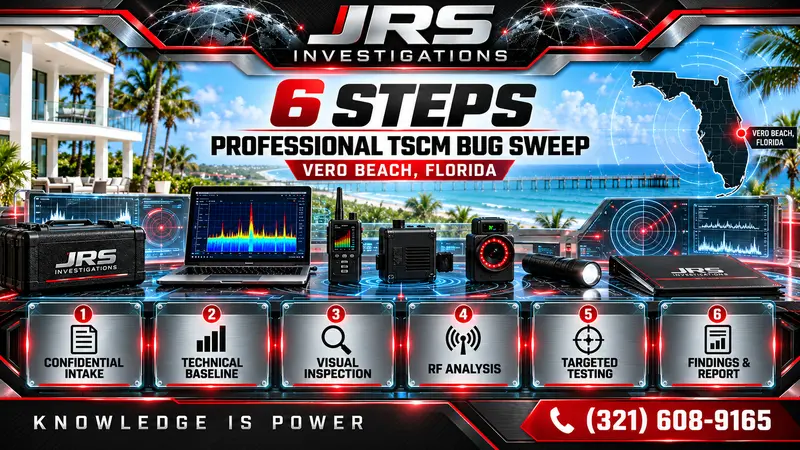
6 Steps in a Professional Vero Beach TSCM Bug Sweep
A professional Vero Beach TSCM bug sweep is a structured inspection of an authorized residence, office, meeting area, vehicle or other defined environment for possible unauthorized audio, video or location-surveillance technology. The work should begin with a specific concern and end with verified findings—not fear-driven assumptions or promises that one device can detect every threat.
Vero Beach properties may contain smart-home systems, marine electronics, security cameras, Wi-Fi networks, Bluetooth devices and neighboring signals. Those normal technologies create a busy baseline. A Technical Surveillance Countermeasures inspection combines several methods so ordinary equipment can be distinguished from anomalies that deserve further investigation.
Although every assignment is different, these six stages explain how a carefully scoped TSCM assessment may be performed.
1. Confidential intake and threat assessment
The first stage defines what information may have been exposed, when the concern began, who had access and which locations or conversations are most sensitive. Useful details can include unexplained information leaks, recent service visits, personnel changes, new electronics, temporary guests or a suspicious item found in a vehicle or room.
An investigator should also ask what the client already knows and what outcome is expected. A residential privacy concern, an executive meeting, a business dispute and a suspected vehicle tracker require different priorities. The intake creates an efficient scope and helps avoid searching large areas that have no connection to the reported risk.
2. Establish the normal technical environment
Before treating a signal or device as suspicious, the examiner should identify equipment that belongs at the property. This may include routers, access points, cameras, smart speakers, alarm components, cellular devices, marine systems and other authorized electronics.
A basic equipment inventory and site walkthrough help create a baseline. In multi-unit buildings, hotels, offices and dense residential areas, signals may originate from neighboring spaces. A signal’s presence alone does not prove that a listening device is inside the client’s property. Location, behavior, power, accessibility and physical verification all matter.
3. Perform a systematic visual and physical inspection
Many useful discoveries begin with methodical observation. The examiner may inspect accessible furniture, fixtures, outlets, chargers, clocks, smoke detectors, décor, wiring paths and recently changed items. The goal is to identify objects or components that do not match their expected construction or purpose.
Physical inspection must respect the client’s authority and the property’s limitations. It does not justify destructive entry into walls, locked containers, neighboring units or equipment the client does not own or control. When invasive inspection may be necessary, the scope and permission should be addressed before work begins.
4. Analyze radio-frequency activity
RF spectrum analysis can help identify and characterize active wireless transmissions in the inspection area. The examiner may compare signal strength and behavior across locations, observe changes over time and attempt to associate signals with known equipment.
RF analysis is only one part of a sweep. Some devices do not transmit continuously; others may be dormant, hardwired or recording locally. Authorized Wi-Fi, Bluetooth, cellular and security equipment can also create signals that appear unfamiliar. Every anomaly requires investigation before a conclusion is reached.
5. Use targeted electronic and vehicle checks
Depending on the site and agreed scope, an examiner may use additional tools to investigate electronic components, optical reflections, wiring irregularities or possible concealment points. Non-linear junction detection may be appropriate in selected accessible areas because it can help identify electronic junctions even when a device is not actively transmitting. It can also respond to ordinary authorized electronics, so physical verification remains essential.
If unauthorized location monitoring is part of the concern, a separately scoped vehicle inspection may examine accessible areas where a foreign tracker could be attached or concealed. Account-based location sharing, mobile-device compromise and stalkerware are different problems. A physical TSCM sweep does not automatically include full computer, phone, cloud-account or malware forensics; those concerns may require a qualified digital-forensics or cybersecurity specialist.
6. Verify, document and recommend next steps
A professional report should distinguish confirmed findings from unresolved anomalies and benign equipment. It may describe the areas examined, methods used, environmental limitations and any items that warrant further analysis. A verbal briefing can address urgent concerns, while photographs and a written report can help the client preserve a clear record.
If a suspicious device is discovered, avoid touching, disconnecting or destroying it until appropriate guidance is obtained. The best next step may depend on personal safety, ownership, potential criminal conduct, evidence preservation and advice from counsel or law enforcement. If someone faces immediate danger, contact emergency services.
What a Vero Beach TSCM sweep can cover
The exact coverage should be confirmed before the appointment. An authorized engagement may include:
- Private residences, condominiums and seasonal homes.
- Executive offices, conference rooms and commercial spaces.
- Hospitality rooms, rental properties and temporary meeting areas.
- Selected vehicles, boats or marine environments when included in the scope.
- Newly installed electronics, chargers, adapters and security equipment.
- Post-event or post-access inspections following contractors, guests or personnel changes.
Learn more on the dedicated Vero Beach TSCM bug-sweep service page and the comprehensive Vero Beach TSCM guide.
Local considerations in Vero Beach
Assignments may involve mainland offices, barrier-island residences, gated communities, hospitality properties and waterfront homes with extensive connected systems. Seasonal occupancy, household staff, property management, repairs and short-term visitors can create many legitimate access events. The intake should identify the access window most closely connected to the concern rather than assuming every visitor is a threat.
Waterfront and marine electronics can also contribute to the technical environment. Nearby boats, navigation devices, security systems and residential networks may produce normal activity that must be separated from signals originating inside the inspection area.
JRS Investigations also provides broader support through its Vero Beach private investigator page. For nearby coverage, review the Port St. Lucie TSCM page. Readers dealing with a separate relationship concern may find the Vero Beach infidelity-investigation guide useful.
How to prepare for the inspection
- Write a short chronology of the concern and any information that was exposed.
- List the rooms, vehicles, devices and conversations that matter most.
- Identify recent visitors, contractors, repairs and equipment changes.
- Keep authorized devices powered and in their usual locations unless instructed otherwise.
- Do not alert unnecessary parties that an inspection is planned.
- Preserve photographs, messages and access records without handling a suspected device.
- Confirm who can authorize access to each area or vehicle.
Preparation improves efficiency, but it does not require the client to prove surveillance before requesting an assessment. The purpose of the intake is to turn a broad concern into a rational inspection plan.
Understand the limits of TSCM
No responsible provider can guarantee that a location will remain permanently free of surveillance devices. A device can be dormant, concealed in an inaccessible space, introduced after the inspection or use a method outside the agreed scope. Building conditions and client access can also limit what can be examined.
The value of a professional sweep is the disciplined process: establish the baseline, inspect systematically, investigate anomalies, document findings and explain limitations. The outcome may be a confirmed device, a benign explanation or practical recommendations that reduce future risk.
Schedule a Vero Beach TSCM bug sweep
JRS Investigations can discuss the concern, location, access, timeline and desired deliverables before recommending a scope. Residential, commercial, vehicle and marine-related requests should each be evaluated according to their specific environment.
Call (321) 608-9165 or contact JRS Investigations to request a confidential assessment.