(888) 737-7690

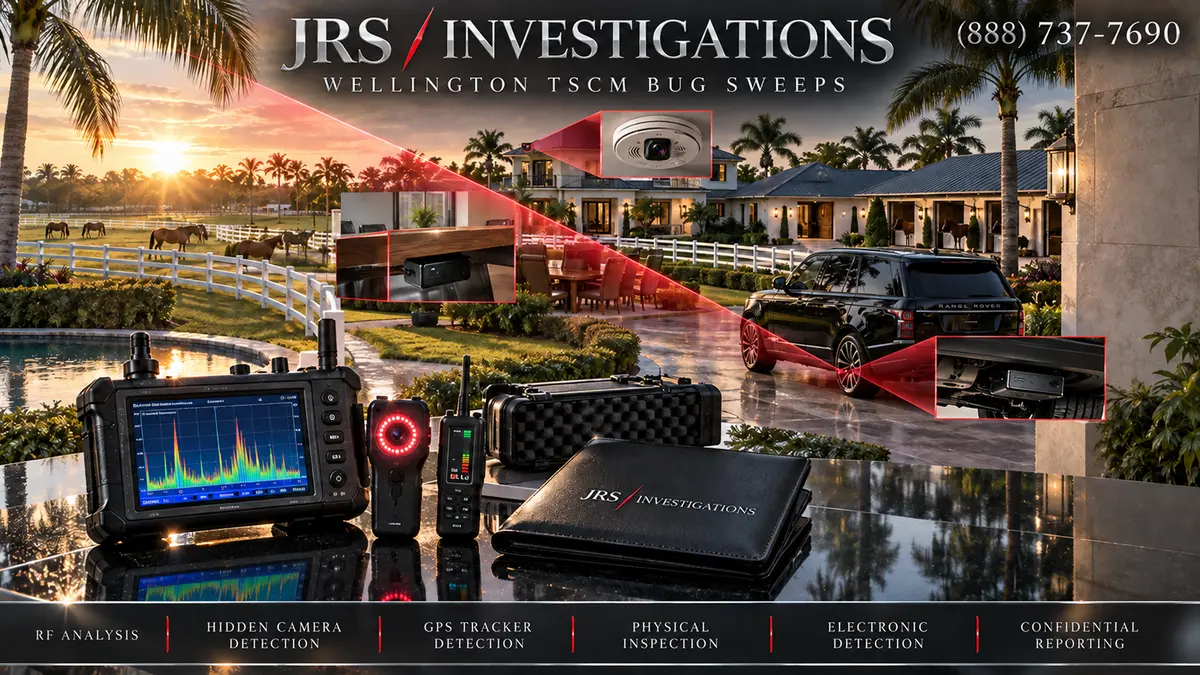
Wellington TSCM Bug Sweeps: Homes, Offices & Vehicles
Wellington homes, professional offices, private meeting spaces, equestrian properties, and vehicles can all hold conversations or information that should remain private. When there is a credible concern about unauthorized audio, covert video, or location tracking, a professional Wellington TSCM bug sweep provides a structured way to inspect an authorized space and document what was found.
Technical Surveillance Countermeasures, usually shortened to TSCM, is more than waving a detector around a room. A careful inspection combines scope planning, physical examination, radio-frequency analysis, electronic and optical detection, vehicle checks when authorized, and confidential reporting. Each method sees a different part of the problem, so the work is strongest when those methods are used together.
What a Wellington TSCM bug sweep can cover
The right scope depends on the concern, the property, and who has legal authority to approve the inspection. JRS Investigations can plan authorized inspections for residences, home offices, conference rooms, executive offices, professional suites, selected equestrian-facility spaces, and vehicles. The assignment may focus on one room or expand to connected areas where wiring, power, networking equipment, or access patterns create a reasonable inspection path.
A sweep can look for signs associated with unauthorized microphones, hidden cameras, transmitting devices, recorders, altered electronics, and GPS trackers. It can also identify physical-security weaknesses that deserve correction. A finding is not assumed before the inspection begins, and an instrument alert is not treated as proof by itself. Signals and anomalies must be interpreted in context.
When people request TSCM services in Wellington
Private residential concerns
A homeowner may notice an unfamiliar object, evidence that a fixture was moved, unexpected access by a vendor or visitor, or disclosure of information that was discussed privately. These facts can justify a closer look, but they do not automatically establish surveillance. A methodical inspection helps separate ordinary electronics, maintenance issues, and normal wireless traffic from items that need additional examination.
Business and professional confidentiality
Attorneys, executives, healthcare professionals, investors, family offices, and business owners may need privacy for strategy discussions, financial decisions, negotiations, personnel matters, or protected client information. In Wellington, that work may happen in a conventional office, a private residence, a temporary meeting location, or a property connected to the equestrian community. The inspection scope should follow where sensitive conversations actually occur.
Vehicle and location-tracking concerns
A vehicle inspection may be appropriate when there is a specific concern about unauthorized location tracking or a suspicious object. Because modern vehicles contain factory telematics, Bluetooth systems, Wi-Fi, driver-assistance sensors, and aftermarket accessories, the inspection must distinguish normal vehicle technology from an unauthorized device. Ownership and consent should be confirmed before work begins.
How a professional TSCM inspection works
1. Confidential intake and lawful authorization
The process begins with a private discussion about the concern, the locations involved, recent access, timing, and the client’s goals. JRS defines the authorized areas, identifies practical constraints, and discusses whether legal counsel, property management, security personnel, or law enforcement should be involved. This step keeps the inspection focused and avoids unnecessary disturbance.
2. Physical inspection
A detailed visual and hands-on examination looks for altered fixtures, unfamiliar power supplies, unusual cabling, misplaced objects, new holes, disturbed surfaces, modified smoke detectors, chargers, clocks, décor, furniture, networking equipment, and other plausible concealment points. Physical inspection matters because some devices store information without transmitting a continuous radio signal.
3. RF analysis
Radio-frequency analysis surveys the active signal environment and helps identify transmissions that deserve investigation. The examiner considers frequency, signal strength, duration, modulation, movement, and whether a signal changes when legitimate equipment is isolated. Wellington properties may contain dense wireless environments, so normal routers, phones, cameras, smart-home equipment, security systems, and nearby devices must be carefully differentiated from unexplained activity.
4. Electronic and hidden-camera detection
Additional instruments can support the search for electronic components or optical reflections associated with camera lenses. No single tool detects every possible device. Results are compared with the physical inspection and the known equipment inventory. A suspicious response should be traced and documented before anyone draws a conclusion.
5. Vehicle and GPS-tracker inspection
When a vehicle is included, the inspection may address accessible exterior mounting areas, the passenger compartment, cargo areas, the diagnostic port, power connections, and unfamiliar aftermarket equipment. Some areas require mechanical access beyond a routine TSCM inspection. If deeper disassembly is justified, the client may need a qualified automotive technician working within an agreed evidence plan.
6. Debriefing and confidential reporting
After the inspection, the client receives a clear explanation of findings, unresolved limitations, and recommended next steps. Reporting should distinguish confirmed items from ordinary devices, interference, and conditions that could not be fully evaluated. When appropriate, the report can document inspected areas, notable observations, photographs, equipment categories, and security improvements.
Six services combined in a layered sweep
- RF analysis: evaluates active radio signals and investigates unexplained transmissions.
- Hidden-camera detection: uses physical and optical methods to examine plausible camera locations.
- GPS-tracker detection: checks an authorized vehicle for suspicious tracking hardware or related indicators.
- Physical inspection: examines fixtures, wiring, furniture, electronics, and concealment opportunities.
- Electronic detection: uses specialized instruments to identify electronic components or anomalies that merit inspection.
- Confidential reporting: records findings, limitations, and practical recommendations without overstating certainty.
This layered approach is important because devices behave differently. Some transmit intermittently, some operate only when triggered, some record locally, and some may be built into objects that appear ordinary.
Wellington-specific inspection planning
Wellington assignments often require careful logistics. Large residential properties may include detached offices, guest areas, garages, staff spaces, gate systems, and multiple wireless networks. Equestrian-related properties can add barns, tack rooms, administrative spaces, trailers, transport vehicles, vendor access, and seasonal activity. A business may also operate from a professional suite while decision-makers conduct sensitive conversations at home or in a vehicle.
For that reason, a good plan prioritizes the spaces where confidential information is created, viewed, or discussed. It also considers who recently had legitimate access: contractors, cleaning crews, IT providers, household staff, maintenance personnel, guests, temporary employees, or property-management teams. The goal is not to treat every visitor as suspicious; it is to understand realistic access and choose an efficient scope.
What to do if a suspicious device is found
Do not immediately unplug, move, dismantle, or destroy a suspicious item. Handling it can alter fingerprints, DNA, stored data, timestamps, power state, location information, or other evidence. It can also alert another party if the device stops communicating.
- Keep people away from the immediate area.
- Record the time and exact location without touching the item.
- Contact qualified counsel or law enforcement when the circumstances may involve a crime, threat, court matter, or safety risk.
- Follow an evidence-preservation plan before removal or technical examination.
- Avoid discussing the discovery in a location or on a device that may still be part of the concern.
A TSCM provider can document observations, but only law enforcement, counsel, a court, or a qualified forensic specialist can determine the next legal or evidentiary step for a particular situation.
Important limits of a bug sweep
No ethical provider should promise that an inspection can guarantee a space is “clean forever.” A sweep evaluates defined locations during a defined period using available methods. Results can be affected by inaccessible construction, powered-off equipment, intermittent transmissions, encrypted communications, large numbers of legitimate signals, or devices introduced after the work is complete.
TSCM also does not replace a cybersecurity assessment. A bug sweep may identify exposed networking equipment, rogue hardware, or physical conditions that affect information security, but compromised accounts, malware, cloud access, mobile-device forensics, and network intrusion require appropriately qualified cybersecurity or digital-forensics professionals.
How to prepare for the inspection
- Limit discussion of the planned sweep to people who genuinely need to know.
- Do not conduct a casual search that may move or destroy evidence.
- Prepare a list of authorized rooms, vehicles, and devices.
- Identify recent vendors, repairs, access events, and newly installed electronics.
- Keep normal equipment in its usual position unless the examiner advises otherwise.
- Arrange keys, alarm access, parking access, and permission for all included areas.
- Share floor plans or equipment inventories when they are available.
Before the appointment, JRS can help refine the scope so time is spent on the highest-priority areas. Clients can also review the broader counter-surveillance and TSCM services page and the dedicated Wellington TSCM service page.
Florida privacy and tracking-device considerations
Authorization and evidence handling matter. Florida Statutes § 934.03 addresses interception and disclosure of wire, oral, and electronic communications. Florida Statutes § 934.425 addresses installation or use of tracking devices and tracking applications, including specified exceptions.
These links are provided for general context, not legal advice. A client facing a divorce, injunction, employment dispute, criminal allegation, threatened disclosure, or active litigation should obtain advice from a Florida attorney about consent, ownership, preservation, and reporting obligations.
Choosing a Wellington TSCM provider
Ask how the provider defines the scope, confirms authorization, combines physical and electronic methods, documents limitations, protects confidentiality, and handles a possible discovery. Be cautious of claims that one handheld detector can find every device or that every unexplained signal proves surveillance. Professional work is evidence-aware, methodical, and clear about uncertainty.
JRS Investigations serves authorized residential, professional, and vehicle assignments in Wellington and across South Florida. Related local investigative support is available through the Wellington private investigator page.
Wellington TSCM bug sweep FAQs
How long does a sweep take?
Timing depends on property size, number of rooms, signal density, vehicle scope, access, and the complexity of the concern. A focused office or vehicle review may take less time than a large residence with detached areas and multiple networks. Scope is discussed before scheduling.
Can you inspect a home, office, and vehicle together?
Yes, when the client has authority to approve each location. Combining related areas can be useful when confidential conversations and travel patterns cross between them.
Will you find every hidden device?
No responsible provider can promise that. Layered methods improve coverage, but every inspection has technical, physical, timing, and access limitations. Those limitations should be explained in the final debriefing.
Should I turn off Wi-Fi before the sweep?
Usually not unless instructed. The examiner may want to observe the environment in its normal state and then isolate known devices methodically. Making changes in advance can remove useful context.
Can a sweep prove who installed a device?
Finding an item does not automatically identify who placed it or why. Attribution may require fingerprints, DNA, purchase records, digital forensics, witness information, legal process, or law-enforcement investigation.
How do I request a confidential consultation?
Contact JRS Investigations or call (888) 737-7690. Be ready to describe the location, the concern, recent access, and whether a vehicle or multiple properties should be included. If there is an immediate threat or emergency, contact law enforcement first.