(888) 737-7690

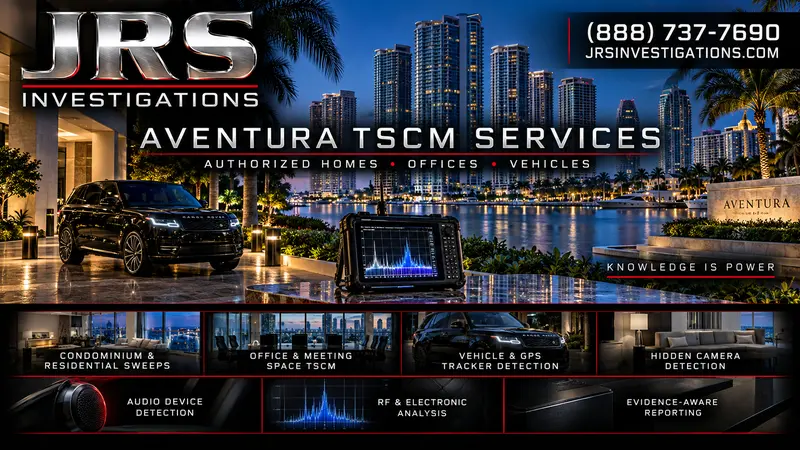
Aventura TSCM Bug Sweeps for Homes, Offices & Vehicles
A professional Aventura TSCM bug sweep should be matched to the environment being examined. A high-rise residence, an executive office, and a vehicle present different access questions, legitimate electronics, surveillance risks, and detection limits. Treating all three as the same “quick scan” can miss important context and create false confidence.
JRS Investigations provides authorized technical surveillance countermeasures for homes, offices, meeting spaces, and vehicles in Aventura and surrounding South Florida communities. Each assignment begins with lawful authority, a defined scope, and a clear explanation of what the inspection can and cannot establish.
What TSCM means
TSCM stands for technical surveillance countermeasures. A professional inspection combines physical examination, radio-frequency assessment, electronic-component detection, review of accessible connections or systems, and documentation of relevant findings. The objective is to distinguish normal equipment and environmental interference from an unexplained device or condition that requires further investigation.
No single detector, phone application, or visual check can evaluate every surveillance method. Some devices transmit continuously, some only at intervals, and some store information without transmitting. Other privacy concerns originate in cloud accounts, phones, computers, vehicle telematics, or people with legitimate access. The inspection method must fit the property and the concern.
Aventura home bug sweeps
Aventura includes high-rise condominiums, gated residences, waterfront properties, townhomes, and buildings with shared electronic infrastructure. These environments can contain dense Wi-Fi, Bluetooth, cellular, security, building-control, and audiovisual activity. A signal appearing on an analyzer is not proof of unauthorized surveillance.
A residential inspection may include authorized living areas, home offices, accessible communications equipment, smart-home devices, and other agreed spaces. In a condominium, the unit owner or authorized resident may not control shared hallways, utility rooms, telecom spaces, parking systems, or building equipment. Property-management or association permission may be required before those areas can be examined.
Recent contractors, domestic staff, guests, maintenance visits, relationship conflict, unauthorized entry, or unexpected disclosure of private conversations may help define the scope. These circumstances are leads, not proof. The investigator documents the condition of the space, identifies legitimate electronics, and evaluates anomalies without assuming that every unusual object or signal is malicious.
Aventura office and meeting-space sweeps
Executive offices, professional suites, conference rooms, home offices, temporary meeting rooms, and shared workspaces have different risks from residences. The concern may involve confidential negotiations, legal strategy, financial information, client matters, personnel decisions, intellectual property, or an unexplained information leak.
Before the inspection, the client should identify who controls the suite, which rooms are included, whether the landlord or building has access, who uses the audiovisual and network systems, and whether the work must occur outside business hours. Shared walls, neighboring tenants, managed Wi-Fi, building security, and conference technology create legitimate activity that must be distinguished from an anomaly.
For a sensitive meeting, timing matters. A pre-meeting inspection assesses the room under known conditions, but later access can change those conditions. Access control, attendee-device rules, visitor management, and post-inspection security are part of the broader protection plan. A bug sweep cannot compensate for uncontrolled entry or compromised accounts.
Aventura vehicle and GPS-tracker inspections
Vehicle inspections require clear ownership or other lawful authority. The investigator should understand whether the vehicle is owned, leased, financed, employer-provided, jointly used, rented, or connected to a family-law dispute. The facts can affect who may authorize the work and how a finding should be handled.
A vehicle may contain factory telematics, paired phones, navigation history, aftermarket accessories, insurance devices, fleet systems, service equipment, and mobile applications that share location. Not every location concern involves a separately concealed tracker. Account access and manufacturer-connected services may require a different response from a physical TSCM inspection.
Physical examination, radio-frequency assessment, and evaluation of accessible electronic components may be used within the agreed scope. Intermittent, dormant, integrated, inaccessible, or previously removed devices may not be detectable during a single appointment. JRS does not publish concealment locations or instructions that could help someone hide a tracker.
For more detail about location devices, review the JRS guide to Bluetooth, GPS/cellular, and vehicle-telematics tracking technologies.
How the inspection process changes by environment
Authority and access
A residence requires permission from the owner or another person with a legitimate right to authorize inspection. An office may require the tenant, employer, property owner, or venue representative. A vehicle requires the owner or another person with clear authority. Common areas and third-party systems remain outside scope unless separately authorized.
Baseline electronics
Homes contain smart devices and neighboring signals. Offices contain managed networks, conference systems, access control, and employee electronics. Vehicles contain factory modules, telematics, entertainment systems, and aftermarket accessories. Building a baseline prevents ordinary equipment from being misidentified.
Physical examination
The investigator examines accessible areas systematically and documents items that require further evaluation. The work should avoid damage and remain within the agreed authority. Components requiring removal, electrical work, vehicle disassembly, or manufacturer access may need a qualified specialist.
Radio-frequency assessment
RF analysis evaluates signal activity, behavior, location, and association with known devices. Aventura’s dense residential and commercial environment can produce significant legitimate wireless traffic. Interpretation matters more than the number of signals displayed.
Electronic-component detection
Specialized methods may help identify electronic components even when they are not actively transmitting. Results must still be interpreted in context because modern rooms and vehicles contain many legitimate circuits.
Reporting and follow-up
A useful report identifies the areas examined, methods used, relevant findings, unresolved limitations, and recommended next steps. Follow-up may involve law enforcement, legal counsel, digital forensics, cybersecurity, a vehicle manufacturer, an electrician, building management, or a later reinspection.
Warning signs are not proof of surveillance
Private information becoming known unexpectedly, evidence of unauthorized entry, unfamiliar equipment, unexplained account activity, or a tracker alert can justify a closer review. Static, dropped calls, battery drain, a warm device, or an unusual sound can also have ordinary technical explanations.
Consumer checklists often present vague symptoms as confirmation that a person has been bugged. A professional assessment documents facts, tests reasonable explanations, and avoids escalating fear without evidence.
TSCM is different from cybersecurity and digital forensics
A physical sweep does not automatically determine whether an email account, cloud service, phone, computer, smart-home platform, or connected-vehicle account has been compromised. Those issues may require password and access review, manufacturer support, network analysis, incident response, or forensic examination.
JRS can document the physical environment and help identify when another qualified discipline is required. Keeping those scopes separate leads to clearer findings and more defensible recommendations.
Safety and evidence preservation
If the concern involves stalking, threats, domestic violence, extortion, or immediate danger, move to a safe location and contact law enforcement. Do not confront a suspected person, announce the planned inspection, destroy an unfamiliar device, or create a private meeting to test a theory.
Preserve screenshots, alerts, dates, messages, visitor records, service appointments, access logs, and photographs. If an unfamiliar object is found, photograph it in place when safe and avoid unnecessary handling. Removal may affect evidence, safety, vehicle operation, or an ongoing investigation.
Florida law and lawful authorization
Florida Statute § 934.03 generally prohibits intentional interception and certain use or disclosure of wire, oral, or electronic communications unless an exception applies. Consent requirements and statutory exceptions can be fact-specific.
Florida Statute § 934.425 addresses use of tracking devices or applications on another person’s property without consent and contains specified exceptions. Ownership, lease, employment, parental, and court-order circumstances may affect the analysis.
JRS does not determine criminal liability or provide legal advice. A lawyer or law-enforcement agency should evaluate how the law applies to a specific situation and direct evidence handling when appropriate.
How to prepare for an Aventura TSCM inspection
- List the exact residence, office rooms, meeting space, or vehicle to be examined.
- Confirm who owns or controls each area and who can authorize access.
- Prepare a timeline of entries, repairs, visitors, account alerts, disclosures, and unusual events.
- Identify legitimate Wi-Fi, Bluetooth, security, audiovisual, smart-home, telematics, and aftermarket equipment.
- Avoid discussing the planned inspection in the location being examined.
- Do not move or discard suspicious items before the appointment.
- Arrange condominium, office-building, parking, valet, elevator, loading, or after-hours access.
- Tell the investigator about injunctions, police reports, litigation, safety risks, or attorney involvement.
Aventura TSCM resources
Review the dedicated Aventura TSCM and hidden-camera-detection service page, the broader JRS TSCM and counter-surveillance page, and the Aventura private investigator service page. Our guide to South Florida TSCM scheduling considerations provides additional risk-planning context.
Frequently asked questions
Can one sweep cover my condominium, office, and vehicle?
They can be included in one coordinated assignment when authority, access, time, and scope are established for each. Each environment is inspected and reported according to its own conditions.
Can a sweep guarantee that no device is present?
No. A device may be dormant, intermittent, inaccessible, integrated into legitimate equipment, removed before the inspection, or outside the authorized scope. The report should explain the methods used and the limitations.
Can JRS inspect condominium common areas or an employer’s property?
Only when the appropriate owner, employer, association, manager, or other authorized party permits it. Permission for a private unit does not automatically extend to shared or third-party property.
Does a vehicle sweep include connected-app accounts?
Not automatically. A physical inspection and an account-security review are different scopes. Manufacturer support, cybersecurity, or digital forensics may be needed for connected services.
What should I do if a device is found?
Document it, avoid unnecessary handling, and consider safety and evidence needs before removal. Law enforcement or legal counsel may need to direct the next step.
Request a confidential Aventura consultation
JRS Investigations can define an authorized inspection for an Aventura residence, office, meeting space, or vehicle. We will discuss the concern, access, legitimate electronics, site conditions, reporting needs, and realistic limitations before scheduling.
Use the confidential contact page or call (888) 737-7690.
Knowledge is power. Get the facts before deciding your next step.
This article provides general information and is not legal advice. Services are subject to lawful authority, applicable law, safety considerations, conflict checks, and case-specific limitations.