(888) 737-7690

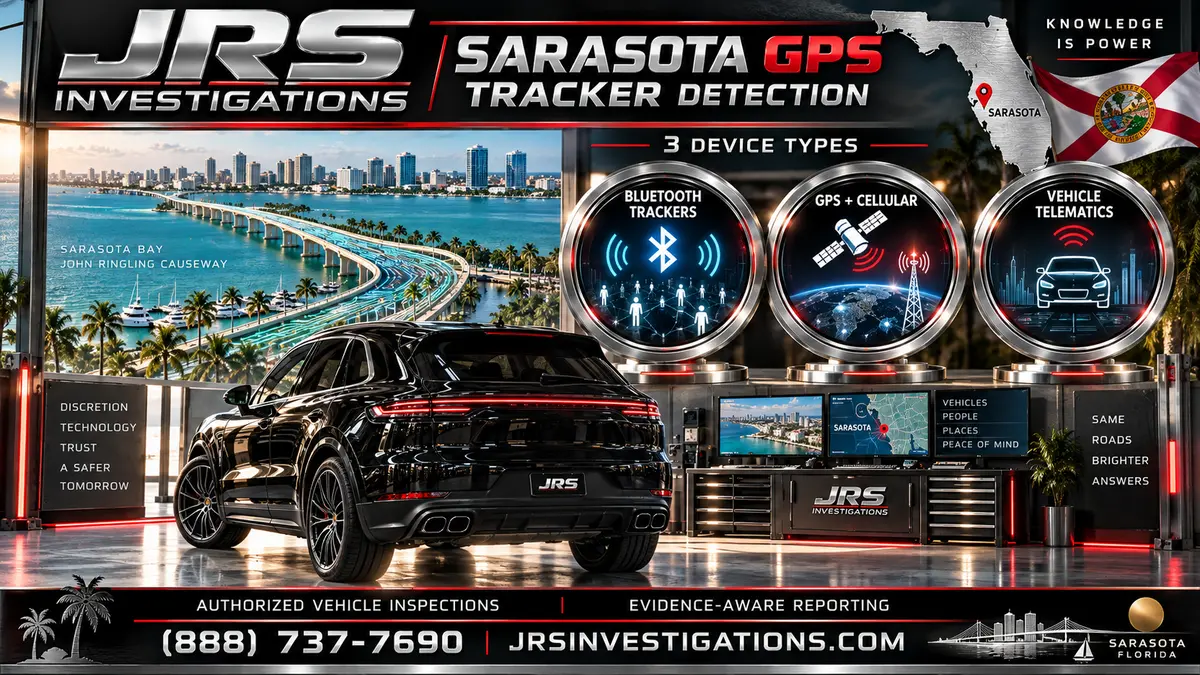
Sarasota GPS Tracker Detection: 3 Device Types
An unexpected tracker alert or unexplained location exposure can be frightening, but it is not proof by itself that someone is deliberately following you. A professional GPS tracker detection inspection in Sarasota should identify the technology involved, preserve useful information, and separate a legitimate device or borrowed item from a potentially unauthorized tracker.
JRS Investigations provides authorized vehicle and property inspections in Sarasota and surrounding Gulf Coast communities. This guide explains three broad tracking-device categories, what each one can—and cannot—tell you, and how to respond without damaging evidence or creating additional risk.
Three tracking technologies an inspection may evaluate
“GPS tracker” is often used as a catch-all phrase, but location devices do not all work the same way. Some use satellite positioning and cellular data. Others rely on nearby phones and a crowdsourced Bluetooth network. A vehicle may also have factory or aftermarket telematics that share location through an account or subscription.
Because the technology differs, a competent inspection should not rely on one scanner, one phone app, or one quick visual check. The scope may require physical inspection, radio-frequency analysis, account review by the authorized owner, and documentation of any relevant findings.
1. Bluetooth item trackers
Small Bluetooth trackers are designed to help owners locate keys, bags, luggage, and other personal property. Compatible phones can warn a person when an unknown tracker appears to be moving with them over time. These alerts are valuable safety features, but context still matters: the device may belong to a borrowed item, a passenger, or property that was legitimately shared.
If you receive an alert, preserve screenshots showing the alert, map, dates, and device information before changing settings. Follow the manufacturer’s instructions to play a sound or locate the item. Apple publishes guidance for unwanted Find My alerts, and Android provides built-in unknown-tracker alerts and manual scanning on supported devices.
If you feel unsafe, move to a safe public location and contact law enforcement. Do not confront a suspected person or create a private meeting to test whether the alert follows you.
2. Dedicated GPS and cellular trackers
A dedicated tracker may use satellite positioning to determine location and a cellular connection to transmit that information. Some devices report continuously; others transmit only at intervals, after movement, or when awakened. A dormant or intermittent unit may not produce a constant radio signal, which is why a single electronic scan cannot guarantee that every device will be found.
A professional vehicle inspection combines multiple methods. The investigator verifies the owner or authorized party, documents the vehicle and condition before inspection, examines accessible areas without damaging the vehicle, evaluates relevant radio-frequency activity, and records any item that requires closer analysis. If removal could affect safety or evidence, the investigator may recommend law-enforcement or legal coordination before disturbing it.
JRS does not publish a list of concealment locations or provide instructions that could help someone hide a tracker. The purpose of the inspection is defensive: assess an authorized vehicle, document findings, and help the client choose a safe next step.
3. Vehicle telematics and connected-location services
Not every location concern involves a separately hidden device. Many vehicles include factory telematics, navigation history, mobile-app access, connected services, fleet systems, or aftermarket accessories installed for insurance, financing, maintenance, or business operations. Account access left active after a relationship, employment, or ownership change can create location exposure without an added tracker.
The authorized owner may need to review account users, paired phones, connected applications, subscription access, and manufacturer support options. This is different from digital forensics. A physical TSCM inspection cannot determine whether every cloud account, phone, or manufacturer platform has been compromised.
When the concern includes account access, JRS can document the physical findings and help define which qualified technical, legal, manufacturer, or law-enforcement resource should address the remaining issue.
What to do after an unknown-tracker alert
- Move to a safe public place if you believe you are in immediate danger.
- Save screenshots of the alert, map, device name, serial information, dates, and times.
- Do not confront a suspected person or announce the planned inspection.
- Do not destroy, discard, or reset a located device before considering evidence and safety needs.
- Write down recent trips, passengers, borrowed property, service appointments, and vehicle access.
- Contact law enforcement when safety, stalking, threats, or criminal conduct may be involved.
- Arrange inspection only with the vehicle owner or another person who has clear authority.
Apple’s official unwanted-tracking guidance explains how compatible alerts work and advises contacting law enforcement if safety is at risk. Google’s official Android unknown-tracker guide explains automatic alerts and manual scanning.
Florida law and authorization
Florida Statute § 934.425 generally prohibits knowingly placing or using a tracking device or application on another person’s property without consent, subject to specified exceptions. The statute also addresses court orders, certain parental situations, legitimate business uses, and vehicle ownership or lease circumstances.
The facts can be complicated when a vehicle is jointly owned, leased, employer-provided, used by a minor, or involved in a divorce or injunction. JRS does not determine criminal liability or give legal advice. An attorney or law-enforcement agency can evaluate how the statute applies to a specific situation.
What a professional Sarasota inspection should include
A defensible inspection begins with authority and scope. The investigator should confirm who owns or controls the vehicle or property, what prompted the concern, whether an alert was received, who recently had access, and whether there is a related police report, injunction, family-law matter, or workplace issue.
The inspection may include a documented physical examination, review of accessible power or data connections, radio-frequency assessment, evaluation of suspicious items, photographs, and a written summary. Results should distinguish confirmed devices from normal vehicle electronics and unresolved anomalies.
No responsible provider can promise to find every tracker. Devices can be dormant, intermittent, damaged, removed before the inspection, or integrated into systems outside the scope of a physical sweep. A clear report should explain the methods used, the conditions observed, and the limitations.
Sarasota field considerations
Sarasota cases may involve private residences, condominiums, marinas, commercial parking areas, hotels, rental vehicles, or travel between downtown, barrier islands, Interstate 75, and neighboring Gulf Coast communities. Access rules and ownership questions can change the lawful scope. A vehicle at a dealership, marina, rental agency, workplace, or condominium garage may require permission from more than one party.
For broader regional services, visit the Sarasota private investigator page and the Sarasota TSCM bug-sweep service page. The Sarasota TSCM professional guide explains wider residential, office, and vehicle privacy assessments.
Frequently asked questions
Can a phone detect every type of tracker?
No. Phone alerts are designed for compatible Bluetooth location trackers. They do not prove that every GPS, cellular, telematics, or proprietary device is absent.
Should I remove a device immediately?
If safety is at risk, contact law enforcement and follow their direction. When immediate danger is not present, photograph and document the item before disturbing it, and consider whether removal could affect evidence or vehicle safety.
Can JRS inspect someone else’s vehicle?
Only with lawful authority from the owner or another person who has a legitimate right to authorize the inspection. Ownership, lease, employment, and court-order issues should be clarified first.
Does a tracker alert prove stalking?
No. It is a reason to investigate, preserve information, and assess safety. The alert may have an innocent explanation, or it may identify conduct requiring law-enforcement and legal review.
How do I request an inspection?
Review JRS TSCM and counter-surveillance services, then use the confidential contact page or call (888) 737-7690.
Request a confidential Sarasota tracker inspection
JRS Investigations can help define an authorized, evidence-aware inspection for a vehicle or property in Sarasota. We will discuss the alert or concern, ownership and access, safety considerations, inspection scope, reporting needs, and realistic limitations before work begins.
Call JRS Investigations 24/7 at (888) 737-7690.
This article provides general information and is not legal advice. Inspection services are subject to lawful authority, applicable law, safety considerations, conflict checks, and case-specific limitations.