(888) 737-7690

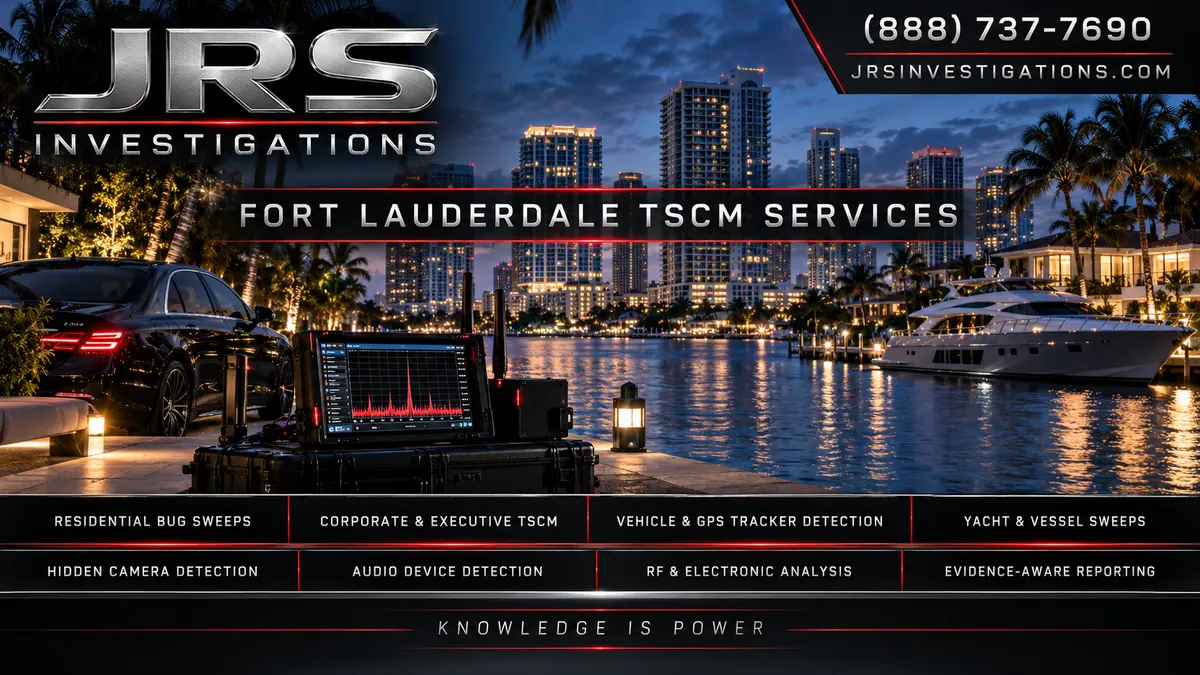
Fort Lauderdale TSCM Bug Sweeps: What to Expect
Concern about a hidden microphone, camera, tracker, or unauthorized recording device deserves a calm, structured response. A professional TSCM bug sweep in Fort Lauderdale is designed to assess an authorized space, document what is found, and separate ordinary electronics or interference from a credible surveillance concern.
JRS Investigations provides technical surveillance countermeasures for authorized homes, offices, meeting rooms, vehicles, and other property in Fort Lauderdale and surrounding Broward County communities. The inspection scope depends on the location, the reason for concern, recent access, available time, and the decisions the client must make after the examination.
What a TSCM bug sweep is designed to answer
TSCM stands for technical surveillance countermeasures. It combines physical inspection, radio-frequency assessment, electronic-component detection, review of accessible wiring or systems, and evidence-aware documentation. The goal is not simply to make a detector beep. It is to identify and evaluate anomalies in context.
A well-scoped inspection may help answer questions such as:
- Is there a visible or concealed device that does not belong in the space?
- Are unexplained radio signals present, and can they be associated with a legitimate source?
- Do accessible telephone, network, power, or audiovisual connections show signs that require closer examination?
- Are there physical changes, unfamiliar accessories, or electronic components that should be documented?
- Does a finding require removal, laboratory review, digital forensics, legal advice, or law-enforcement coordination?
No single instrument can answer every question. A professional sweep relies on multiple methods and a clear understanding of the environment.
When a Fort Lauderdale inspection may be appropriate
Clients request TSCM inspections for many reasons. A business may be preparing for a confidential transaction, executive meeting, legal strategy session, employee investigation, or product discussion. A homeowner may be concerned after an unauthorized entry, relationship conflict, contractor access, property-management visit, or unexpected disclosure of private information. A yacht, vehicle, or temporary meeting space may require a narrower inspection based on ownership and access.
An unusual noise, a dropped call, a blinking light, or a feeling of being watched is not proof of surveillance. Modern homes and offices contain Wi-Fi access points, Bluetooth devices, security systems, smart televisions, wireless cameras, cellular equipment, building controls, and neighboring signals. The purpose of a sweep is to evaluate facts without assuming that every anomaly is malicious.
How a professional TSCM inspection works
1. Confidential intake and lawful authorization
The investigator first defines the concern, the property to be inspected, who owns or controls it, who recently had access, and whether a police report, injunction, lawsuit, employment issue, or domestic dispute is involved. The person requesting the work must have lawful authority to permit inspection of the location, vehicle, vessel, room, or equipment.
This intake also determines whether the issue belongs within TSCM. A compromised email account, phone, cloud service, smart-home account, or computer may require digital forensics or cybersecurity work rather than a physical bug sweep.
2. Site control and baseline review
Before examining the space, the team documents relevant conditions and identifies legitimate electronics. Whenever practical, occupants avoid announcing the sweep, adding new devices, moving furniture, or allowing unnecessary access before the appointment. The baseline helps distinguish normal equipment and expected signals from items that deserve closer attention.
3. Methodical physical inspection
A physical examination is essential because some devices store information locally, transmit only briefly, remain dormant, or use ordinary-looking components. The inspection focuses on accessible areas and property that the client is authorized to have examined. Investigators document anomalies and avoid damaging the premises.
JRS does not publish detailed concealment locations or step-by-step hiding instructions. That information could help someone defeat a future inspection. The client receives findings relevant to the authorized assignment.
4. Radio-frequency assessment
Radio-frequency analysis looks for signal activity and patterns that may require identification. Fort Lauderdale environments can be electronically dense: high-rise offices, condominiums, hotels, marinas, mixed-use buildings, and nearby businesses may produce many legitimate signals. A signal is not evidence of a bug simply because it appears on an analyzer.
The examiner correlates signal behavior with known devices, location, timing, and other findings. Frequency-hopping, encrypted, low-power, intermittent, or cellular devices can complicate the assessment, which is why RF work must be combined with physical and electronic examination.
5. Electronic-component and wired-system checks
Depending on the agreed scope, the inspection may use specialized equipment to evaluate electronic components even when they are not transmitting. Accessible telephone, network, audiovisual, power, or alarm-related connections may also be examined for unexplained additions or changes. The scope should identify what can be inspected safely and what requires a qualified electrician, network professional, vehicle technician, manufacturer, or property representative.
6. Findings, documentation, and next steps
A useful result distinguishes confirmed devices, legitimate equipment, unresolved anomalies, and areas that could not be examined. Photographs, identifiers, locations, observed condition, and the method of discovery should be documented when relevant. If an item may be evidence, the investigator may recommend that it remain undisturbed until law enforcement or counsel provides direction.
The final discussion should also explain limitations. A report that simply says “all clear” without identifying scope and constraints can create false confidence.
Fort Lauderdale planning considerations
Fort Lauderdale assignments often involve spaces with shared infrastructure and controlled access. Condominiums may require elevator reservations, loading access, property-management permission, or coordination with an owner or association. Downtown offices and Las Olas-area businesses may have building security, shared telecom rooms, after-hours access rules, or neighboring wireless systems. Hotels and event venues require clear authority from the party controlling the specific room or meeting space.
Marinas, yachts, and waterfront properties add ownership, crew, dock-access, shore-power, communications, and equipment questions. A vessel inspection must be coordinated with the owner or authorized representative and may require marine technical support. Vehicle work also requires clear ownership or other lawful authority.
These details affect timing and scope. They should be resolved before equipment arrives so the inspection can proceed discreetly and without unnecessary interruption.
What a TSCM sweep cannot guarantee
No responsible provider can promise to find every surveillance device. Equipment may be removed before the appointment, inaccessible, integrated into legitimate systems, damaged, shielded, dormant, remotely activated, or transmitting only under conditions that do not occur during the sweep. Some exposure comes from account access, malware, social engineering, or a person with legitimate access rather than a hidden physical device.
A TSCM inspection is a time-bounded assessment of the authorized areas and conditions examined. Follow-up work may include access-control changes, account security, cybersecurity review, digital forensics, locks or property-management action, scheduled reinspection, meeting-room protocols, or law-enforcement reporting.
Safety and evidence preservation
If you believe a device is connected to stalking, threats, domestic violence, extortion, or immediate danger, move to a safe location and contact law enforcement. Do not confront a suspected person, announce an inspection, destroy a device, or test it by creating a risky meeting.
Preserve relevant dates, messages, photographs, visitor records, access logs, service appointments, and the names of people who had legitimate access. If you discover an unfamiliar object, photograph it in place if that can be done safely and avoid unnecessary handling. The appropriate next step depends on safety, ownership, legal strategy, and whether the item could contain evidence.
Florida recording and interception law
Florida Statute § 934.03 generally prohibits intentional interception and certain use or disclosure of wire, oral, or electronic communications unless a statutory exception applies. The statute includes consent rules and specific exceptions, and the facts can be highly situation-dependent.
A TSCM provider identifies and documents technical findings; it does not decide criminal liability or provide legal advice. An attorney or law-enforcement agency should evaluate whether conduct is unlawful, whether a discovered item should be removed, and how evidence should be handled.
How to prepare for a bug sweep
- Identify every room, vehicle, vessel, or system you want assessed.
- Confirm who can authorize access and inspection.
- Prepare a timeline of concerns, disclosures, entries, repairs, visitors, and device changes.
- List legitimate Wi-Fi, Bluetooth, security, smart-home, audiovisual, and communications equipment.
- Avoid discussing the planned sweep in the location being examined.
- Do not add consumer “bug detectors” or move suspicious items before the appointment.
- Arrange building, marina, parking, elevator, or after-hours access in advance.
- Tell the investigator about safety concerns, court orders, police reports, or counsel involvement.
Choosing a Fort Lauderdale TSCM provider
Ask how the provider defines the scope, confirms authorization, combines physical and electronic methods, distinguishes legitimate signals, documents findings, protects confidentiality, and explains limitations. Be cautious of guaranteed results, instant conclusions from one handheld detector, dramatic claims, or instructions to destroy a suspected device.
Review the dedicated Fort Lauderdale TSCM service page and JRS TSCM and counter-surveillance services for broader information about authorized inspections. Our guide to choosing professional bug-sweep support provides additional planning questions.
Frequently asked questions
How long does a Fort Lauderdale bug sweep take?
Time depends on the size and complexity of the location, electronic density, access, number of rooms or vehicles, and the findings encountered. A proper scope is established before scheduling; a quick walk-through is not equivalent to a complete inspection.
Can an inspection find a device that is turned off?
Some inactive electronics may be identified through physical inspection or specialized component-detection methods. Others may be inaccessible or indistinguishable from legitimate systems. No method guarantees detection of every dormant device.
Can JRS inspect a condominium, hotel room, office, yacht, or vehicle?
Potentially, when the requesting party has clear lawful authority and any building, venue, marina, ownership, lease, or access requirements are satisfied. The exact scope is confirmed before work begins.
Does a TSCM sweep include phone or computer forensics?
Not automatically. Physical TSCM, digital forensics, cybersecurity, account recovery, and network analysis are different disciplines. The intake process helps determine which service or referral is appropriate.
What happens if a suspicious device is found?
The investigator documents the finding and discusses safety, ownership, evidence, and reporting considerations. Removal is not automatic. Law enforcement or legal counsel may need to direct the next step.
Request a confidential Fort Lauderdale TSCM consultation
JRS Investigations can help define an authorized, evidence-aware inspection for a Fort Lauderdale home, office, meeting space, vehicle, vessel, or other property. We will discuss the concern, lawful access, scope, site conditions, reporting needs, and realistic limitations before the assignment.
Use the confidential contact page or call (888) 737-7690.
Knowledge is power. Get the facts before deciding your next step.
This article provides general information and is not legal advice. Services are subject to lawful authority, applicable law, safety considerations, conflict checks, and case-specific limitations.
JRS Investigations in Fort Lauderdale: Fort Lauderdale private investigator