(888) 737-7690
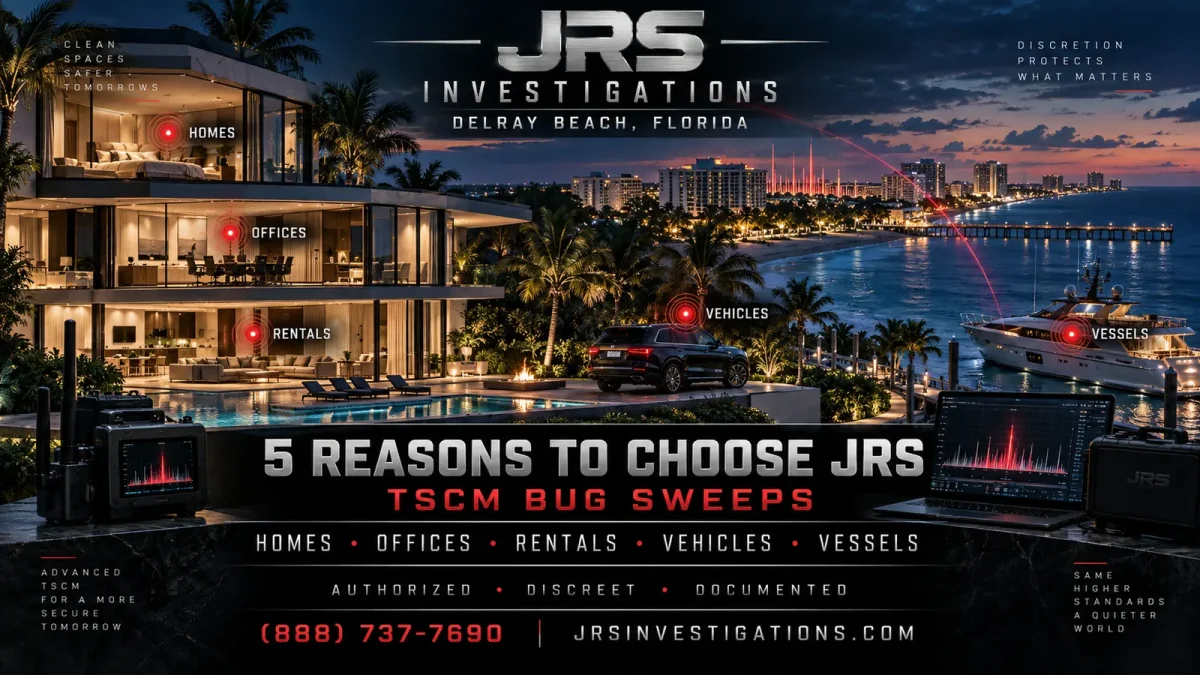
5 Reasons to Hire JRS for a Delray Beach TSCM Bug Sweep
Privacy concerns can begin with a small change: an unfamiliar object in a bedroom, a private conversation repeated by someone who should not know it, unexplained access to a vehicle, or the discovery of a recording app or tracking device. In Delray Beach, these concerns may arise during a difficult relationship, divorce, custody dispute, business conflict, estate matter, or executive security incident. A professional TSCM bug sweep in Delray Beach, FL provides a structured way to examine the environment without relying on guesswork.
Technical Surveillance Countermeasures, commonly called TSCM, combines a careful visual and physical inspection with appropriate electronic testing. The purpose is to identify indicators of unauthorized audio, video, location, or data collection and document what was observed. The scope should always be lawful and authorized by the person who owns or controls the home, office, rental, vehicle, or vessel being inspected.
JRS Investigations approaches each request discreetly and explains the limits of the work before the inspection begins. A sweep cannot prove every suspicion or identify every person who may have had access, but it can replace anxiety with a documented assessment and practical next steps. Here are five reasons clients choose JRS for TSCM services in Delray Beach and throughout South Florida.
1. A Methodical Inspection Beyond a Consumer RF Detector
Low-cost radio-frequency detectors can react to ordinary Wi-Fi, Bluetooth, cellular, and smart-home signals. That makes them difficult to interpret in a modern Delray Beach residence, condominium, office, or vehicle. Some surveillance devices transmit continuously, others send short bursts, and some record locally without transmitting at all. No single tool can evaluate every possibility.
A professional inspection uses several methods as the circumstances require. The work may include a visual examination of likely concealment areas, review of unfamiliar power sources and cabling, radio-frequency analysis, nonlinear junction detection, lens detection, thermal observations, and inspection of accessible fixtures or objects. Equipment is only part of the process. The investigator must distinguish normal electronics from anomalies and avoid making conclusions that the readings do not support.
JRS tailors the scope to the property and the reported concern. A waterfront condominium with building Wi-Fi presents a different signal environment than a private office, detached home, rental property, vehicle, or vessel. Clients can learn more about the broader process on the TSCM bug sweep and counter-surveillance services page.
2. Discreet Help During Relationship and Domestic Privacy Concerns
Many calls about hidden cameras, voice recorders, or trackers are connected to personal relationships. A spouse or former partner may know private details, appear unexpectedly at locations, or have had access to the home, vehicle, phone, or shared accounts. Those facts can be alarming, but they do not by themselves establish that a covert device exists. Shared passwords, location sharing, connected-car accounts, family cloud services, smart-home access, and ordinary observation can create similar concerns.
JRS begins by separating what the client observed from what is assumed. That helps determine whether a physical TSCM sweep is appropriate and which areas should receive priority. In a home, the focus may include bedrooms, home offices, living areas, chargers, clocks, smoke detectors, network equipment, and objects recently introduced or moved. In a vehicle, the inspection may consider accessible hiding areas, power connections, aftermarket accessories, and signs of tampering.
TSCM is distinct from surveillance, infidelity investigation, digital forensics, or account-security work. When a relationship concern extends beyond a physical sweep, JRS can discuss whether another lawful service is better suited to the question. The Delray Beach private investigator page outlines local investigative support, including cheating-spouse, custody, background, missing-person, and other case types. Services are scoped separately so the client understands what each assignment can and cannot establish.
3. Careful Documentation and Evidence-Aware Handling
A sweep is more useful when the findings are documented clearly. JRS records relevant observations, areas examined, anomalies evaluated, and the disposition of any suspicious item located within the authorized scope. Documentation may include photographs, notes, device identifiers, location information, and recommendations for additional examination. The level of reporting is discussed before work begins.
If an unfamiliar device is found, the safest response is not always to remove, power down, or confront someone immediately. Disturbing an item could erase data, alter its condition, alert another party, or create a safety issue. The investigator can help the client consider appropriate next steps, which may include preserving the scene, contacting counsel, notifying law enforcement, or arranging specialist analysis. JRS does not promise that every item will be admissible in court; admissibility depends on collection, authentication, relevance, applicable law, and the decisions of attorneys and courts.
Clients should also avoid conducting unauthorized inspections of property they do not own or control. Consent matters in shared residences, workplaces, rentals, vehicles, and vessels. When authority is uncertain, obtaining legal advice before the sweep can protect the client and the integrity of the work.
4. Local Planning for Delray Beach Homes, Offices, Rentals, and Vehicles
Delray Beach includes single-family homes, condominiums, seasonal residences, rental properties, professional offices, hospitality spaces, vehicles, and boats. Each setting creates different access patterns and privacy risks. Contractors, guests, employees, household members, property managers, maintenance personnel, and prior occupants may all have legitimate reasons to enter a space. A useful inspection plan considers who had access, when the concern began, and what changed around that time.
For condominiums and shared buildings, the investigator must account for dense wireless traffic and equipment belonging to neighboring units or building systems. In rentals or seasonal properties, the client should identify objects provided with the property and any recent maintenance visits. For an office, the priority may be a conference room, executive suite, reception area, or workspace where confidential conversations occur. Vehicle inspections may require a different environment and access than an indoor sweep.
JRS can coordinate service in Delray Beach and across South Florida while protecting scheduling details. The dedicated Delray Beach TSCM service page provides additional location-specific information.
5. Clear Communication, Realistic Limits, and Practical Next Steps
Good TSCM work begins with realistic expectations. A professional sweep can identify many physical indicators and electronic anomalies present during the inspection, but it cannot guarantee that no device has ever been used or that a device will never be introduced later. Intermittent, dormant, removed, well-shielded, or inaccessible equipment can be difficult to locate. A clean result also does not rule out compromised accounts, spyware, shared credentials, cloud access, or information obtained through people rather than devices.
JRS explains these boundaries plainly. The investigator reviews the client’s observations, defines the authorized locations, notes areas that cannot be accessed, and discusses the findings after the inspection. Recommendations may include changing access controls, reviewing smart-home users, updating passwords with a separate trusted device, checking account recovery methods, limiting unnecessary location sharing, improving visitor procedures, or scheduling a follow-up sweep after a high-risk event.
When another service is indicated, JRS can explain available options without presenting one investigation as proof of another. A TSCM inspection evaluates the physical environment. Surveillance may document activities in public view. Background research may verify identity or history. Digital-forensic work examines supported devices or data under proper authority. An overview is available on the private investigation services page.
What a Delray Beach TSCM Consultation May Cover
Before scheduling, it helps to organize the facts. Note the first date something seemed wrong, the exact statements or events that raised concern, who had access to the property, and whether any unfamiliar object appeared. Identify shared accounts, smart-home systems, vehicles, rooms, devices, or recent repairs that may be relevant. Do not dismantle fixtures, scan another person’s property, or post accusations online.
During the consultation, JRS may ask about the size and type of location, occupancy, available access, the timing of the suspected activity, and any immediate safety concerns. This information helps estimate the time, equipment, and personnel required. It also helps identify whether the request is truly a TSCM matter or whether another service should be considered first.
How to Prepare for the Inspection
- Preserve the normal environment: Avoid moving or unplugging unfamiliar items unless safety requires it.
- Arrange lawful access: Confirm that the client can authorize inspection of every room, vehicle, office, or vessel included in the scope.
- Limit advance discussion: Share scheduling details only with people who need to know.
- List recent changes: Note new electronics, gifts, repairs, guests, employees, contractors, or access disputes.
- Gather relevant facts: Bring dates, observations, photographs, model numbers, or account alerts without altering potential evidence.
- Plan enough time: A thorough inspection should not be rushed, especially in a furnished or electronically dense location.
Frequently Asked Questions
Can JRS guarantee that a property is free of every surveillance device?
No. TSCM reduces uncertainty through a professional inspection of the accessible, authorized environment at a specific time. No responsible provider can guarantee the absence of every possible device, prior compromise, or future installation.
Does an RF detector find every hidden camera or recorder?
No. Some devices transmit, some record locally, and some communicate only at intervals. A professional sweep uses multiple inspection methods because one detector cannot cover every threat.
Can a TSCM sweep prove that a spouse or former partner planted a device?
A sweep may locate or document an item, but the presence of a device does not automatically prove who installed it. Attribution may require additional lawful investigation, forensic analysis, witness information, records, or law-enforcement involvement.
Are phones and online accounts included?
Not automatically. A physical TSCM sweep is different from mobile-device forensics, malware analysis, or account-security review. The consultation should identify those concerns so JRS can define the appropriate scope or referral.
How often should a business schedule a sweep?
There is no universal schedule. Frequency depends on access, the sensitivity of conversations, personnel changes, disputes, travel, major meetings, and prior incidents. Some clients request service after a specific event; others use periodic inspections as one part of a broader security plan.
Request a Confidential Delray Beach TSCM Consultation
If you are concerned about a hidden camera, voice recorder, tracker, or other unauthorized surveillance in a Delray Beach home, office, rental, vehicle, or vessel, start with a private consultation. JRS Investigations will review the facts, explain suitable services, define the authorized scope, and provide realistic expectations before work begins.
Contact JRS Investigations or call (888) 737-7690 to discuss a discreet TSCM bug sweep in Delray Beach, Florida. If anyone may be in immediate danger, contact local emergency services first.