(888) 737-7690

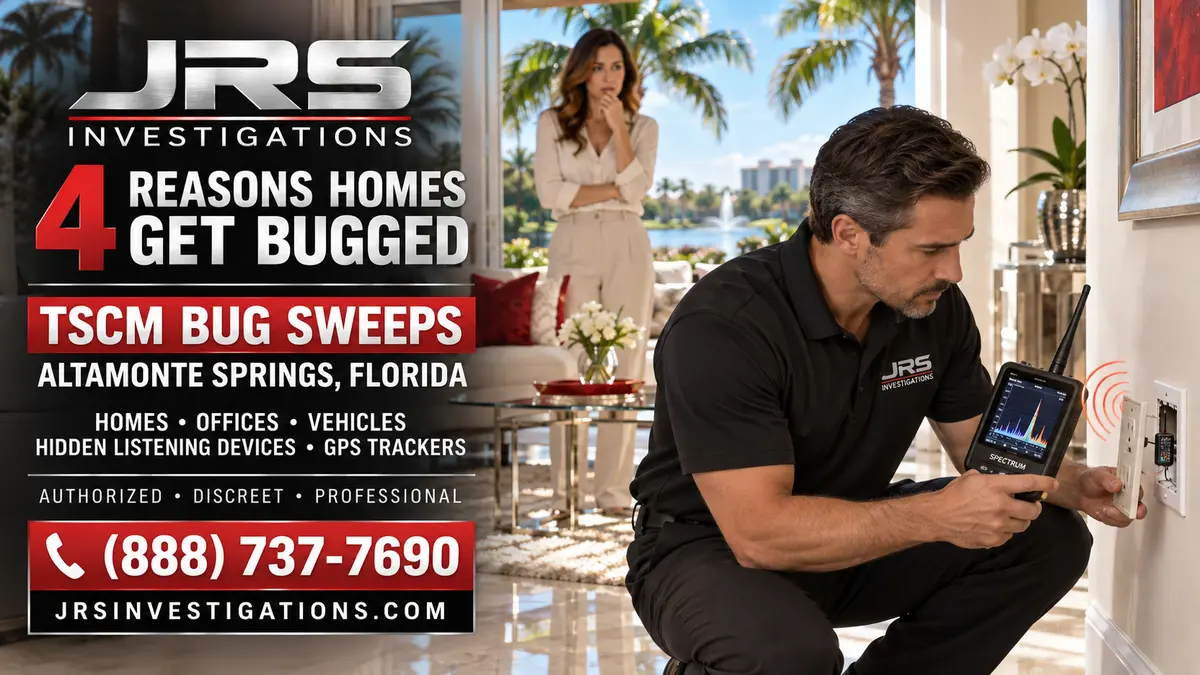
4 Reasons Homes Get Bugged in Altamonte Springs, FL
If private conversations, family plans, passwords, or business details seem to be reaching someone who should not know them, the concern deserves a calm, methodical response. JRS Investigations provides authorized Technical Surveillance Countermeasures, commonly called TSCM or a professional bug sweep, for residences, home offices, commercial spaces, and vehicles in Altamonte Springs and the surrounding Central Florida area.
A strange sound, unfamiliar device, or unexplained disclosure does not automatically prove that a home is bugged. Many ordinary electronics create interference, and account access or shared passwords can expose information without a hidden listening device. A professional assessment helps separate a reasonable concern from speculation and determines which inspection methods fit the location.
Confidential consultation: Call (888) 737-7690 to discuss an authorized TSCM bug sweep in Altamonte Springs, Florida.
Four Common Reasons Someone May Target a Home
1. Relationship conflict, separation, or infidelity concerns
A current or former spouse, partner, roommate, or family member may try to monitor private conversations during a period of jealousy, separation, divorce, or conflict. The information sought can include plans, travel, finances, dating activity, communications with an attorney, or discussions about children. A person who previously lived in the property may also know the layout, Wi-Fi credentials, alarm system, smart-home equipment, or likely places where a small device could be concealed.
Domestic conflict is sensitive because access, ownership, and consent can be disputed. JRS begins by identifying who controls the property or vehicle and whether the requested inspection is authorized. A TSCM sweep is not a substitute for legal advice, a protective order, or law-enforcement assistance when there is an immediate safety threat.
2. Harassment, stalking, or unwanted monitoring
A stalker or obsessive individual may seek location information, routines, conversations, or images. The risk can involve a residence, vehicle, workplace, shared account, or connected device. Warning signs may include private details reaching the wrong person, evidence that fixtures or electronics have been disturbed, an unexplained tracker alert, or repeated access by someone who no longer has permission to enter.
These signs should be treated as information to evaluate, not proof by themselves. If you believe someone may be inside the property, threatening you, or creating an immediate danger, move to a safe location and contact law enforcement. Do not confront a suspected person or dismantle an unfamiliar device in a way that could destroy evidence.
3. Financial information, passwords, or identity data
Homes now contain workstations, smart speakers, routers, cameras, tablets, security systems, and connected appliances. Someone seeking financial gain may be interested in banking discussions, account credentials, identity information, valuable-property details, or access to a home network. In some cases, the real vulnerability is not a traditional radio transmitter. It may be an unauthorized connected device, a compromised account, reused credentials, or equipment left behind by a prior occupant.
A useful assessment therefore starts with the client’s actual concern. The scope may include a physical inspection, radio-frequency review, network-device inventory, and practical recommendations for passwords, routers, cameras, and smart-home access. When the concern is primarily an online account or computer compromise, a separate qualified cybersecurity or digital-forensics service may be more appropriate.
4. Business disputes or workplace information kept at home
Executives, attorneys, consultants, healthcare professionals, sales teams, contractors, and remote employees may discuss confidential matters from a home office. Pricing, bids, client lists, litigation strategy, product plans, schedules, and negotiations can be valuable to a competitor or disgruntled insider. A small business may face the same privacy risks as a large company, particularly when important meetings occur in a residence or shared office.
JRS can help scope an authorized inspection around the rooms, devices, meeting areas, and vehicles that matter most. For broader business concerns, review the firm’s TSCM bug-sweep services and surveillance investigation services.
What an Altamonte Springs TSCM Bug Sweep May Include
No single tool can detect every surveillance threat. Devices can be wireless, wired, dormant, intermittent, concealed inside ordinary electronics, or connected through a local network. The inspection plan should match the property, the suspected access, the type of information being exposed, and the client’s authority over the location.
Pre-inspection consultation and risk review
The process begins with a confidential discussion of what happened, who had access, when the concern started, which information was exposed, and what spaces or vehicles can be inspected. This helps establish priorities and avoids wasting time on areas unrelated to the reported risk. Clients should disclose recent renovations, alarm work, internet-provider visits, cleaning services, guests, former occupants, and smart-home changes when relevant.
Physical and visual examination
A methodical inspection looks for unfamiliar components, altered fixtures, unusual wiring, modified power supplies, objects placed in sensitive areas, and signs of tampering. Particular attention may be given to rooms where private conversations occur and to electronics or fixtures that have a legitimate reason to contain power or communications hardware.
Radio-frequency assessment
RF spectrum analysis can help identify and evaluate active wireless transmissions. The goal is not simply to react to every signal; homes in Altamonte Springs may contain Wi-Fi equipment, Bluetooth devices, cordless accessories, cellular devices, alarm sensors, and signals from nearby properties. The examiner must distinguish expected activity from signals that warrant further investigation. A device that is powered off, wired, dormant, or transmitting only at intervals may require other methods.
Electronic-component detection and targeted technical checks
Depending on the agreed scope, equipment such as a non-linear junction detector may help locate electronic components even when they are not actively transmitting. Network and Wi-Fi review may identify unfamiliar connected devices or unauthorized access points. Thermal or optical methods can also support a targeted examination when conditions make them appropriate. The exact tools used depend on the property and the concern; a long equipment list is not a substitute for experience and a disciplined search process.
Findings, documentation, and next steps
After the inspection, the client should understand what was checked, what was observed, what limitations remain, and what actions are recommended. If a suspicious device is located, the response may involve documentation, evidence preservation, counsel, property management, corporate security, or law enforcement. Removing or operating the device without a plan can affect safety or evidence, so the next step should be considered carefully.
Signs That May Justify a Professional Inspection
- Private conversations or plans repeatedly become known to an unauthorized person.
- A former partner, employee, contractor, tenant, or roommate had unsupervised access to the space.
- A smoke detector, outlet, charger, clock, router, power strip, or other object appears changed or out of place.
- A phone or vehicle reports an unfamiliar tracker or persistent location-sharing alert.
- New wireless devices or access points appear without a clear explanation.
- A home office handles sensitive client, legal, medical, financial, or business information.
- There has been stalking, harassment, coercive control, a contentious separation, or a serious workplace dispute.
- The property experienced an unexplained entry or maintenance visit and confidential information was later exposed.
Static on a call, a warm electronic device, or a battery that drains quickly can have innocent causes. Those symptoms may support a broader review, but they do not prove surveillance. JRS focuses on observable facts, access history, and a proportionate inspection plan.
How to Prepare for a TSCM Sweep
- Limit discussion of the appointment. If monitoring is a real possibility, do not announce the inspection in the space being examined.
- Preserve normal conditions. Avoid moving furniture, unplugging unfamiliar equipment, resetting the router, or cleaning the suspected area unless safety requires it.
- Write down specific incidents. Include dates, information that was exposed, people with access, tracker alerts, account notices, and recent service visits.
- Confirm authorization. Be prepared to document your right to authorize an inspection of the residence, office, rental unit, or vehicle.
- Identify priority areas. Note where sensitive conversations occur, where work is performed, and which rooms or vehicles are most relevant.
- Bring related records. Screenshots, access logs, equipment lists, floor plans, and prior police or incident reports may help define the scope.
Residential, Commercial, and Vehicle Services in Central Florida
Altamonte Springs includes single-family homes, apartments, condominiums, mixed-use buildings, medical and professional offices, retail spaces, and busy commercial properties near major travel corridors. Each setting creates different access and signal conditions. Shared walls, building Wi-Fi, nearby businesses, property-management access, and dense wireless activity can affect how an inspection is planned and interpreted.
JRS tailors the assignment to the authorized space rather than treating every property the same. Service availability, equipment, timing, and pricing depend on the number of rooms or vehicles, the risk indicators, travel, building access, and the technical work required. Learn more about Florida private investigator coverage and the firm’s broader private investigation services.
Frequently Asked Questions
Can JRS inspect an apartment or condominium?
Yes, when the client has authority to request an inspection of the unit or specific space. Shared building systems and common areas may require permission from an owner, association, landlord, or property manager. The authorization and scope should be resolved before the appointment.
Can a sweep find hidden cameras, microphones, or trackers?
A properly scoped inspection can look for multiple device types using physical and technical methods. Detection depends on the device, placement, power state, transmission behavior, access to the area, and surrounding signal environment. No ethical provider should promise that one tool or one brief scan will find every possible threat.
How long does a TSCM inspection take?
Time varies with the size and complexity of the property, the number of rooms or vehicles, the amount of electronic equipment, and the reported risk. A focused consultation allows JRS to recommend a practical initial scope and explain what preparation is needed.
Is a TSCM sweep the same as cybersecurity?
No. TSCM focuses on technical surveillance threats in authorized physical spaces and equipment. Cybersecurity and digital forensics address computers, accounts, networks, malware, data access, and other digital evidence. Some cases overlap, and the appropriate specialists may need to coordinate.
What should I do if a suspicious device is found?
Do not immediately destroy, activate, or publicly discuss it. Document the condition and follow the response plan recommended for the situation. Depending on the facts, that may include law enforcement, an attorney, corporate security, property management, or a qualified evidence professional.
Request a Confidential Altamonte Springs Consultation
If you have a specific reason to believe a home, office, or vehicle is being monitored, JRS Investigations can help you define a lawful, practical next step. The objective is to evaluate the concern professionally, examine the authorized area with appropriate methods, document findings, and explain reasonable security measures after the inspection.
For inspection scope and local scheduling, review our Altamonte Springs TSCM bug-sweep service page.
Call (888) 737-7690 or contact JRS Investigations to discuss an authorized TSCM bug sweep in Altamonte Springs, Florida. Knowledge is power. Get the facts before making accusations or changing the suspected environment.
JRS Investigations in Altamonte Springs: Altamonte Springs private investigator