(888) 737-7690

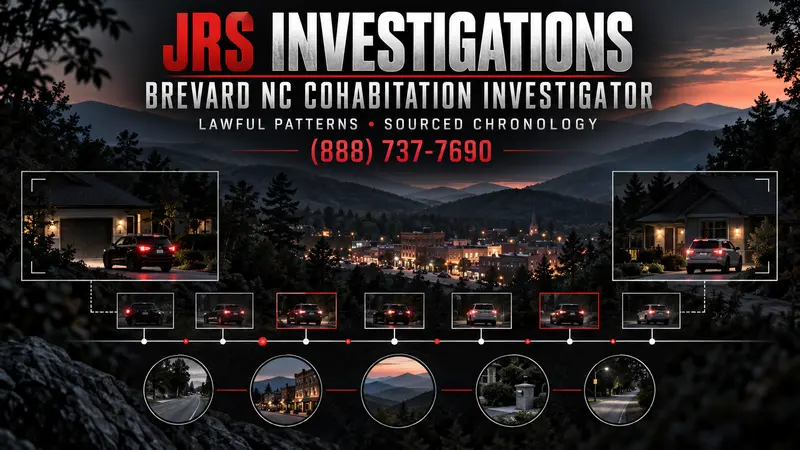
Brevard NC Cohabitation Investigator: 5 Reasons
A Brevard NC cohabitation investigator can help document a living arrangement when a North Carolina family-law question turns on recurring, observable facts. The assignment should begin with counsel’s case theory—not a general effort to monitor a former spouse or new partner. A well-scoped investigation identifies the relevant time period, locations, behaviors, source material, and legal limits before fieldwork begins.
Cohabitation is not established by one overnight stay, a social-media photograph, a shared dinner, or an assumption based on a parked vehicle. The useful record usually develops over time and distinguishes direct observations from public-record leads, client-provided information, and investigator analysis.
For related relationship concerns in nearby Cashiers, review our guide to infidelity investigations in Cashiers.
5 reasons to hire a Brevard NC cohabitation investigator
1. Align the investigation with current North Carolina law
North Carolina General Statute § 50-16.9 addresses modification and termination of postseparation support or alimony. Subsection (b) states that support terminates if the dependent spouse remarries or engages in cohabitation and defines cohabitation through continuous and habitual dwelling together plus the voluntary mutual assumption of marital rights, duties, and obligations. The statute also says the analysis is not necessarily dependent on sexual relations.
That text does not tell an investigator which facts will be decisive in a particular case. An attorney can identify the operative order, jurisdiction, burden, relevant dates, and evidence priorities. The investigator’s role is to document requested facts lawfully, not to decide whether the statutory test has been met or predict how a judge will rule.
The original page’s Florida modification discussion did not belong in a Brevard, North Carolina guide. State law, the wording of the order, and case-specific facts can differ, so clients should obtain advice from qualified North Carolina counsel.
2. Document a pattern instead of an isolated event
A focused cohabitation investigation may examine repeated overnight presence, regular arrivals and departures, access to the residence, recurring household activities, vehicle patterns, deliveries, public outings, or other conduct identified with counsel. Each observation should be dated, timed, located, and described without speculation.
Individual facts can have ordinary explanations. A person may visit frequently without living at the residence. A vehicle may belong to a guest, family member, contractor, or caregiver. A key may be used for a limited purpose. Yard work, errands, travel, or attendance at events may show a relationship but not a shared household. The report should preserve alternative explanations and unresolved gaps rather than label every contact “proof.”
Coverage should be proportionate. A single short surveillance period may miss a routine, while indefinite monitoring can be intrusive and expensive. A staged plan allows counsel and the client to review results before authorizing additional work.
3. Use lawful observation methods in Brevard’s terrain
Brevard and Transylvania County combine a compact downtown with mountain roads, rural properties, wooded lots, vacation homes, gates, driveways, and limited public parking. Weather, darkness, leaf cover, tourism, events, and seasonal traffic can change travel time and visibility. A location that appears simple on a map may provide no safe or lawful place to observe.
A professional surveillance plan identifies public vantage points, alternate routes, daylight, communications, and stop conditions. Local familiarity supports planning, but it does not authorize trespass, entry into a private residence or room, viewing through private windows, following into restricted property, interfering with traffic, or making a prohibited recording.
JRS does not place an unauthorized tracker, enter a gated property without permission, retrieve material from private trash containers, provoke an encounter, contact neighbors under a false pretext, or ask a child to report on household activity.
4. Corroborate observations with appropriate sources
Field observations may be compared with public records, lawfully available address history, property and business records, open-source material, and documents supplied by the client or counsel. The purpose is corroboration, not collecting every available detail about the subjects.
Records have limits. A mailing address may be old or used for convenience. Property ownership does not prove current occupancy. A social-media post may be recycled, staged, or missing context. Shared travel, photographs, or event attendance may show association without establishing a continuous household. Each source should be dated and attributed, and database leads should be checked against multiple identifiers.
JRS does not obtain private utility accounts, passwords, private messages, protected financial or tax records, credit reports, bank transactions, cell-phone logs, or location data without lawful authority. It does not impersonate a subject, pretext a provider, purchase stolen data, or represent that restricted information is available through a special database.
5. Provide a sourced chronology for counsel
A useful report may include an assignment statement, observation logs, a chronology, labeled photographs or video, source notes, public-record references, and a discussion of limitations. Direct observations, third-party statements, client-provided assertions, database leads, and investigator analysis should be clearly separated.
Objective presentation matters, but a private investigator’s work is not automatically admissible and does not carry guaranteed weight. Counsel determines how material fits the case, and the court decides admissibility, credibility, and the legal effect of the evidence. An investigator should not promise alimony termination, a payment reduction, success in a custody issue, attorney-fee recovery, or any other outcome.
What a cohabitation investigation should avoid
- Self-directed confrontations, threats, public accusations, or social-media exposure.
- Repeated personal monitoring that creates safety, stalking, or harassment concerns.
- Entering private property, a home, hotel room, or gated area without permission.
- Unauthorized GPS tracking, account access, password use, or communications interception.
- Contacting children or coaching witnesses.
- Presenting an association, visit, photograph, or database match as conclusive proof.
If there is a protective order, history of domestic violence, stalking concern, or immediate safety risk, disclose it during intake. The case may require additional safeguards, coordination with counsel, or a decision that private investigation is not appropriate.
Questions to define with counsel
- Which order, agreement, statute, and time period govern the question?
- What facts would be relevant, and which facts would not?
- Which addresses, vehicles, dates, and routines are already supported by reliable information?
- How much field coverage is proportionate to the decision at issue?
- What format, source detail, and media handling does counsel need?
Discuss a focused Brevard assignment
JRS provides private investigation services in Brevard, North Carolina and scopes cohabitation matters around the client’s legitimate purpose, counsel’s evidence priorities, safety considerations, and lawful methods. No investigator can guarantee that the requested pattern will be observed or that a court will find cohabitation.
To discuss the operative order, known facts, relevant locations, deadlines, and a proportionate plan, contact JRS Investigations or call (888) 737-7690.