(888) 737-7690

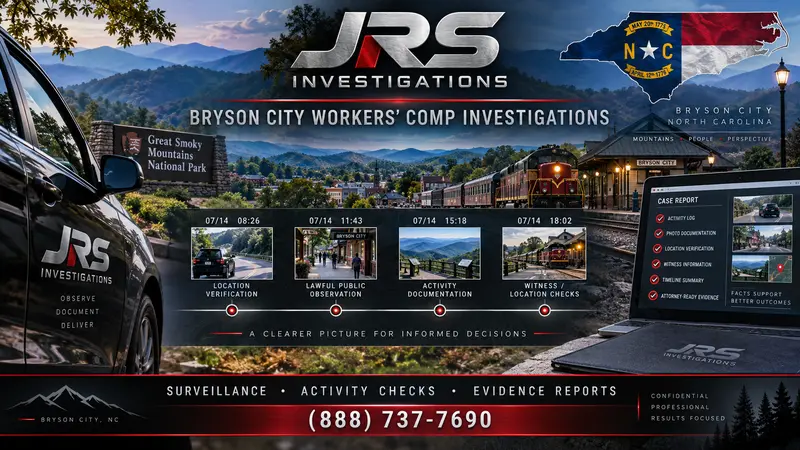
Bryson City Workers’ Compensation Investigator: 5 Uses
A workers’ compensation claim can involve an injury that no one else witnessed, changing work restrictions, conflicting accounts of how an accident occurred, or questions about activity outside the workplace. A Bryson City workers’ compensation investigator helps attorneys, insurers, employers, claims professionals, and—in appropriate cases—injured workers document facts without assuming that anyone has committed fraud.
JRS Investigations conducts focused, lawful investigations in Bryson City, Swain County, and surrounding western North Carolina communities. The objective is not to create a misleading “gotcha” moment. It is to answer a defined case question, preserve the context of what was observed, and provide a reliable report that the legal and claims teams can evaluate.
For an overview of the service, visit our workers’ compensation investigations page or our Bryson City private investigator page.
What does a workers’ compensation investigator do?
The investigation should be tailored to the actual dispute. Depending on the assignment, JRS may document an accident location, locate and interview witnesses, verify a subject’s current address or employment, research public business activity, review publicly available online evidence, or conduct surveillance from lawful public locations.
Investigators do not decide whether a claim is compensable, diagnose an injury, or determine a person’s medical restrictions. Those decisions belong to the North Carolina Industrial Commission, medical professionals, and the parties’ attorneys or claims representatives. Investigative evidence is one part of the record and must be considered with medical and employment documentation.
1. Document the accident scene and preserve time-sensitive facts
Conditions can change quickly after a workplace accident. Equipment may be moved, warning signs replaced, lighting altered, temporary barriers removed, or a work area renovated. An early scene check can preserve photographs, measurements, sight lines, access points, and surrounding conditions before those details disappear.
In Bryson City and Swain County, the work site may be a small business, construction area, mountain property, lodging facility, outdoor-recreation operation, roadway, or remote service location. Terrain, weather, narrow roads, and limited cellular coverage can affect both the incident and the investigation plan. A useful report records when and where each image was taken and distinguishes direct observation from information supplied by a witness.
2. Locate and interview witnesses
Coworkers, contractors, customers, first responders, property owners, or nearby residents may have seen the event or conditions surrounding it. Witness memories fade, and employees may change jobs or contact information. A licensed investigator can locate witnesses, request voluntary interviews, compare accounts, and document the source of each statement.
Professional interviews should be neutral. Questions should test timing, position, visibility, lighting, equipment, instructions, and what the witness personally observed. Investigators should not pressure a witness, promise a legal outcome, or present assumptions as facts. When appropriate, the report identifies conflicts that counsel may need to address in a sworn statement or deposition.
3. Conduct proportionate surveillance from lawful locations
Surveillance may be appropriate when a party has a legitimate need to compare reported physical limitations with observable activity. The strongest surveillance is planned around a specific question and conducted over a reasonable period. A short clip rarely tells the entire story, so investigators should preserve the activity before and after a relevant event and report periods when nothing material occurred.
JRS documents conduct visible from lawful public vantage points. Investigators do not trespass, enter a home or private area, peer into places where a person has a reasonable expectation of privacy, or use tracking technology without a lawful basis. The report should describe what the video shows without offering a medical opinion. Carrying an item, driving, walking, or performing a household task does not automatically prove that an injury is false.
4. Research employment, business, and public online activity
A case may involve a question about undisclosed employment, self-employment, contracting, or operation of a business while benefits are being paid. Investigators can review lawful public sources for business registrations, professional advertising, public marketplace listings, company websites, and other activity linked to the subject.
Publicly available social-media content can also preserve dates, locations, advertised services, or activities relevant to the claim. JRS documents the source, URL, date, and surrounding context. We do not hack accounts, bypass privacy settings, obtain protected medical or financial records, or use deceptive access to a private profile. An online photograph without a verified date or identity should be treated as a lead, not a final conclusion.
5. Deliver an organized, attorney-ready evidence record
Raw video is not enough. A professional case file should connect the assignment objective to the work performed and the evidence collected. JRS reporting may include:
- Investigator activity logs with dates, times, locations, and weather or visibility notes.
- Photographs and video indexed to the written chronology.
- Witness contact results and clearly attributed statements.
- Public-record and online-source references with capture dates.
- Vehicle, address, employment, and business leads that require additional verification.
- A neutral distinction between confirmed facts, observations, inconsistencies, and unresolved questions.
JRS does not guarantee that evidence will be admitted, that a claim will be denied or approved, or that a case will settle. Counsel decides how the evidence fits North Carolina law and the rules of the North Carolina Industrial Commission.
Bryson City investigation planning matters
Bryson City’s mountain geography creates practical issues that do not exist in a dense urban area. A subject may travel between Bryson City, Cherokee, Franklin, Sylva, Robbinsville, or job sites farther across western North Carolina. Mountain roads can limit safe observation points, and a conspicuous vehicle can compromise surveillance in a small community.
A local plan should account for lawful parking, traffic patterns, public access, seasonal tourism, Great Smoky Mountains travel, railroad activity, weather, and realistic travel time. JRS uses advance research and defined objectives to reduce wasted hours and avoid unnecessary intrusion.
What investigators cannot lawfully promise
- No guaranteed finding of fraud, malingering, or misrepresentation.
- No access to private medical, bank, tax, telephone, or account records without proper authority.
- No trespass, harassment, pretexting for protected information, or surveillance inside private spaces.
- No unauthorized GPS tracking, interception of communications, hacking, or bypassing privacy controls.
- No medical opinion about pain, disability, maximum medical improvement, or work restrictions.
- No guarantee that a photograph, video, online post, or statement will be admitted or control the case outcome.
Information to provide before the investigation
A focused assignment generally begins with the claim number, the legal names and identifiers of the parties, the reported date and location of injury, the specific restrictions or factual issue to be examined, known addresses and vehicles, relevant deadlines, and contact information for the attorney or claims professional. Do not send records that you are not authorized to share.
Clients who want broader local guidance can also review our guide to hiring a private investigator in Bryson City and our private investigation services.
Request a confidential Bryson City case review
To discuss a workers’ compensation, workplace injury, surveillance, witness-location, or evidence-documentation assignment in Bryson City or western North Carolina, call (888) 737-7690 or email contact@jrsinvestigations.com.
For another sensitive family-related matter, review our Bryson City guide to four types of child abuse and lawful documentation considerations.
#BrysonCityPrivateInvestigator #WorkersCompInvestigation #NorthCarolinaPrivateInvestigator #SurveillanceInvestigation #JRSInvestigations