(888) 737-7690

Four Types of Child Abuse: Bryson City NC Guide
If a child is in immediate danger, call 911. Suspected child abuse or neglect in North Carolina should be reported to the county Department of Social Services. A private investigator does not replace law enforcement, Child Protective Services, medical care, or legal counsel.
Understanding Four Broad Types of Child Maltreatment
Concerns about a child’s safety can arise during a custody dispute, visitation exchange, household transition, or unexplained change in the child’s behavior or condition. Families need to respond carefully. An allegation is not proof, and one sign rarely establishes what happened. At the same time, credible safety concerns should never be ignored.
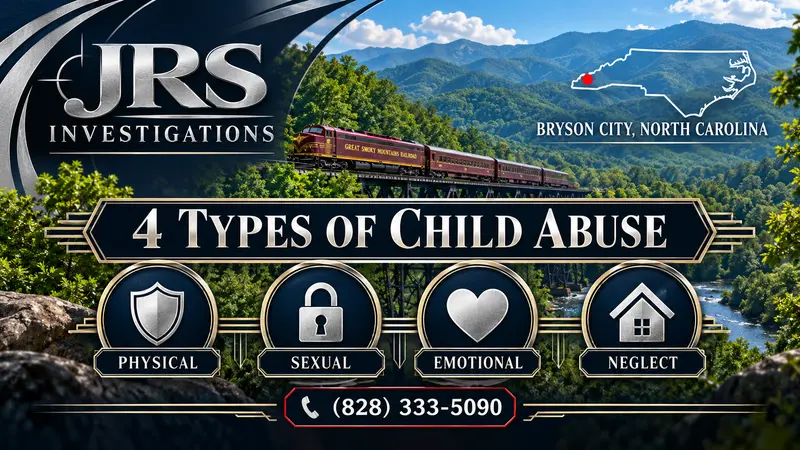
The terms below describe four broad categories commonly discussed when evaluating possible child maltreatment: physical abuse, sexual abuse or exploitation, emotional or psychological maltreatment, and neglect. Exact legal definitions and agency findings depend on the facts and applicable North Carolina law. The purpose of this guide is educational and is not a diagnosis or legal conclusion.
1. Physical Abuse
Physical abuse generally involves nonaccidental physical force or conduct that injures a child or creates a substantial risk of injury. Possible indicators can include unexplained injuries, repeated injuries with inconsistent explanations, marks in unusual locations, fear of a particular adult, or a sudden reluctance to return to a home.
Many childhood injuries have ordinary explanations. Active children fall, play sports, and experience accidents. An investigator should not decide that an injury proves abuse. The responsible approach is to document objective facts: dates, visible conditions, available photographs, witness observations, medical records obtained through lawful channels, and inconsistencies that may require review by qualified authorities.
Medical professionals, law enforcement, and child-protection personnel determine the appropriate response to suspected injury. Anyone who believes a child faces immediate danger should call 911 rather than attempt a private investigation first.
2. Sexual Abuse or Exploitation
Sexual abuse or exploitation involves sexual conduct, exposure, grooming, exploitation, or the use of a child in sexual material. Children cannot provide lawful adult consent to abusive conduct. Possible warning signs may include age-inappropriate sexual knowledge or behavior, unexplained fear of a person or location, abrupt behavioral changes, regression, sleep problems, or a disclosure by the child.
These indicators can also have other causes. Adults should avoid repeatedly questioning, coaching, confronting, or pressuring a child. Leading questions may increase distress and can complicate a professional forensic interview. A spontaneous disclosure should be taken seriously, recorded as accurately as possible without embellishment, and reported to the proper authorities.
A licensed private investigator may support an attorney or authorized client with lawful fact gathering, background research, timeline development, or documentation outside the role reserved for child-protection investigators and trained forensic interviewers. JRS Investigations does not replace those agencies and does not conduct medical examinations.
3. Emotional or Psychological Maltreatment
Emotional maltreatment may involve a persistent pattern of threats, humiliation, intimidation, rejection, isolation, coercive control, or exposure to extreme conflict that harms a child’s emotional well-being. Unlike a visible injury, the effects may be difficult to document and should be evaluated by qualified mental-health or child-welfare professionals.
Potential concerns can include a marked change in mood, persistent anxiety, extreme withdrawal, fearfulness, loss of confidence, developmental regression, or severe behavior changes associated with a particular environment. No single behavior proves maltreatment. Family transitions, school problems, health issues, grief, and other stressors may produce similar changes.
In a custody-related investigation, objective documentation may include lawful observations of conduct, communications supplied by the client or attorney, witness statements, exchange patterns, and a reliable chronology. Investigators should report what they actually observed rather than offering a psychological diagnosis.
4. Neglect
Neglect generally concerns a caregiver’s failure to provide appropriate supervision, food, shelter, hygiene, medical attention, education, or other care necessary for a child’s safety and well-being. The facts matter. Poverty, limited resources, or a temporary hardship should not automatically be mislabeled as neglect.
Possible concerns may include a young child repeatedly left without appropriate supervision, unsafe living conditions, chronic lack of necessary medical care, repeated school absence without explanation, inadequate food, dangerous access to drugs or weapons, or exposure to hazardous behavior. A pattern is often more informative than one isolated event.
Documentation should be lawful, specific, and time-based. Dates, exchange records, firsthand observations, communications, photographs taken where legally permitted, and corroborating witnesses may help an attorney or agency understand the situation. Investigators should not trespass, invade private communications, or encourage a client to violate a custody order.
How Child-Custody Investigations Can Help
When an attorney or authorized parent has a legitimate concern, a child-custody investigation can gather neutral information relevant to safety, supervision, living conditions, substance use, compliance with court orders, or conduct during custody and visitation. The goal is not to manufacture evidence or prove a predetermined claim. It is to establish verifiable facts.
Depending on the lawful scope, work may include:
- Creating a clear timeline of custody exchanges, incidents, and reported concerns
- Conducting lawful surveillance in public settings when appropriate
- Locating and interviewing relevant witnesses with authorization
- Reviewing publicly available records and client-supplied documents
- Documenting observable conditions without speculation or exaggeration
- Preparing organized reports for the client and legal counsel
Evidence is most useful when it is gathered ethically, preserved accurately, and presented without inflammatory conclusions. Learn more about child custody and domestic investigations or our Bryson City private-investigator services.
Reporting a Concern in North Carolina
North Carolina’s Department of Health and Human Services directs people who suspect child abuse or neglect to contact the local county Department of Social Services and ask for a Child Protective Services intake worker. Its official guidance and county contact directory are available through NCDHHS child-protection resources. If the situation is an emergency, call 911.
Do not delay a required report while waiting for a private investigator. Do not confront a suspected offender if doing so could endanger the child, and do not remove or alter potential evidence without guidance from the appropriate authorities or counsel.
Why Objective Documentation Matters
Custody disputes can involve intense emotions and competing accounts. Accurate notes and reliable evidence help separate facts from assumptions. Keep original messages, record dates and times, preserve complete files rather than edited excerpts, and identify who personally observed each event. Avoid posting allegations on social media, which may expose the child and complicate the matter.
JRS Investigations works within an agreed lawful scope and communicates investigative options before an assignment begins. Findings are reported as observations and supported facts, not as medical diagnoses, agency determinations, or promises about a court outcome.
Bryson City Child-Custody Investigation FAQs
Can a private investigator determine that child abuse occurred?
A private investigator can document lawful observations and evidence but does not replace CPS, law enforcement, physicians, therapists, forensic interviewers, or the court. Those authorities determine official findings within their roles.
Should I question the child myself?
Avoid repeated or leading questions. If a child makes a spontaneous disclosure, listen calmly, do not promise secrecy, record the child’s words accurately, and contact the appropriate authorities or qualified counsel.
Can evidence from an investigation be used in court?
Potential use depends on how the evidence was obtained, authenticated, and presented. An attorney should advise whether particular material is relevant and admissible.
What should I bring to a confidential consultation?
Bring the current court order, a concise chronology, relevant communications, names of potential witnesses, prior reports, and specific questions for your attorney or investigator. Do not gather material unlawfully.
Schedule a Confidential Bryson City Consultation
If you or your attorney need lawful, objective documentation related to a Bryson City custody or visitation concern, JRS Investigations can discuss the available investigative options and appropriate scope.