(888) 737-7690

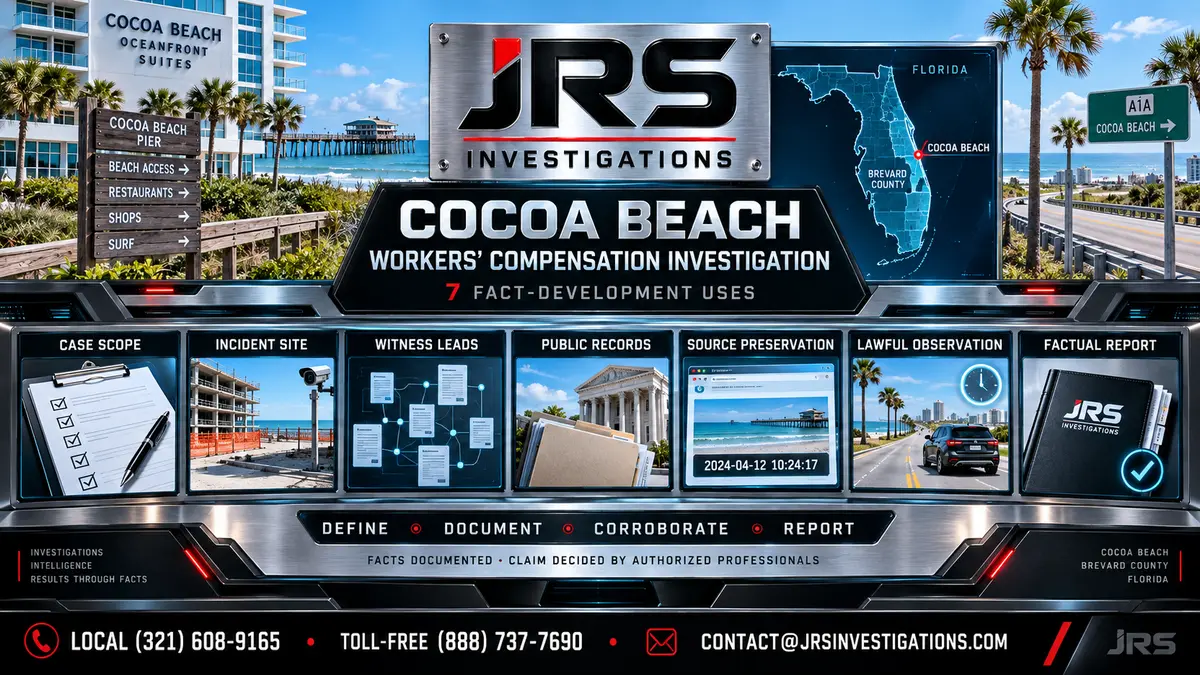
Cocoa Beach Workers’ Compensation Investigator: 7 Uses
A Cocoa Beach workers’ compensation investigator should answer defined factual questions without presuming that an injured worker, employer, provider or witness is dishonest. JRS Investigations assists insurers, self-insured employers, claims professionals, defense counsel and claimant’s counsel with lawful scene documentation, witness development, public-record research and proportionate surveillance in Cocoa Beach and throughout Brevard County.
The investigator does not make medical findings, determine work capacity, decide compensability or declare fraud. Those decisions belong to authorized claims professionals, medical providers, counsel, judges and public agencies. JRS documents observable facts, preserves source context and reports limitations so the investigation can be evaluated with the rest of the claim file.
For broader local support, review our Cocoa Beach private investigator services and our private investigation services.
When a Cocoa Beach workers’ compensation investigation may help
An investigation may be appropriate when a material fact remains unresolved: the incident location has changed, a witness cannot be found, competing accounts describe different events, relevant video may be overwritten, outside work or business activity requires verification, or counsel requests limited observation of public activity. The assignment should identify the question, relevant period, lawful methods, geographic limits and reporting standard.
“Prove fraud” is not a responsible instruction. A neutral scope might ask who had firsthand knowledge, what the worksite looked like on the incident date, whether a named business is active, or what activity was observable during specified public periods. That structure reduces unnecessary intrusion and produces information the authorized decision-maker can actually use.
Seven ways an investigator can develop claim facts
1. Define the question and preserve neutrality
A useful intake identifies the retaining party, claim number, represented parties, counsel, reported incident, relevant restrictions and the precise fact that needs investigation. Allegations should be treated as allegations. JRS separates client-provided information from independently obtained observations and records. Work can be staged so an initial records or witness phase informs whether surveillance is necessary. Additional activity requires client approval rather than an open-ended search for damaging material.
2. Document the incident site and changing conditions
Worksites change quickly. A beachfront hotel may renovate; a construction area may be cleared; a restaurant may move equipment; lighting, signage or access routes may change after an incident. With lawful access, an investigator may photograph relevant areas, map sight lines, identify entrances, note lighting and weather, record measurements and locate possible cameras. The report should distinguish current conditions from conditions confirmed for the reported date and avoid technical causation opinions outside the investigator’s qualifications.
3. Locate and interview relevant witnesses
Coworkers, supervisors, customers, contractors or first responders may hold firsthand information about the incident, reporting sequence or scene. Interviews should focus on what the person directly saw, heard or did; where the witness was positioned; when events occurred; and whether related photographs, schedules, messages or reports exist. An investigator should not pressure a witness, misstate authority or contact family, neighbors and unrelated associates merely because they know a claimant.
4. Research employment, businesses and public records
Lawful records research may help test a defined claim about an employer, outside business, professional license, property interest, related lawsuit or prior incident. Sufficient identifiers are essential because a shared name is not proof. A record should be tied to the correct subject and its relevance explained. Old claims, lawsuits or business connections are not automatically material. JRS offers separately scoped background-check services when the purpose and identifiers support that work.
5. Identify and preserve public-source information
Public posts, event listings, business advertisements, public videos and job postings may provide leads or preserve a date-specific fact. Context matters. An old image can be reposted; a vacation photograph may not show when it was taken; a short video cannot establish medical ability or endurance. Investigators should capture the source, date, URL, surrounding context and relevant account information. JRS does not hack accounts, use stolen credentials or seek access to private profiles through deception.
6. Conduct proportionate public-place surveillance
Limited surveillance may document observable conduct when the client has a lawful purpose and the activity is relevant to the defined question. It should use lawful vantage points and avoid trespass, harassment and protected private areas. A brief activity may have many explanations and cannot, by itself, establish diagnosis, pain level, safe repetition, endurance or fraud. Reports should describe the action, duration, conditions and any breaks in observation without converting video into a medical conclusion.
7. Deliver a factual report and evidence index
The final report should state the assignment, dates, locations, methods, observations, source records, media references and limitations. It should separate direct observation, client information, witness statements and investigator inference. Original photographs and video should be retained, with working copies and excerpts clearly identified. No investigator can guarantee admissibility, benefit denial, settlement, prosecution or another legal result.
A practical seven-step workflow
- Confirm authority. Identify the client, counsel, permitted purpose and approved decision-maker.
- Frame the factual question. Define the relevant event, period, subject and location.
- Review necessary source material. Use only the records needed to plan the assignment.
- Select proportionate methods. Match scene work, witness outreach, records research or observation to the question.
- Preserve original information. Record sources, dates, file names and transfer history.
- Corroborate and test conflicts. Compare observations with independent information and state uncertainty.
- Report without deciding the claim. Present facts, context, limitations and appropriate follow-up options.
JRS explains its observation practices on our surveillance investigation service. Clients can also use our 17 questions to ask before hiring a private investigator to compare licensing, scope, reporting and evidence handling.
Cocoa Beach and Brevard County field planning
Cocoa Beach is a barrier-island community where State Road A1A, the State Road 520 causeway and limited mainland routes shape travel. Bridge traffic, beach access, special events, launches, severe weather and seasonal tourism can change travel time and parking. An assignment that extends to Cape Canaveral, Port Canaveral, Merritt Island, Cocoa, Melbourne or another Brevard County location needs realistic repositioning time and a clear jurisdiction plan.
Local claims may arise in hospitality, restaurants, retail, construction, property maintenance, maritime and charter work, healthcare, transportation or aerospace-support businesses. Hotels, condominiums, gated properties, employer worksites and marinas have different access rules. JRS does not enter controlled property without permission merely because the location is connected to a claim.
Coastal conditions affect documentation. Bright glare, heavy rain, salt spray, wind, surf events and crowded beach access can limit visibility or alter ordinary activity. Reports should state these conditions because they affect what could be seen and how a short event should be interpreted. A clear local plan improves efficiency and reduces the risk that tourism or weather-driven behavior is mischaracterized.
Florida workers’ compensation and licensing boundaries
Florida’s workers’ compensation system is governed primarily by Florida Statutes Chapter 440. Section 440.105 addresses prohibited conduct involving false, fraudulent or misleading statements related to benefits and payments. Its provisions reach conduct by different participants in the system; an investigator should not assume that only one side can create a problem.
The Florida Division of Workers’ Compensation provides official information for workers, employers, carriers and providers. Suspected criminal violations may fall within the responsibilities of the Bureau of Workers’ Compensation Fraud. A private investigator working for an authorized client does not replace the Division, law enforcement, a medical professional or the judge.
Florida regulates private-investigation firms and investigators through Chapter 493. The Florida Department of Agriculture and Consumer Services private-investigation licensing page explains the applicable classifications and regulation. Clients should verify the agency and assigned personnel before fieldwork begins. This page provides general information, not legal advice.
Work for different parties
Insurers, self-insured employers and defense counsel may request site documentation, witness interviews, public-record research or limited surveillance to clarify a material inconsistency. A neutral assignment should include corroborating information and should not direct the investigator to manufacture contradiction.
Claimants and claimant’s counsel may need to locate witnesses, preserve a changing scene, identify third-party video, obtain public records or test an employer’s factual account. The same standards of authority, proportionality and evidence handling apply.
Employers should coordinate investigative requests through the appropriate claims professional or attorney. Separate, informal activity can produce duplicate work, privacy concerns or inconsistent instructions.
Information to provide at intake
- the claim number, parties and counsel contacts;
- reported incident date, worksite and job duties;
- the exact factual question requiring investigation;
- known witnesses and prior contact attempts;
- available incident reports, schedules, photographs and video;
- approved locations, time period, budget and reporting cadence;
- instructions for urgent preservation or safety issues; and
- the person authorized to approve additional work.
A focused intake saves resources and helps avoid collecting personal information that has no legitimate connection to the claim. For local hiring considerations, see our Cocoa Beach investigator hiring guide and our areas served.
Frequently asked questions
Does surveillance video prove workers’ compensation fraud?
No. It shows observable activity during a limited period. Medical significance, work ability, credibility and fraud must be evaluated by the appropriate professionals and decision-makers with the complete record.
Can an investigator film inside a home or private area?
Investigators must respect lawful access and reasonable privacy expectations. Work should avoid trespass and intrusive recording in protected private areas. Counsel should address case-specific questions.
Can private social-media content be accessed?
JRS does not hack accounts, use stolen credentials or gain access through deception. Relevant public content may be documented with its date, source and surrounding context.
Will JRS interview neighbors or family members?
Only when the contact has a legitimate connection to the defined question and the method is appropriate. Broad personal outreach can be intrusive and unreliable. Witness strategy should be approved by the client or counsel.
Can an investigator guarantee a court or claim outcome?
No. JRS gathers and reports facts. The authorized claims and legal decision-makers determine how the information affects the matter.
Request a confidential Cocoa Beach case review
To discuss a lawful and proportionate assignment, call local (321) 608-9165, toll-free (321) 608-9165, or email contact@jrsinvestigations.com. Provide the factual question, dates, locations, available records and deadline so JRS can define a focused first phase.
Define. Document. Corroborate. Report. Knowledge is power when the inquiry remains neutral, lawful and evidence-conscious.
JRS Investigations in Cocoa Beach: Cocoa Beach TSCM bug sweeps