(888) 737-7690

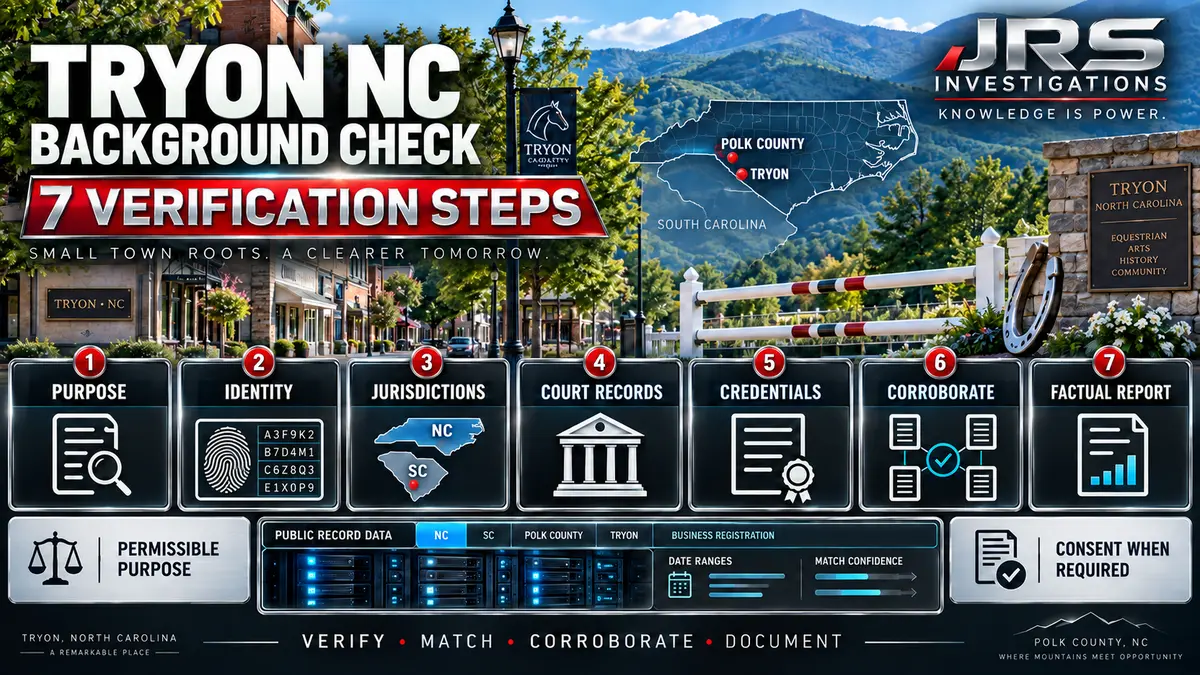
Tryon NC Background Check Investigator: 7 Verification Steps
A background check is useful only when it answers a lawful, defined question about the correct person. In Tryon, North Carolina, that may involve hiring, a business relationship, litigation, a household service provider, a tenant-screening process, an online relationship or another decision with a legitimate need for verification.
JRS Investigations performs background checks and related private investigation services using identifiers, source-specific research and corroboration. The objective is a factual report that distinguishes confirmed information, possible matches and unresolved gaps. It is not a promise to uncover every record or judge a person’s character.
Why a professional background investigation can add value
Cheap database reports may combine records from people with similar names, omit county-level material, display outdated data or fail to explain the source. A professional investigation begins with purpose and identity. It then selects sources that fit the question and jurisdiction, checks important facts independently and explains limitations.
Tryon sits in Polk County near the South Carolina line. People may live, work, own property, form businesses or appear in court records across more than one county or state. The area’s equestrian, hospitality, construction, property-management and service economies can also create decisions involving contractors, vendors, caregivers, tenants, employees and business partners. A search limited to one automated national database may miss that context.
7 verification steps in a Tryon NC background check
1. Define the purpose and permitted use
The investigator first identifies who is requesting the search, why the information is needed and how the report will be used. Employment, housing, credit, insurance and other regulated decisions may trigger federal or state requirements that do not apply to ordinary litigation or business research.
A lawful purpose also limits scope. An employer does not need a subject’s unrelated personal life. A prospective business partner may need entity, litigation and credential verification rather than a consumer-style report. A dating concern may focus on identity and major inconsistencies, not intrusive personal detail.
2. Confirm identifiers and obtain required authorization
Reliable matching may require a full legal name, prior names, date of birth, known addresses, relevant jurisdictions and other lawful identifiers. A name alone is rarely enough. Common names, aliases, transcription errors and family members sharing an address can produce false matches.
When a consumer report is used for employment or another purpose governed by the Fair Credit Reporting Act, the requesting party must follow applicable disclosure, authorization, certification, notice and dispute procedures. The Federal Trade Commission’s employer guidance and the Equal Employment Opportunity Commission’s background-check guidance provide starting points. Clients should obtain legal advice for their specific process.
3. Map the relevant jurisdictions
The search plan should follow the person’s verified history and the decision at issue. For a Tryon matter, relevant sources may include Polk County, other North Carolina counties, nearby South Carolina jurisdictions, federal courts, professional regulators, business registries and property records.
Jurisdiction matters because records are created, indexed and updated by different agencies. A “no record found” result in one source does not prove that no record exists elsewhere. The report should identify which sources and date ranges were checked.
4. Review court and public records carefully
North Carolina court information should be researched through appropriate sources and interpreted in context. The North Carolina Judicial Branch provides official court services and record information. Dockets can contain similar names, dismissed matters, amended charges or incomplete dispositions. An arrest is not a conviction, and a filing is not a finding of liability.
The investigator should verify identifying details, review the available disposition and avoid presenting allegations as established facts. Sealed, expunged, juvenile, protected or otherwise unavailable records are not bypassed.
5. Verify credentials, employment and business claims
Depending on the assignment, a background investigation may confirm a business registration, professional license, claimed position, educational credential, property connection or litigation history. Verification should use the authoritative issuing organization when possible.
A corporate registration does not prove that a business is active, insured, reputable or capable of performing a contract. Likewise, an online profile or resume is a claim, not verification. The report should state exactly what the source confirms.
6. Corroborate material findings
Important conclusions should not rest on one aggregator. The investigator compares identifiers, dates, addresses, entities and source records. Conflicts are investigated or disclosed. If a possible match cannot be resolved, it should remain a possible match rather than being assigned to the subject.
This step is particularly important in small communities, where relatives may share surnames, addresses or business connections. Association does not prove participation in another person’s conduct.
7. Deliver a clear report with limitations
The report should state the purpose, subject identifiers, sources, jurisdictions, date ranges, findings and unresolved limitations. It should separate verified facts from client-supplied information and investigator inference. If the report supports a regulated decision, the client must also follow the required notice and dispute process.
No investigator should guarantee a completely clean history, future conduct, hidden bank balances or a particular hiring, housing, legal or business outcome.
Common background-check uses in Tryon
Employment screening
Employers may verify identity, work history, education, credentials and job-relevant records through a compliant process. Criteria should be connected to the position and applied consistently. The EEOC cautions employers to avoid unlawful discrimination when using background information.
Tenant screening
Landlords and property managers may use consumer reports for a permissible housing purpose, subject to federal and state requirements. Applicants have rights when information in a report contributes to an adverse decision. The Consumer Financial Protection Bureau’s tenant-background-check resources explain reports and dispute options.
Business and vendor due diligence
A company or individual considering a contract, investment or partnership may need to verify entity status, principals, litigation, licenses, property claims and material representations. The scope should match the transaction. JRS handles broader cross-border ownership questions under a separately defined international asset investigation; research does not guarantee recovery or access to private financial accounts.
Litigation and witness research
Counsel may request identity, location, credibility or prior-record research relevant to a dispute. The investigator should follow counsel’s scope, preserve source information and avoid contacting a represented party improperly. A background report does not replace discovery or legal analysis.
Caregivers, contractors and household service providers
A family may verify identity, licenses, business registration, references and relevant public records before granting access to a home, dependent adult, child, vehicle or financial information. Consent and employment-screening rules may apply depending on the relationship and use.
Online dating and personal identity questions
An identity-focused inquiry may compare images, profile claims, contact points, public records and business or location details. It cannot hack accounts or guarantee the identity of the person communicating online. See JRS guidance on using an online dating scam investigator.
North Carolina licensing and legal boundaries
North Carolina regulates private investigative work through Chapter 74C and the Private Protective Services Board. Clients should verify the provider and identify who will manage and perform the work.
Background investigations do not authorize impersonation, hacking, password use, protected-account access, unlawful pretexting or the purchase of restricted data without a permitted purpose. Medical, financial, education, motor-vehicle and consumer-report information may have source-specific restrictions. A client’s curiosity is not the same as lawful authority.
What a quality report should not claim
- That one national database contains every criminal or civil record.
- That a same-name record definitely belongs to the subject.
- That an arrest or allegation proves misconduct.
- That bank accounts and balances can always be located.
- That the investigator can rate honesty, character or future behavior.
- That a “clean” report guarantees safety or performance.
- That employment or tenant decisions are automatically compliant.
Information to prepare before the search
- the decision the report will support;
- the subject’s verified full name and known prior names;
- date of birth and address history when lawfully available;
- claimed employment, education, licenses or businesses;
- relevant counties, states and time periods;
- required consent or authorization documents;
- the deadline and first-phase budget; and
- the specific concerns to verify without assuming they are true.
Questions to ask the background-check investigator
- What license applies to this North Carolina assignment?
- Who will perform the research?
- What is the permissible purpose and required authorization?
- Which jurisdictions and date ranges will be searched?
- How will you resolve same-name matches?
- Which findings will be verified at the source?
- What records are unavailable or restricted?
- Will the report identify sources and limitations?
- What dispute or correction process applies?
- What is included in the fee?
Review JRS’s broader coverage areas and 17 questions to ask before hiring for additional provider-vetting guidance.
Frequently asked questions
Can a private investigator find every criminal record?
No. Availability depends on identity, jurisdiction, date range, source access and record status. A professional should state which sources were checked and what remains unresolved.
Can JRS access private bank balances?
Not without lawful authority and an appropriate process. Public asset and entity research is different from accessing protected financial-account information.
Is consent required?
It depends on the purpose and source. Employment and tenant screening commonly require specific FCRA procedures. The client should confirm requirements with qualified counsel.
What if the report contains a possible match?
The investigator should compare additional identifiers and label uncertainty. A possible match should not be presented as a confirmed subject record.
Does a clean background check guarantee safety?
No. A background check reports available information from a defined time and source set. It cannot predict future conduct or replace supervision, references, interviews or sound controls.
Request a Tryon background-check consultation
Review our Tryon private investigator services for local planning and related case types. To define a lawful and proportionate search, contact JRS Investigations with the purpose, subject identifiers, relevant jurisdictions, deadline and decision the report should support. JRS will preserve the existing scope boundary and clearly document findings and limits.
For broader investigative support in western North Carolina, see the reasons clients hire a private investigator in Marshall.