(888) 737-7690

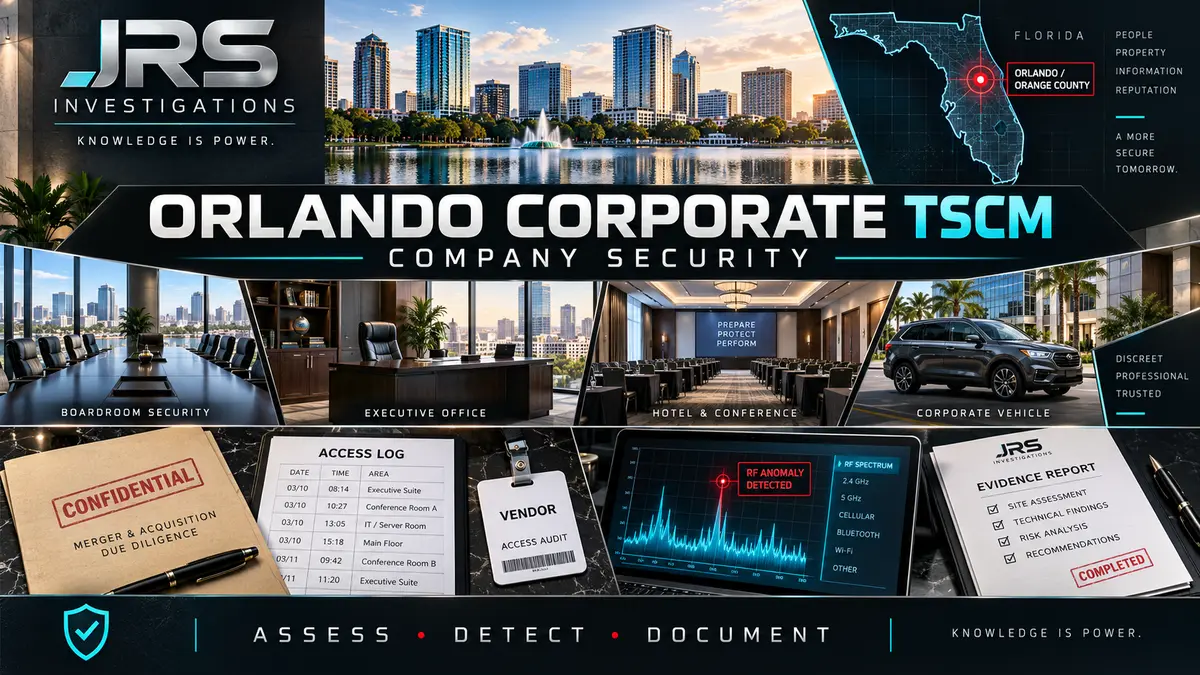
Orlando Corporate TSCM: 7 Security Triggers
Orlando companies handle confidential discussions in offices, hotels, convention spaces, executive residences, vehicles, and temporary project rooms. A corporate TSCM inspection helps an authorized organization examine a defined environment for signs of unauthorized audio, video, tracking, or related technical surveillance. The purpose is to reduce uncertainty, document findings, and support a measured security response—not to make sensational claims or guarantee that every concern will reveal a device.
JRS Investigations conducts lawful technical-surveillance countermeasures work for authorized clients. A company-security engagement should begin with authority, scope, safety, and preservation of potential evidence. It should also coordinate with legal counsel, internal security, information technology, human resources, compliance, or law enforcement when the facts require those roles.
Seven business events that may justify an Orlando TSCM review
1. A merger, acquisition, financing, or major transaction
Deal rooms, executive offices, home offices, conference spaces, and temporary meeting locations can contain sensitive valuation, pricing, ownership, personnel, and strategy discussions. A risk-based TSCM plan identifies the rooms, vehicles, travel settings, access windows, and authorized systems that matter most before the high-sensitivity period begins.
A sweep is only one layer. Document control, identity and access management, visitor handling, approved communications, clean-device practices, and counsel-led confidentiality procedures remain necessary. The NIST Cybersecurity Framework gives organizations a voluntary structure for governing, identifying, protecting, detecting, responding to, and recovering from cybersecurity risk; corporate TSCM can complement those controls where physical and technical surveillance concerns overlap.
2. A board, C-suite, legal, or strategy meeting
Some conversations carry concentrated risk because a single unauthorized disclosure could affect litigation, negotiations, employee safety, product timing, or market position. The company should define the protected meeting area, identify legitimate audiovisual and collaboration equipment, control access before and after the session, and assign a decision-maker who can act on findings.
For an Orlando hotel or convention venue, the organization may have limited control over the room and frequent contact with venue staff, audiovisual vendors, caterers, contractors, and prior occupants. The inspection scope and timing should reflect those realities without implying wrongdoing by ordinary service providers.
3. An executive, employee, contractor, or vendor access change
Resignations, terminations, disputed ownership, vendor turnover, renovation, and changes in property management can alter physical and administrative access. A company should first inventory keys, credentials, accounts, smart devices, security systems, conference technology, and authorized recording equipment. TSCM then addresses the physical-technical environment within the client’s lawful control.
The CISA Insider Threat Mitigation Guide treats insider-risk management as a program involving people, processes, technology, and organizational culture. A sweep should not become a substitute for fair employment procedures, access review, cybersecurity, or evidence-based investigation.
4. An unexplained disclosure of private information
A surprising leak does not prove that a room is bugged. The cause may be an authorized attendee, forwarded email, shared cloud file, weak account control, visible document, overheard conversation, vendor access, or an ordinary configuration error. A defensible inquiry tests competing explanations instead of starting with a predetermined accusation.
JRS can help document who knew the information, when it existed, where it was discussed, who had access, and what lawful records or observations support each theory. Related background research may assist with identity and relationship questions, while digital-forensics or cybersecurity specialists may be needed for systems and accounts.
5. A move, buildout, renovation, or newly occupied suite
Orlando office space often passes through landlords, contractors, cabling vendors, furniture installers, managed-service providers, security companies, and prior occupants. Before a sensitive team moves in, the company can establish a baseline of authorized equipment and access. A post-buildout inspection can then document the environment at a known point in time.
The scope should include only spaces and systems the client is authorized to inspect. TSCM does not permit entry into another tenant’s office, tampering with building infrastructure, or interception of third-party communications.
6. Repeated travel, convention, or off-site executive activity
Orlando’s convention, tourism, aviation, and hospitality environment creates frequent use of temporary spaces. A proportionate security plan may prioritize specific meetings, vehicles, devices, and periods rather than attempt to treat every hotel room or venue as a permanent controlled facility.
Timing is critical. An inspection performed too early may not reflect the room at meeting time; one performed too late may have little preventive value. The organization should coordinate access, room setup, audiovisual installation, and participant arrival with the TSCM team and venue contact.
7. A recurring high-risk security program
Some organizations schedule reviews around sensitive events, executive changes, access incidents, or defined risk thresholds. There is no universal frequency. A useful program is tied to business events, documented ownership, follow-up responsibility, and measurable corrective actions rather than a calendar alone.
The Orlando corporate TSCM process
1. Confirm authority and stakeholders
The engagement identifies the authorized client representative, property rights, inspection areas, systems in scope, confidentiality requirements, counsel involvement, and people permitted to receive results. JRS does not accept assignments intended to facilitate illegal monitoring, retaliation, unauthorized entry, or the targeting of another person.
2. Build a threat-informed scope
The intake focuses on facts: what information appears exposed, when the concern began, where it was discussed, who had legitimate access, what equipment is authorized, and whether an active criminal, employment, domestic, regulatory, or civil matter affects handling. Vague fear is converted into testable questions.
3. Establish the environmental baseline
Known wireless networks, conference systems, cameras, access controls, telephones, smart devices, building systems, and authorized transmitters are documented. This baseline reduces false positives and helps distinguish a normal signal or object from an anomaly that warrants validation.
4. Conduct layered technical and physical examination
Methods are selected for the facility and risk. They may include physical inspection, radio-frequency analysis, examination for nontransmitting electronics, and review of authorized equipment. No single consumer detector or phone application can evaluate every threat category. JRS does not publish a universal search route or evasion-sensitive details.
5. Validate anomalies
An unexpected signal, object, account, or cable is not labeled a surveillance device until it is examined in context. Validation can include repeated observations, comparison with legitimate equipment, location and condition documentation, and consultation with an appropriate network, digital-forensics, automotive, legal, or law-enforcement specialist.
6. Preserve findings and make controlled decisions
If a suspected device or significant anomaly is found, the response depends on danger, ownership, legal strategy, and potential evidentiary value. Immediate removal may be inappropriate. The client’s designated decision-maker, counsel, security lead, or law enforcement should determine the controlled next step.
7. Report and assign remediation
A useful deliverable states the authorized scope, inspection date, relevant methods at an appropriate level, observations, confirmed findings, unresolved limitations, and recommended priorities. Each action should have an owner—facilities, IT, security, HR, counsel, management, a vendor, or law enforcement—and a target completion point.
How corporate TSCM fits with wider security
Technical surveillance is only one path by which confidential information may leave an organization. A mature response also considers physical access, identity and account management, visitor procedures, offboarding, device administration, document handling, meeting discipline, supply-chain access, and incident reporting. NIST’s identity and access management resources emphasize ensuring that the right people and systems have the right access at the right time.
JRS can coordinate the investigative portion with the client’s existing advisers. Review the broader JRS investigation services and the dedicated counter-surveillance and debugging service to understand how a TSCM assignment can fit within an evidence-focused response.
Florida legal boundaries that shape the engagement
Florida law regulates tracking, interception, recording, digital voyeurism, and private investigative work. The exact application depends on the facts, so the following is general information rather than legal advice.
- Tracking: Florida Statutes section 934.425 generally restricts placing or using tracking devices or applications without consent, subject to stated exceptions.
- Communications: Section 934.03 addresses prohibited interception, use, and disclosure of wire, oral, or electronic communications and its statutory exceptions.
- Private visual recording: Section 810.145 addresses specified digital-voyeurism conduct in circumstances involving a reasonable expectation of privacy.
- Licensing: Florida private-investigation businesses and investigators operate under Chapter 493.
A TSCM engagement does not authorize JRS or the client to trespass, hack, obtain passwords by deception, access protected records, intercept communications, or secretly monitor employees or third parties unlawfully. Counsel should address consent, employment policy, notice, preservation, disclosure, and reporting questions.
Orlando-specific planning considerations
- Convention and hospitality venues: coordinate room access, audiovisual vendors, setup windows, and the point at which the environment becomes controlled.
- Shared and flexible offices: define which rooms, networks, equipment, and storage areas the client is authorized to inspect.
- Executive residences and home offices: separate business-risk scope from personal or domestic issues and confirm ownership or occupancy authority.
- Vehicles and aircraft: establish ownership, lease, employer authority, maintenance access, and whether specialist support is needed.
- New construction and renovations: document authorized cabling, conferencing, access-control, surveillance, and smart-building systems.
- High-turnover vendor environments: maintain access logs, escort rules, credential retirement, and an inventory of legitimate devices.
For local service information, see the Orlando private investigator page and the dedicated Orlando TSCM service. A separate Orlando TSCM professional guide covers general sweep considerations; this page focuses on company-security governance and deployment.
What the client should prepare
- A written list of protected spaces, meetings, vehicles, and information.
- Proof of authority over each proposed inspection area or asset.
- Dates, access events, disclosures, personnel changes, and specific observations.
- An inventory of authorized audiovisual, wireless, security, building, and smart-office equipment.
- The names of counsel, IT, security, HR, facilities, and executive stakeholders who may need to act.
- Any evidence-preservation instructions or law-enforcement case information.
- A plan for confidential access to the site and controlled distribution of findings.
Frequently asked questions
Does an information leak mean the room is bugged?
No. Leaks can result from people, accounts, documents, cloud sharing, vendors, overheard conversations, or ordinary errors. TSCM tests part of the physical-technical environment while the wider inquiry evaluates other paths.
Can JRS guarantee a boardroom is completely secure?
No. An inspection documents a defined environment at a point in time and has stated limitations. Security also depends on access control, systems, people, procedures, and what changes after the inspection.
Should the company tell all employees before a sweep?
That is a governance and legal decision. The authorized leadership team should coordinate with counsel and HR to determine notice, privacy, labor, and evidence considerations while keeping distribution proportionate.
What happens if an unfamiliar device is found?
The item is documented and evaluated before conclusions are drawn. Depending on safety, ownership, and legal context, the next step may involve counsel, law enforcement, digital forensics, facilities, IT, or another specialist. Immediate removal is not always appropriate.
How often should an Orlando company schedule TSCM?
Use a risk trigger rather than a generic promise. Transactions, executive changes, access incidents, office moves, renovations, unexplained disclosures, and high-sensitivity off-site meetings may justify review. The organization’s threat assessment should determine timing.
Request a confidential Orlando corporate-security consultation
JRS Investigations can help define a lawful, evidence-conscious TSCM scope for an Orlando office, boardroom, executive residence, hotel meeting space, vehicle, or other authorized environment. Contact JRS Investigations or call 1-888-737-7690 to discuss the setting, authority, urgency, and reporting needs.