(888) 737-7690

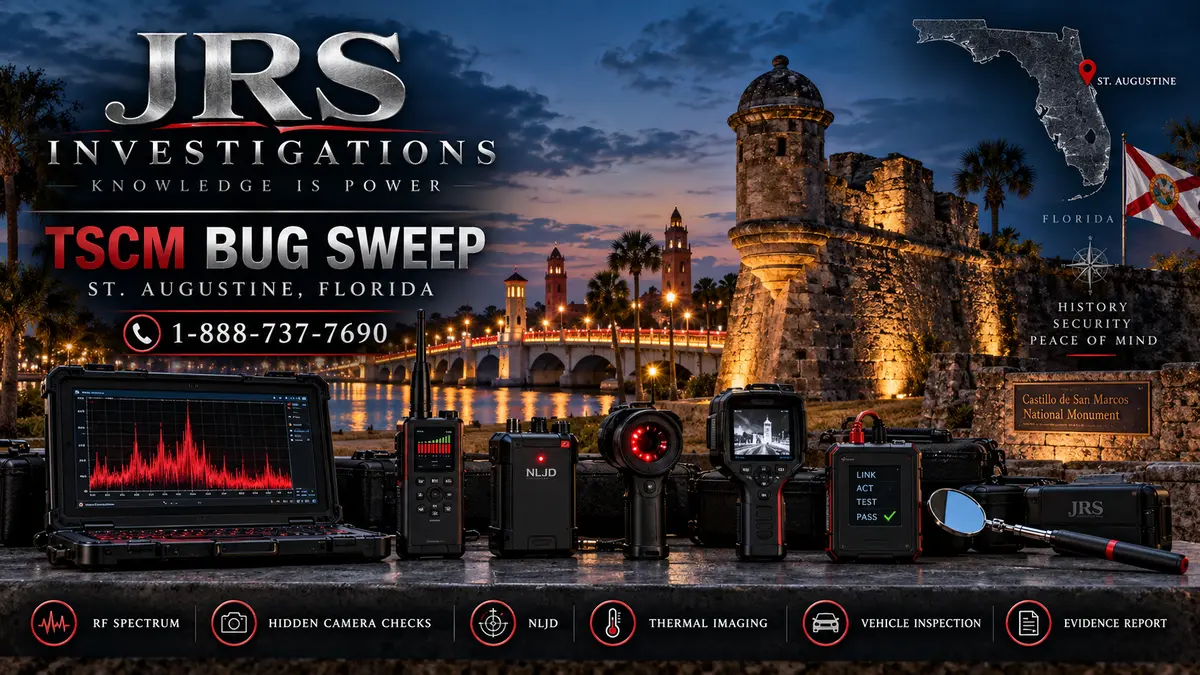
St. Augustine TSCM Bug Sweep: What to Expect
A St. Augustine TSCM bug sweep is a structured inspection for covert audio, video, tracking and related surveillance risks. JRS Investigations combines a careful physical review with professional electronic testing so clients can make decisions from documented findings rather than fear, guesswork or consumer-detector alerts.
St. Augustine presents a varied inspection environment. Historic residences may contain thick masonry, additions and decades of electrical changes. Coastal rentals and hospitality properties can have frequent guest, vendor and maintenance access. Professional offices may rely on conference rooms, shared networks and equipment installed by several contractors. Those differences affect the scope, time and tools required for a meaningful sweep.
For a confidential consultation, call the St. Augustine service line at (888) 737-7690 or toll-free at (888) 737-7690. You can also contact JRS Investigations with the property or vehicle type, reason for concern and the people who recently had authorized access.
For local service coverage and intake details, review the dedicated Saint Augustine TSCM bug-sweep service page.
What a professional TSCM sweep evaluates
Technical surveillance countermeasures, commonly called TSCM, examines the environment in layers. The objective is not simply to scan for a radio signal. A capable inspection considers transmitting devices, equipment that records locally, dormant electronics, concealed cameras, unauthorized wiring, tracking devices and ordinary technology that may explain an alert.
JRS defines the assignment before testing begins. The client must have lawful authority to authorize the inspection. The team identifies priority rooms, vehicles, devices and communications areas, then considers who had access, when the concern began and what information may have been exposed. This threat history helps distinguish a targeted inspection from an unfocused search.
A sweep can identify suspicious equipment or conditions, but no legitimate provider can promise that every device will be found in every circumstance. Devices may be tiny, inactive, carefully concealed, intermittently transmitting or integrated into normal-looking hardware. Construction materials, radio congestion and limits on access can also affect the inspection. JRS documents those limitations instead of presenting an absolute guarantee.
St. Augustine locations that may need inspection
Homes, condominiums and historic properties
Residential concerns often arise after a relationship conflict, custody dispute, move, renovation, service visit or unexplained disclosure of private conversations. Older structures can have unusual wall cavities, layered trim, converted spaces and legacy wiring. The physical inspection should therefore follow the building rather than assume a modern floor plan. Learn more about broader St. Augustine private-investigation services.
Offices, professional practices and meeting rooms
Attorneys, executives, medical practices, real-estate professionals and other organizations may use TSCM after an employee departure, access-control failure, disputed negotiation, confidential-information leak or preparation for a sensitive meeting. Conference rooms, executive offices, reception areas, shared equipment, telecommunications paths and adjacent access points may all deserve attention.
Vacation rentals, hotels and hospitality spaces
Short-term rentals and hospitality environments change occupants and service personnel frequently. A client may request an authorized inspection of a property they own or control after suspicious alterations, an incident report or a credible privacy concern. The scope must respect ownership, consent and access boundaries. JRS does not enter or inspect a third party’s property without proper authorization.
Vehicles and mobile workspaces
Vehicle concerns may involve location trackers, concealed recorders, cameras, modified power connections or unfamiliar accessories. A vehicle inspection should include the cabin, cargo area, accessible body and undercarriage locations, diagnostic and power connections, and relevant wireless activity. Road grime, heat, vibration and aftermarket equipment can complicate interpretation, so visual and technical findings must be considered together.
Indicators that justify a closer look
A single odd noise, battery problem or unfamiliar Bluetooth name is not proof of surveillance. Many normal devices generate signals, heat and network traffic. A professional review is more useful when concerns are tied to specific access, timing or information exposure.
- Private information is repeatedly known by someone who should not have it.
- An unknown person, former employee, contractor or domestic party recently had unsupervised access.
- Wall plates, smoke alarms, chargers, fixtures, furniture or vehicle trim appear moved or modified.
- An unfamiliar device, cable, adapter, power draw or network client appears without a clear owner.
- A home, office, rental or vehicle is involved in a stalking, harassment, litigation or corporate-confidentiality concern.
- A sensitive meeting or transaction requires a preventive inspection before participants arrive.
The related JRS guide to places that may need a Saint Augustine TSCM sweep provides additional location examples.
How JRS conducts a St. Augustine TSCM bug sweep
1. Authorization and threat assessment
The process begins with ownership or authority, scope and safety. JRS asks what changed, who had access, what information is at risk and whether there are court orders, workplace policies or law-enforcement concerns. The client and investigator identify priority areas and decide whether the inspection will be preventive, incident-driven or part of a recurring security program.
2. Environmental baseline
Before treating a signal as suspicious, the investigator accounts for expected technology such as routers, access points, smart televisions, security systems, wireless peripherals, cellular devices, utility equipment and neighboring transmitters. St. Augustine homes and offices may also receive signals from dense nearby properties, tourism corridors or shared buildings. A baseline reduces false positives and guides deeper testing.
3. Physical and optical inspection
The investigator examines accessible fixtures, wall plates, furniture, power supplies, chargers, smoke detectors, vents, decorative objects, network hardware and other plausible concealment points. Optical tools can help identify camera lenses, while borescopes may support inspection of narrow accessible spaces. The review looks for altered fasteners, inconsistent components, unusual holes, new wiring or objects that do not fit their surroundings.
4. Radio-frequency and electronic testing
Spectrum analysis and RF detection are used to identify and evaluate radio activity across relevant frequency ranges. Near-field probes and directional antennas can help narrow a signal’s source. A nonlinear-junction detector may identify semiconductor components in concealed or non-transmitting electronics. Thermal imaging can reveal unusual heat patterns, although normal power supplies and building systems can produce similar signatures.
5. Cable, network and device review
When included in the authorized scope, JRS reviews accessible telecommunications paths, network equipment, wired connections and visible Wi-Fi or Bluetooth activity for anomalies that deserve explanation. This is not a substitute for a forensic examination of computers or mobile devices. It also does not authorize access to accounts, private communications or systems the client does not control. The JRS counter-surveillance and debugging overview explains the broader service.
6. Corroboration and reporting
Potential findings are evaluated in context. A radio signal, heat source or electronic response alone may come from ordinary equipment. JRS correlates instrument readings with physical location, device function, access history and other observations. The final report can record areas inspected, methods used, relevant limitations, photographs, findings and recommended next steps.
Tools used during a TSCM inspection
Equipment selection depends on the assignment. Common tools may include spectrum analyzers, RF detectors, near-field probes, directional antennas, nonlinear-junction detectors, optical camera-detection tools, thermal imagers, cable and network testers, borescopes, inspection mirrors and ordinary hand tools. No single instrument can reliably identify every type of surveillance device.
Consumer RF finders can react to Wi-Fi routers, phones, smart devices, broadcast sources and neighboring equipment. A professional investigator evaluates signal characteristics and location, changes the environment when appropriate, and cross-checks electronic data against a physical inspection. This layered method is more informative than declaring every meter response a bug.
For a tool-by-tool explanation, see the JRS guide to professional TSCM sweep equipment and its limitations.
Florida privacy and evidence considerations
TSCM work should be planned around lawful access, privacy and evidence preservation. Florida’s communications-security statute addresses the interception and disclosure of wire, oral and electronic communications; review the current text of Florida Statute 934.03. Florida law also addresses digital voyeurism in Florida Statute 810.145.
These links are provided for general reference, not legal advice. If a device may be connected to stalking, domestic violence, theft of trade secrets or another crime, the client should consider legal counsel or law enforcement. Avoid confronting a suspected person, broadcasting the discovery or dismantling equipment before safety and evidence-handling decisions are made.
How to prepare for the appointment
- Write a short timeline of incidents, access events and information disclosures.
- List authorized wireless, smart-home, security and office devices.
- Identify recent contractors, guests, employees, tenants or other authorized visitors.
- Keep the location in its normal operating condition unless the investigator advises otherwise.
- Do not remove, reset or power-cycle suspicious equipment merely to test it.
- Arrange access to locked rooms, vehicles, network equipment and relevant utility areas.
- Plan for privacy and minimal occupancy during technical testing.
Photos of unfamiliar objects and screenshots of device or network alerts can be useful, but do not trespass, access another person’s account or place yourself at risk to collect them.
Frequently asked questions
How long does a St. Augustine TSCM bug sweep take?
Time depends on square footage, construction, clutter, number of rooms or vehicles, radio conditions, access and the threat history. A small controlled space may take less time than a historic multi-level property, busy office or vehicle-and-residence assignment. JRS defines the practical scope before the appointment.
Can a sweep find a device that is turned off?
Some dormant electronics may be discoverable through physical inspection or nonlinear-junction detection, but not every inactive device can be located. Concealment, depth, surrounding materials and access limitations matter. That is why RF scanning alone is not enough.
Can JRS inspect Wi-Fi cameras and Bluetooth devices?
Authorized Wi-Fi and Bluetooth observations can help identify unfamiliar devices or activity, but names and addresses may be misleading or randomized. Network review must be correlated with physical findings and ownership information. It is separate from hacking an account or conducting a full digital-forensic examination.
Should I turn off phones, routers and smart devices?
Do not change the environment before the appointment unless instructed. Known devices can help establish the baseline, and controlled power or network changes may be performed during the inspection. Bring a list of authorized equipment and access information for systems you lawfully control.
What happens if something suspicious is found?
JRS can photograph and document the item or condition, preserve relevant observations and discuss safe next steps. Depending on the circumstances, those steps may include leaving the item in place temporarily, consulting an attorney, contacting law enforcement or arranging specialized digital-forensic work. The response should match the risk and evidence needs.
Is one sweep enough?
A one-time sweep addresses the conditions present during that inspection. Organizations with recurring sensitive meetings, frequent personnel changes or elevated access risk may benefit from periodic assessments, access controls and communications-security procedures. Residential clients may need follow-up work if new access or incidents occur.
Schedule confidential TSCM help in St. Augustine
JRS Investigations provides authorized residential, commercial and vehicle TSCM services in St. Augustine and surrounding St. Johns County. The statewide Florida TSCM bug-sweep page explains additional service coverage.
Call (888) 737-7690 or toll-free (888) 737-7690 for a confidential consultation, or send JRS Investigations a secure service request.