(888) 737-7690

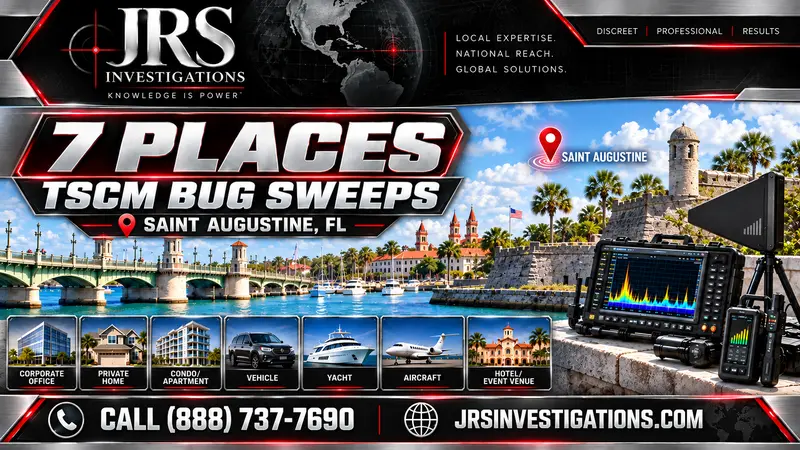
7 Places That May Need a TSCM Bug Sweep in Saint Augustine
Technical Surveillance Countermeasures, commonly called TSCM, is a structured process for evaluating a space or asset for indicators of unauthorized microphones, cameras, tracking devices, transmitters, and other surveillance risks. The work may combine a visual review, physical inspection, radio-frequency analysis, and other specialized methods selected for the environment.
JRS Investigations coordinates TSCM bug sweeps in Saint Augustine for lawful residential, commercial, travel, and transportation-related concerns. Every assignment begins by confirming who controls the property, what can legally be inspected, what information may have been exposed, and which locations present the greatest risk.
Here are seven types of places where a professional TSCM assessment may be appropriate in Saint Augustine and the surrounding Northeast Florida area.
1. Corporate offices and executive suites
Executive offices, boardrooms, private meeting rooms, and strategy areas often contain information that should remain confidential. A company may consider a sweep before a merger discussion, legal meeting, major contract negotiation, product launch, personnel action, or other sensitive event.
The inspection scope may include accessible fixtures, furnishings, communications pathways, electronic equipment, and relevant radio-frequency activity. It should also account for ordinary sources of exposure such as shared calendars, video-conference systems, visitor access, remote-work devices, and conversations audible outside the room. A TSCM sweep addresses defined physical and technical surveillance risks; cybersecurity concerns may require a separate specialist.
2. Private residences and home offices
Homes can become part of a surveillance concern during a relationship dispute, stalking matter, high-conflict separation, sensitive legal case, executive-risk situation, or unexplained disclosure of private conversations. Home offices also hold business information that may be exposed through both physical access and connected devices.
A residential sweep must be authorized by the person with lawful control of the property or inspected area. The plan may prioritize bedrooms, offices, living areas, entry points, common electronics, and locations where confidential conversations occur. Normal repairs, smart-home devices, electrical problems, and household movement can resemble suspicious activity, so observations should be documented without assuming they prove surveillance.
3. Apartments and condominiums
Multifamily properties present additional considerations because walls, utilities, hallways, networks, and maintenance access may be shared. A resident may hear interference, notice an unfamiliar device, or discover that private information has circulated, but those events can have ordinary explanations involving neighboring units, building systems, or authorized service work.
The inspection must remain within the client’s lawful authority. Common areas, adjacent units, building infrastructure, and property-management systems generally require separate permission. A focused TSCM plan distinguishes the client-controlled space from areas that cannot be inspected and identifies when building management, law enforcement, legal counsel, or a qualified technical contractor should be involved.
4. Cars and other vehicles
A vehicle may be considered for inspection when there is a credible concern about unauthorized location tracking, hidden audio recording, concealed cameras, or unexplained access. Modern vehicles already contain factory telematics, Bluetooth systems, navigation history, mobile-app connections, and diagnostic electronics, so an unknown signal or battery issue does not automatically indicate a covert device.
A professional review can examine the concern in context, confirm ownership or inspection authority, and determine which accessible areas and systems are within scope. If a suspected device is found, avoid destroying it. Preserving its location and condition may be important if law enforcement or legal counsel becomes involved.
5. Boats, yachts, and marina-based vessels
Saint Augustine’s coastal setting makes marine assignments an important category. Private vessels may host family travel, executive meetings, financial discussions, charter operations, or high-profile guests. Surveillance exposure can involve the vessel itself, marina access, service personnel, shore-side movements, onboard networks, and portable electronics.
A marine sweep should account for the vessel’s layout, communications equipment, electrical systems, crew and guest access, recent maintenance, and the authority of the owner or operator. Specialized navigation, safety, engine, and marine-electronics systems should be handled only by properly qualified personnel. TSCM work should not interfere with equipment essential to safe vessel operation.
6. Aircraft, hangars, and aviation-related spaces
Private aircraft and aviation facilities may contain sensitive travel schedules, passenger information, business conversations, and valuable equipment. An inspection may be considered after unexplained access, before a high-risk itinerary, or when confidential information connected to a flight becomes known unexpectedly.
Aircraft work requires strict coordination with the owner, operator, maintenance authority, airport or facility rules, and applicable safety requirements. A TSCM provider should not dismantle or disturb flight-critical systems without appropriate aviation authorization and qualified technical support. Depending on the concern, the safer scope may focus on accessible passenger areas, portable items, hangar spaces, or preflight security procedures.
7. Hotels, conference rooms, and event venues
Saint Augustine’s hospitality and event economy creates frequent short-term environments where business, legal, family, and private conversations occur. Hotel rooms, conference facilities, wedding venues, temporary offices, and rented meeting spaces may be considered for a sweep when the client has lawful access and the property authorizes the inspection.
Timing matters. A room can change after cleaning, maintenance, vendor setup, or guest turnover. The inspection should occur as close as practical to the sensitive meeting or occupancy period, without disrupting the venue or violating another person’s privacy. Access control, room assignments, attendee procedures, and secure handling of devices may be as important as the technical inspection itself.
What a Saint Augustine TSCM sweep may include
The exact methods depend on the property, construction, electronic environment, client authority, and documented concern. A professional assignment may include:
- A confidential intake and written inspection scope
- A visual and physical review of authorized areas
- Radio-frequency spectrum analysis for relevant signals or anomalies
- Nonlinear junction detection or optical inspection when appropriate
- Review of selected fixtures, furnishings, electronics, and access points
- Documentation of findings and practical risk-reduction recommendations
No single tool detects every possible surveillance method. A sweep is also a point-in-time assessment, not a permanent guarantee. The environment can change after the inspection, so access controls, meeting procedures, cybersecurity measures, and follow-up reviews may be recommended.
How to prepare for an inspection
- Keep the concern confidential. Limit discussion to people who need to know.
- Record objective facts. Note dates, access, information disclosures, changes, and unfamiliar items.
- Do not conduct a destructive search. Avoid opening, disconnecting, moving, or discarding suspected equipment.
- Preserve relevant records. Keep lawful copies of visitor logs, maintenance records, photographs, messages, or access reports.
- Confirm authority. Identify the owner, tenant, manager, operator, or other person who can authorize each inspection area.
- Arrange secure communication. Discuss an alternative contact method if a normal phone or email account may be compromised.
Frequently asked questions
Does an unusual noise or signal prove that a space is bugged?
No. Interference, wiring faults, normal wireless devices, neighboring systems, and software or equipment problems can create similar symptoms. Findings must be evaluated in context.
Can JRS inspect any property requested by a client?
No. The client must have lawful authority, and some locations require permission from an owner, manager, operator, facility, or other responsible party.
Will a sweep also find malware on a phone or computer?
TSCM and digital forensics overlap in some situations but are not identical. Suspected malware, account compromise, deleted data, or network intrusion may require a qualified digital-forensics or cybersecurity specialist.
What should I do if I believe there is an immediate threat?
Contact the appropriate emergency or law-enforcement authority first. A private technical inspection does not replace emergency response or legal advice.
Discuss TSCM bug sweeps in Saint Augustine
For more service details, visit the Saint Augustine TSCM bug sweep page or the JRS TSCM services overview. To discuss a specific concern, contact JRS Investigations or call (888) 737-7690 for a confidential consultation.