(888) 737-7690

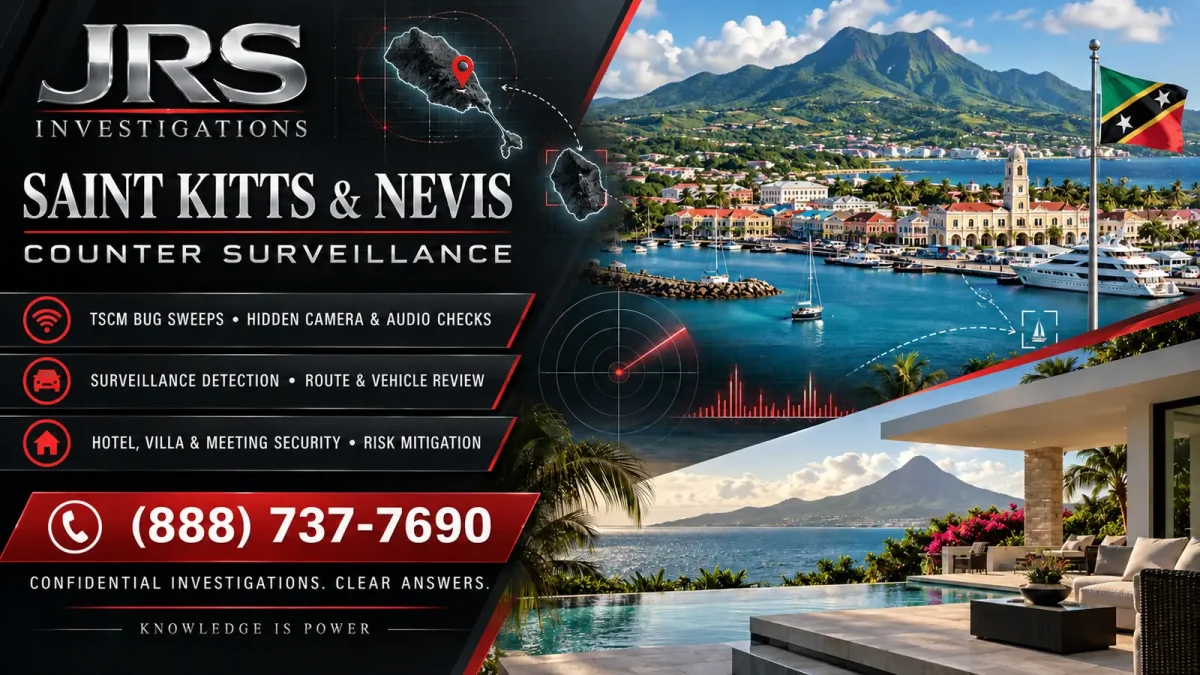
Saint Kitts and Nevis Counter Surveillance: Risk Guide
Saint Kitts and Nevis counter surveillance services help individuals, attorneys, executives, businesses, and travelers assess credible concerns about unwanted monitoring. A concern may involve a residence, hotel room, villa, office, meeting space, vehicle, electronic device, or a repeated pattern around daily movements. JRS Investigations provides confidential case assessment, lawful inspection planning, surveillance-detection support, and practical risk-reduction guidance throughout authorized Caribbean assignments.
Counter surveillance is a risk-assessment process—not a guarantee that every device, observer, signal, or method will be identified. The goal is to define the concern, establish lawful access, select an appropriate inspection or fieldwork scope, document relevant findings, and explain what remains uncertain.
Counter-surveillance services in Saint Kitts and Nevis
Technical Surveillance Countermeasures
A professional TSCM assessment, often called a bug sweep, may be appropriate when there is a reasonable concern about hidden cameras, microphones, transmitters, recorders, unauthorized wireless devices, or other monitoring equipment. The inspection scope depends on the site, construction, available access, risk profile, equipment involved, and the client’s specific concern. Our Caribbean TSCM services explain the broader regional approach.
Physical surveillance-detection assessment
Repeated sightings of the same person or vehicle, unexplained knowledge of private plans, or suspicious activity around several locations may justify further review. JRS can organize the reported sightings, locations, times, vehicle descriptions, photographs, communications, and travel patterns to determine whether lawful observation or additional research is proportionate.
One sighting is not proof that someone is being followed. Route conditions, local traffic, resort access, tourism patterns, and normal staff or vendor activity can create coincidences. A responsible assessment looks for a repeatable pattern and considers ordinary explanations before reaching conclusions.
Hotel, resort, villa, and meeting-space reviews
Travelers and organizations may discuss sensitive personal, legal, or business matters in places they do not fully control. A pre-meeting assessment can identify visible vulnerabilities, unusual devices, access concerns, exposed screens, predictable routines, and areas that may require greater attention. Inspection requires authorization from the person or entity entitled to grant access.
JRS can help the client define which rooms, work areas, vehicles, routes, and meeting periods matter most. A focused scope usually provides more value than treating an entire resort or property as equally sensitive.
Residential, office, and vehicle concerns
Depending on ownership, consent, access, and the agreed scope, an assessment may include a residence, office, conference area, private villa, or vehicle. JRS confirms who may lawfully authorize inspection before work begins. A technical inspection never authorizes entry into another person’s property, interception of communications, or access to protected devices and accounts.
Device and account-security indicators
Some monitoring concerns involve accounts or mobile devices rather than a hidden room transmitter. Unexpected login notices, unfamiliar device sessions, changed forwarding rules, excessive battery or data use, unknown applications, altered permissions, or an account recovery method controlled by someone else may justify technical review by the appropriate specialist.
Basic precautions include locking devices, reviewing active account sessions and recovery methods, limiting unnecessary permissions, securing sensitive documents, and avoiding untrusted chargers or cables. JRS can document reported indicators and coordinate an appropriate referral, but a physical TSCM inspection is not a substitute for account security, malware analysis, or digital forensics.
Security awareness and risk reduction
Counter-surveillance planning may include visitor access, room selection, confidential-meeting practices, device placement, information handling, transportation routines, privacy screens, document storage, and who knows the schedule. These measures can reduce exposure, but they cannot make a location impenetrable or guarantee complete confidentiality.
Findings and mitigation guidance
JRS documents relevant observations and explains what was found, what was not observed, what could not be examined, and which practical next steps may reduce risk. When a suspected device or immediate safety concern is identified, the appropriate response may include preserving evidence and contacting counsel, property management, security personnel, a technical specialist, or law enforcement.
TSCM and physical counter surveillance are different
TSCM focuses on technical threats within an authorized location or asset. Physical counter surveillance focuses on whether observable conduct, movement, or repeated sightings support concern about human surveillance. Digital security addresses accounts, applications, networks, and device compromise. These disciplines can overlap, but one service does not automatically answer every question.
- Technical concern: unusual hardware, hidden-camera risk, unknown wireless activity, or confidential-room exposure.
- Physical concern: repeated persons or vehicles, route patterns, location-based observation, or unusual activity near several destinations.
- Digital concern: unexpected logins, unknown applications, changed permissions, malicious links, location sharing, or compromised account recovery.
- Operational concern: excessive schedule disclosure, weak visitor controls, unsecured documents, exposed screens, or predictable travel habits.
A consultation helps identify the right discipline before equipment, travel, or fieldwork is committed.
Lawful scope and local regulatory context
Saint Kitts and Nevis maintains an official online collection of legislation through the Government’s Law Commission. Telecommunications and spectrum matters fall within the national regulatory framework administered by the National Telecommunications Regulatory Commission. These official resources help counsel and qualified professionals identify the current rules relevant to communications, equipment, privacy, and lawful authority.
JRS does not provide legal advice, intercept private communications, enter property without permission, or access protected systems. The client should disclose ownership, occupancy, employment, litigation, and consent issues before an inspection is scheduled. When the legal authority is unclear, qualified local counsel should resolve it first.
When to consider a professional assessment
- Private conversations or travel plans appear to be known by an unauthorized person.
- An unfamiliar device, wire, adapter, camera, charger, or object appears in a sensitive area.
- The same unfamiliar person or vehicle appears near multiple locations.
- A recent relationship, employment, litigation, business, or security dispute creates a specific monitoring concern.
- There are signs of unauthorized access to a room, office, vehicle, luggage, files, or equipment.
- A confidential meeting, transaction, executive visit, or legal discussion is planned in a temporary space.
- Staff, vendors, former partners, or other third parties had unsupervised access to a sensitive area.
These are reasons to assess the facts, not proof that surveillance occurred. JRS separates observations from assumptions and recommends work that is proportionate to the available evidence.
How an island assignment is planned
1. Confidential consultation
We review the concern, timeline, people involved, properties, travel dates, devices, vehicles, prior incidents, and evidence already available. Clients should identify the exact event that raised concern rather than relying only on a general feeling of being monitored.
2. Authority and lawful purpose
JRS confirms the client’s lawful objective and the authority available for any requested access or inspection. Ownership, rental rights, employer policies, hotel rules, vehicle control, and third-party privacy may affect the scope.
3. Scope and logistics
The plan accounts for whether the assignment is on Saint Kitts or Nevis, property access, timing, transportation, equipment, power and connectivity, investigator availability, safety, and any necessary local coordination. Providing accurate dates, photographs, floor plans, vehicle details, device descriptions, and access contacts before travel can reduce delay and expense.
4. Assessment or fieldwork
Approved work is conducted using methods suited to the environment and agreed objective. JRS documents relevant conditions and does not expand into unrelated searches without authorization.
5. Reporting and recommendations
The client receives an explanation of material observations, limitations, and practical next steps. If a concern falls outside the original discipline, the report can identify whether counsel, digital forensics, cybersecurity, property management, or law enforcement may be the better next resource.
What counter surveillance can and cannot establish
A professional assessment can identify suspicious patterns, potential devices, physical vulnerabilities, unusual signals, access weaknesses, or conditions that justify deeper examination. It can also help preserve information and improve privacy practices.
No inspection can guarantee that every monitoring method will be found. Results may be affected by timing, access, device type, transmission mode, power state, concealment, building materials, radio-frequency conditions, or whether a device or observer is present during the assessment. JRS reports what is observed or detected and never promises a predetermined result.
Counter-surveillance work also does not establish who installed a device, who received a transmission, or who directed an observer unless additional admissible evidence supports that conclusion. Attribution usually requires a separate investigation.
Frequently asked questions
Can JRS inspect a hotel room or rental villa?
An inspection depends on the client’s lawful authority to authorize access and the property’s rules. The location, occupancy, management requirements, and access arrangement must be reviewed before an inspection is scheduled.
Can you determine whether someone is following me?
Depending on the facts and lawful purpose, an investigator may assess reported patterns and conduct appropriate observation or research. A consultation is needed to determine whether the evidence supports fieldwork and which routes or locations matter.
Should I remove a suspected device?
Avoid destroying or extensively handling a suspected device if doing so could compromise evidence or create a safety risk. Photograph it from a safe position, restrict unnecessary access, write down when and how it was discovered, and obtain appropriate professional or law-enforcement guidance.
Are TSCM results guaranteed?
No. Effectiveness depends on access, timing, equipment, environment, device characteristics, and other conditions. The purpose is to reduce risk and provide evidence-based findings, not to promise complete confidentiality.
How far in advance should an island assignment be arranged?
As early as practical. Scheduling depends on the exact island and property, scope, travel requirements, access, equipment, urgency, and investigator availability.
Related JRS resources
- Counter-surveillance and TSCM services
- Caribbean private investigation services
- Caribbean private security services
- Surveillance investigation services
- JRS private investigation services
Request a confidential consultation
To discuss a counter-surveillance concern in Saint Kitts and Nevis, prepare a short timeline, the exact locations, access information, travel dates, people and vehicles involved, photographs, device descriptions, and the facts that caused concern. JRS will review the lawful objective, practical limits, and a proportionate first phase.
For broader case planning and lawful field investigations, visit our Saint Kitts and Nevis private investigator page.
Knowledge is power. Contact JRS Investigations or call (888) 737-7690 for a confidential consultation.
Organizations planning Caribbean due diligence can also review the background checks available in Saint Lucia.